
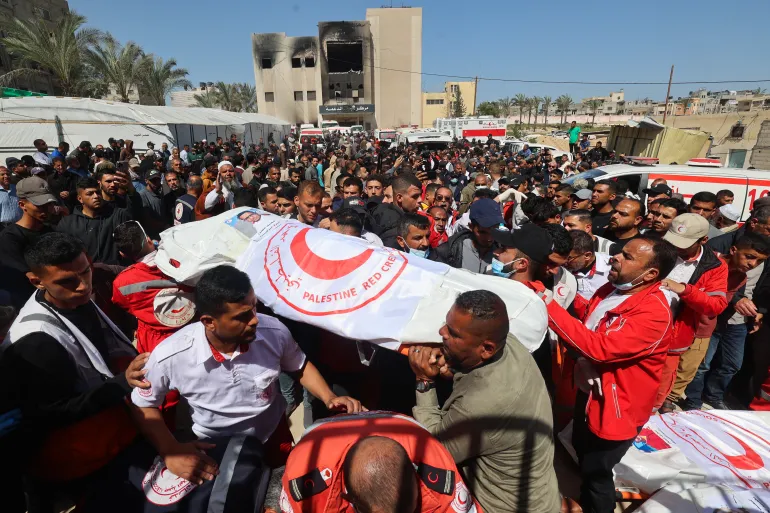
Forensic report on Gaza massacre says Palestinian aid workers were killed in execution-style attack
A new forensic investigation has concluded that Israeli soldiers fired more than 900 bullets during a deadly Gaza massacre that killed 15 Palestinian aid workers, some in what researchers described as execution-style killings.
The joint investigation was carried out by London-based research group Forensic Architecture and audio analysis agency Earshot. Using 3D digital reconstruction, satellite imagery and advanced audio-ballistic analysis, the researchers recreated the March attack near Rafah in southern Gaza.
Ambush on Emergency Vehicles in Gaza
The victims included ambulance crews from the Palestinian Red Crescent Society, rescue workers from the Palestinian Civil Defense and a staff member from UNRWA.
According to the report, the attack began shortly after 4 a.m. when Israeli troops opened fire on an ambulance responding to an earlier airstrike, killing two crew members. Additional ambulances and a fire truck arrived at the scene minutes later.
“All vehicles were clearly marked and had their emergency lights on,” the investigation stated.
Researchers documented at least 910 gunshots, with 844 rounds fired within a five-and-a-half-minute period captured on video by paramedic Refaat Radwan, who was among those killed. More than 90 percent of the bullets were directed at the emergency vehicles and aid workers.
The study found no evidence of an exchange of fire in the area and said there was no tangible threat to Israeli soldiers at the time.
Close-Range Killings and Evidence Concealment
The investigation alleges that Israeli troops continued shooting for over two hours before advancing on the vehicles. Several victims were reportedly shot at close range after soldiers reached them.
Audio analysis suggested that one paramedic, Ashraf Abu Libda, was shot from a distance of between one and four meters, coinciding with the last recorded sound of his voice.
Researchers also accused Israeli forces of attempting to conceal evidence. Satellite imagery and on-the-ground documentation showed vehicles crushed and partially buried, bodies placed in a mass grave and mobile phones buried.
Fourteen bodies were discovered in a mass grave near the site on March 30. Another victim’s remains were found earlier nearby.
International Reaction and Military Response
The massacre, which occurred during Israel’s ongoing war in Gaza that has reportedly killed more than 72,000 Palestinians, sparked international condemnation.
Initially, Israel said its troops believed they were facing a threat. On April 20, the Israeli military acknowledged “professional failures” and breaches of protocol in its internal inquiry. A duty commander was dismissed for submitting an incomplete report, but no additional disciplinary measures were announced.
The findings by Forensic Architecture and Earshot add new scrutiny to the incident and raise further questions about accountability in the Gaza conflict.
The Gaza aid workers massacre stands as one of the most controversial and deadly incidents involving humanitarian personnel in the ongoing war.
Source: Arab News & Al jazeera