
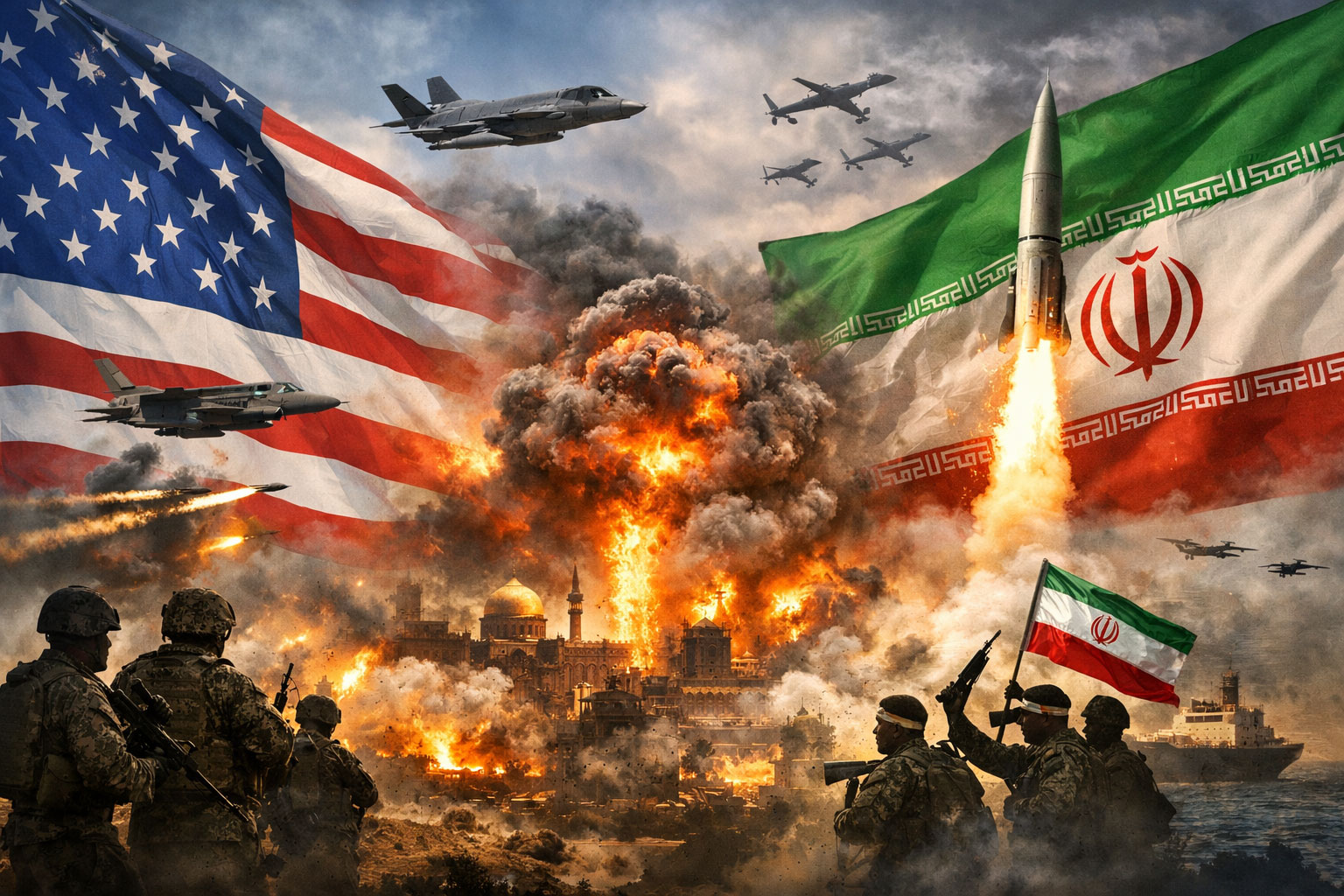
A conflict decades in the making came to a head on February 28, 2026, when US and Israeli forces launched a joint military campaign that killed Iran’s supreme leader and triggered the most serious regional crisis the Middle East has seen in a generation.
Published: March 8, 2026
The morning of February 28, 2026 began quietly enough in Tehran. Negotiations between Iran and the United States over a new nuclear agreement were still technically alive. Iran’s foreign minister had told reporters just three days earlier that a deal was within reach. Then the missiles started falling.
Within hours, strikes hit multiple districts of the Iranian capital and cities across the country, including Isfahan, Qom, Tabriz, Kermanshah, and Karaj. By the following morning, Iranian state media confirmed what many had suspected: Supreme Leader Ali Khamenei, who had held power since 1989, was dead. The 86-year-old had been killed in a strike on his compound in central Tehran.
The United States and Israel had launched what Washington codenamed Operation Epic Fury, described by President Donald Trump as “major combat operations” designed to destroy Iran’s military capabilities and prevent it from ever developing a nuclear weapon. Iran immediately began firing back with hundreds of missiles and drones across the region. Seven days into the conflict, the fighting shows no sign of stopping.
For anyone trying to make sense of how this happened, the short answer is that it did not happen suddenly. This war is the product of nearly five decades of hostility, a collapsed diplomatic framework, and a series of decisions made in Washington and Tel Aviv over a period of months that ultimately chose military force over a negotiated agreement.
Here is what you need to know.
Nearly Five Decades of Bad Blood
The roots of the US-Iran conflict go back to 1979, when the Islamic Revolution overthrew the US-backed Shah and Iranian students seized the American embassy in Tehran, holding 52 diplomats and staff hostage for 444 days. That episode poisoned the relationship at a foundational level and the two countries have had no normal diplomatic relations since.
Tensions between the United States and Iran stretch back to the Islamic Revolution in 1979 and the subsequent hostage crisis, which set a tone of mutual hostility and deep distrust. In the decades that followed, the rivalry played out through sanctions, proxy conflicts, and repeated near-misses with direct confrontation. Iran deepened ties with armed groups across the region, including Hezbollah in Lebanon and, later, the Houthis in Yemen. When the United States invaded Iraq in 2003, Iranian-backed militias began targeting American forces there.
The nuclear question eventually became the central issue. Iran maintained its uranium enrichment programme was for civilian energy purposes. The United States, Israel, and European governments argued it was a cover for building a bomb. A 2015 multilateral agreement, the Joint Comprehensive Plan of Action, placed limits on Iran’s nuclear activities in exchange for sanctions relief. It held for three years. Then, in 2018, during his first term, Trump pulled the United States out of the deal, saying it was too narrow and too short-term. Iran gradually stepped up its enrichment activities in response.
By 2025, the situation had already turned militarily violent. A 12-day conflict in June 2025 saw Israel strike Iran’s air defences and cause significant damage to Iranian military and nuclear infrastructure, with US forces ultimately hitting underground nuclear facilities at Fordow, Natanz, and Isfahan. That conflict ended without a formal agreement, leaving both sides further apart and the underlying grievances entirely unresolved.
The Months Before the Bombs
The final months before February 28 were marked by a sharp escalation in American military presence in the region. Beginning in late January 2026, the United States carried out its largest military buildup in the Middle East since the 2003 invasion of Iraq, deploying air, naval, and missile defence assets amid escalating tensions. Two aircraft carriers, the USS Abraham Lincoln and the USS Gerald R. Ford, were repositioned to the region.
Inside Iran, the situation was already deeply unstable. In the aftermath of the 12-day conflict, Iran’s currency entered a free fall, exacerbated by the imposition of new international sanctions. The economic spiral led to the outbreak of protests on December 28, 2025, which spread across Iran in January 2026. According to officials cited in Iranian Ministry of Health reports, security forces unleashed a brutal crackdown, killing at least 30,000 people. These figures are disputed, and independent verification has not been possible given restrictions on access inside Iran.
Diplomatic activity was running in parallel with the military build-up. US and European officials say Washington presented Iran with three core demands: a permanent end to all uranium enrichment, strict limits on Iran’s ballistic missile programme, and a complete halt to support for regional groups such as Hamas, Hezbollah, and the Houthis. Indirect nuclear talks were held in Oman’s capital Muscat on February 6, and a second round was scheduled in Geneva. Neither produced a breakthrough. Three days before the strikes began, Iran’s foreign minister stated publicly that a historic agreement was within reach. Then the talks ended, and the war began.
What Washington Says It Is Fighting For
President Trump set out the campaign’s objectives publicly on social media as the strikes were underway. He said the United States aimed to destroy Iran’s missile programme, annihilate its navy, prevent nuclear weapons development, and cut off support to what he called Iranian proxy groups across the region.
Secretary of State Marco Rubio offered a more specific rationale when speaking to reporters. He said Washington knew Israel was going to strike Iran regardless, and that the administration feared an Israeli operation conducted without direct US involvement would trigger retaliatory attacks on American forces. The United States therefore chose to act alongside Israel rather than risk being drawn into the conflict on less favourable terms.
Trump also cited the January protests. He framed the mass killing of Iranian demonstrators as a moral justification for action, pointing to his earlier public warning to Iran’s government that those responsible would “pay a very big price.”
The Center for Strategic and International Studies estimated the cost of the first 100 hours of Operation Epic Fury at approximately $3.7 billion, or around $891 million per day, with most of that cost unbudgeted.
The Intelligence Questions That Will Not Go Away
The administration’s core legal justification for launching the war without a congressional vote rested on the claim that Iran posed an imminent threat to the United States. This claim has been directly challenged by some of the people best positioned to assess it.
The Defence Intelligence Agency concluded in 2025 that it would be a decade before Iran would be able to develop missiles capable of reaching the United States. That assessment was not classified. It was part of the annual worldwide threat report presented openly to Congress.
According to an anonymous Pentagon source, closed-door congressional briefings included the statement that there was no intelligence suggesting Iran was planning to attack US forces first. The administration stated publicly that Trump authorised the strikes after receiving intelligence that Iran was planning a preemptive missile launch, but it did not provide supporting evidence for that claim.
While Trump stated at his State of the Union address that Iran had restarted its nuclear programme and was developing missiles capable of striking the US, the International Atomic Energy Agency later reported it had found no evidence of an organised nuclear weapons programme, while also noting it could not confirm Iran’s broader programme was exclusively peaceful, as the agency had been denied full access.
These are not minor disputes at the edges of the debate. They go directly to the question of whether the legal and factual basis for the war holds up. The comparison many analysts have drawn to the false weapons of mass destruction claims that preceded the 2003 Iraq War is uncomfortable, and the parallel is not exact, but it has been raised by credible voices and cannot be simply set aside.
The Congressional Authorisation Debate
The United States Constitution grants Congress the power to declare war. Trump launched Operation Epic Fury without a congressional vote or formal authorisation.
A Senate war powers resolution brought by Senators Tim Kaine and Rand Paul, which would have required Trump to seek congressional authorisation for hostilities against Iran, was voted down 47 to 53. The measure was largely symbolic, as Trump would almost certainly have vetoed it, but the vote illustrated the depth of the disagreement in Washington over the war’s legal basis. Paul was the only Republican senator to support the measure.
In the House of Representatives, a separate effort to halt the war and require congressional authorisation was voted down 219 to 212.
Iran’s Response and the Regional Spread
Iran did not absorb the strikes passively. Its response began within hours and has expanded steadily across the region.
Iran launched hundreds of drones and ballistic missiles at targets in Israel and at US military bases in Qatar, Bahrain, the United Arab Emirates, Kuwait, Iraq, Jordan, and Saudi Arabia. Iran also struck civilian infrastructure in Kuwait, the UAE, Oman, and Azerbaijan. Britain’s Akrotiri and Dhekelia military base on Cyprus was struck by a drone.
The US Embassy in Riyadh was struck by a drone and subsequently closed. The US Embassy in Kuwait was also shut indefinitely. Iran struck Amazon Web Services data centres in Bahrain and the UAE, which the Iranian Fars news agency said was retaliation for the company’s support of US military and intelligence activities. Those facilities remained offline as of this publication.
According to the Iranian Red Crescent Society, more than 1,300 people in Iran have been killed since the strikes began. These figures could not be independently verified given restrictions on journalist access inside the country.
Israel has pressed forward with its own campaign. The Israeli military stated it had carried out more than 2,500 strikes and claimed to have destroyed approximately 80 percent of Iran’s air defence systems. Israel also heavily bombarded Lebanon, issuing evacuation warnings for parts of Beirut.
What This Has Done to the Global Economy
The economic consequences of the conflict have spread far beyond the Middle East, and they began within hours of the first strikes.
The Strait of Hormuz is the narrow waterway through which roughly 20 percent of the world’s oil supply passes. Iran declared it closed. The disruption led Iraq, a major oil producer, to shut down some of its production, while Saudi Arabia’s largest oil refinery suspended operations. Bahrain, Kuwait, Qatar, and the UAE all reported oil refineries being struck during the first week of fighting.
Oil prices surged above $90 per barrel, the highest since September 2023. The average price of gasoline in the United States rose to $3.32 per gallon, according to AAA.
Brent crude oil prices surged between 10 and 13 percent to around $80 to $82 per barrel by March 2, 2026. Analysts forecasted prices could reach $100 per barrel if disruptions persisted, potentially adding 0.8 percent to global inflation.
Global aviation was also severely disrupted. Airspace closures across the UAE, Qatar, Kuwait, Bahrain, and other Gulf states led to more than 4,000 daily flight cancellations, stranding hundreds of thousands of passengers. Dubai International Airport was damaged by drone strikes and temporarily halted all flights. Emirates Airlines suspended operations from Dubai, with Etihad and Qatar Airways facing similar disruptions, leading to losses estimated in the billions.
Stock markets registered the alarm. The Dow Jones Industrial Average fell more than 1,000 points in a single session, heading for its worst trading day since April 2025. The S&P 500 and Nasdaq Composite also posted significant losses. Goldman Sachs chief executive David Solomon noted the market reaction had been surprisingly contained so far, but warned it would likely take several weeks for markets to fully absorb the implications of the conflict.
European natural gas prices nearly doubled after Iranian attacks on Qatari facilities caused Qatar to close its liquefied natural gas plants at Ras Laffan Industrial City and Mesaieed Industrial Area. Asia’s largest energy importers, including China, India, Japan, and South Korea, which together account for around 75 percent of the region’s oil exports and 59 percent of its LNG exports, faced sharply higher energy costs.
Egypt’s President Abdel Fattah el-Sisi warned publicly that his country was in a state of near-emergency as the conflict threatened to drive up prices across the region.
ANALYSIS: What This War Is Really About
The following section represents editorial interpretation of reported facts and is clearly labelled as such.
Wars rarely have a single cause, and this one is no exception. But looking across the full picture of what has happened and how it happened, several things stand out.
The stated justifications for the war have shifted enough to suggest that no single rationale was ever fully decisive. The imminent threat framing, the one with the clearest legal standing under international law, is the one most directly contradicted by available intelligence. The regime change framing, which Trump himself signalled when he told Iranians in January that “help is on its way,” carries its own historical weight given the CIA’s role in overthrowing an Iranian government in 1953.
What seems clearer is the opportunity side of the equation. Iran in early 2026 was as weak as it had been in years. Its currency had collapsed. Mass protests had been met with a crackdown that killed tens of thousands of its own citizens. Its regional allies had been degraded. Its air defences had already been dismantled in the 2025 conflict. From a purely strategic standpoint, if there was ever a moment to act, this appeared to be it.
Whether the result will be a more stable Middle East or a more dangerous one depends entirely on what comes next, and that remains genuinely uncertain. A country of 90 million people with deep national identity and a history of resistance to foreign interference is not easily subdued from the air. The succession question following Khamenei’s death adds another layer of unpredictability to an already volatile situation.
The economic consequences, particularly for countries that depend on Gulf energy exports and Middle Eastern trade routes, including Sri Lanka, are real and already being felt. How long they last depends on how long the conflict lasts, and on that question, nobody in Washington, Tel Aviv, or Tehran appears to have a reliable answer.
Where Things Stand Now
As of March 8, 2026, the war is in its eighth day. US and Israeli strikes continue across Iran. Iran continues to fire missiles and drones across the region. The Strait of Hormuz remains effectively closed to commercial shipping. Global energy markets remain under significant pressure.
Trump has said he expects the campaign to last approximately four weeks, though military operations rarely conform to predicted timelines. The succession to Khamenei remains unresolved. Reports have suggested his son Mojtaba Khamenei as a possible successor, though no formal announcement has been made.
The diplomatic path that existed three days before the war, imperfect as it was, is gone. Whatever comes next will have to be built on entirely new foundations, in conditions that are considerably more dangerous than those that existed before February 28.
Sources: This article draws on reporting from Al Jazeera, Reuters, the Associated Press, NPR, CNBC, Encyclopaedia Britannica, Wikipedia’s sourced conflict timeline, and the Center for Strategic and International Studies. Casualty figures are attributed to their original sources and could not be independently verified. Economic data is attributed to the institutions that produced it. All statements attributed to officials are drawn from their public remarks.
This article is based on publicly available reporting from named international news agencies and attributed official statements. All claims about ongoing events are attributed to their original sources. The analysis section represents editorial interpretation of reported facts and does not constitute advocacy for any party to the described conflict. This publication does not take political positions on active military conflicts.
By Bala, Editor, Global War News & Research.