
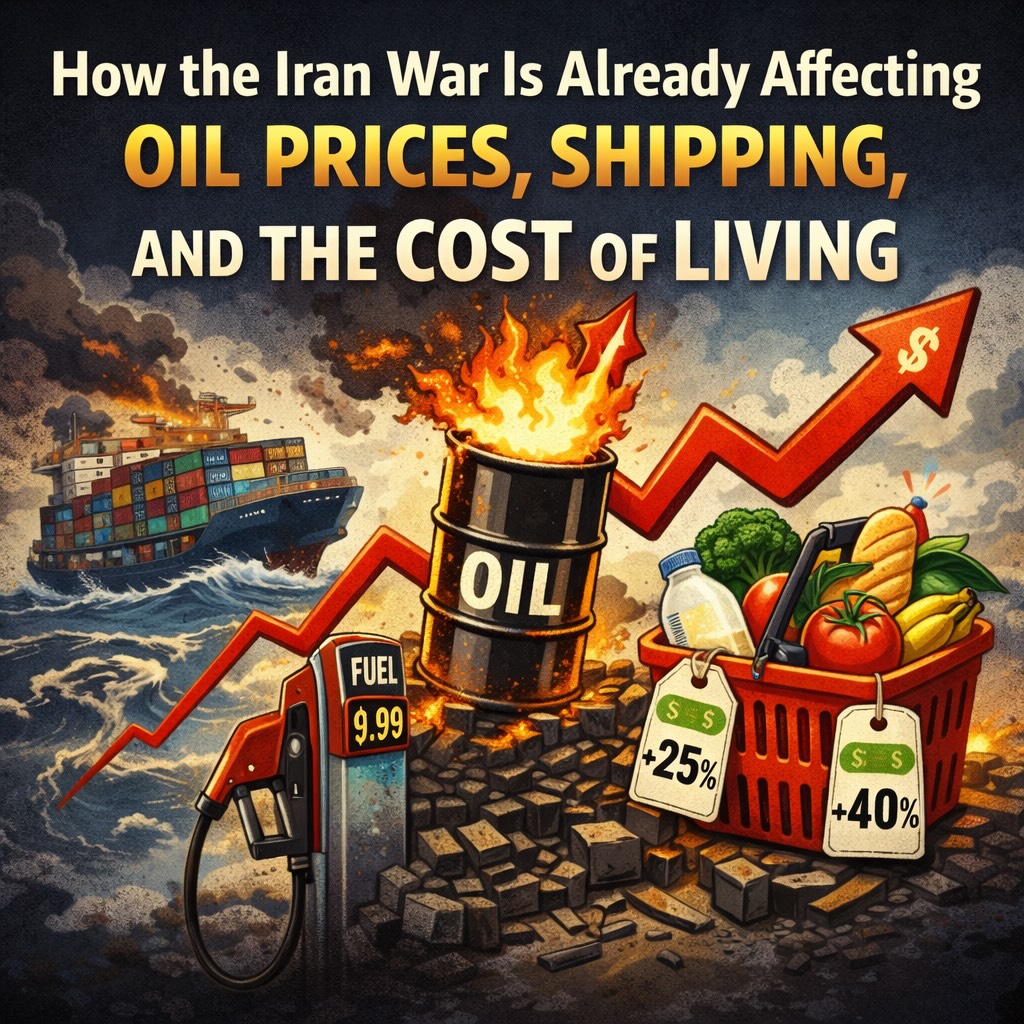
Five weeks into the conflict, the economic damage is measurable and spreading. Brent crude has surged more than 55 percent since the war began. The world’s four largest shipping companies have suspended Gulf operations. Jet fuel has more than doubled. The International Energy Agency has called this the worst energy crisis in recorded history.
Published: 5 April 2026 | Last updated: 5 April 2026
Wars reshape economies. This one is doing so at unusual speed, through an unusually direct mechanism. The closure of the Strait of Hormuz has removed roughly 20 percent of the world’s daily oil supply from the market. That is not a disruption at the margins. It is a structural shock to the global energy system, and the ripple effects are now moving through every sector of the world economy that depends on fuel, freight, or food.
This article explains, in plain terms, what has happened to prices since 28 February 2026, how the shock is travelling from oil fields through shipping lanes to supermarket shelves, what governments and international bodies have done to buffer the impact, and what all of this means for ordinary people in different parts of the world. The numbers here are sourced from named institutions and named reporting organisations. Where data is preliminary or contested, that is noted.
The Oil Price Surge
Before the war began, Brent crude, the global oil benchmark, was trading at approximately 72 dollars per barrel. By the end of March 2026, it had closed at 112.78 dollars. Brent soared about 55 percent in March alone, a record for the contract dating back to its inception in 1988. The previous monthly record was a 46 percent gain in September 1990 during the first Gulf War.
That comparison matters. The 1990 Gulf War triggered a global recession. The current disruption is larger.
The International Energy Agency described the energy crisis sparked by the US-Iran war as the worst in history. Its executive director Fatih Birol said that in the two previous oil crises of the 1970s, the world lost about 5 million barrels per day of supply each time. “Today, we lost 12 million barrels per day, more than two of these oil crises put together,” he said.
The IEA has warned that April will be worse than March, as the pre-war inventory buffer works through the system. “In March there were already some cargo ships carrying oil and gas that transited through the Strait of Hormuz before the war broke out. They are still coming to ports, still bringing oil and energy,” Birol explained. Once that pipeline drains, the physical shortage becomes more acute.
Emergency measures have been taken. The IEA’s 32 member countries agreed to release a record 400 million barrels of oil from emergency stockpiles. This is the biggest emergency reserve release on record. But analysts have been explicit about the limits of that intervention. Birol stated that releasing more reserves “will not be a cure. The cure is opening up the Strait of Hormuz.”
As of 5 April 2026, the strait remains effectively closed to most commercial traffic.
How the Shipping Industry Shut Down
Oil tankers were the first to be affected. But within days of the war beginning, the disruption spread to the entire global container shipping network.
On 1 March 2026, at least three tankers were attacked in the area between the Strait of Hormuz and the Gulf of Oman, leaving one seafarer dead and several injured. Maersk announced the indefinite suspension of all transits through the Strait of Hormuz, stating that the safety of crews, vessels, and cargo was its absolute priority.
The four carriers that suspended Hormuz transit, Maersk, CMA CGM, MSC, and Hapag-Lloyd, collectively control approximately 65 percent of global container shipping capacity. Their simultaneous withdrawal from the route was unprecedented in peacetime maritime history.
The suspension did not stop at the strait. All four carriers also halted sailings through the Red Sea, because Houthi threats from Yemen made that corridor simultaneously dangerous. The only remaining route for ships moving between Asia and Europe became the detour around Africa via the Cape of Good Hope. Rerouting via the cape adds approximately 10 to 14 days to transit times for vessels travelling between Asia and Europe or the Americas.
Cost consequences were immediate. Hapag-Lloyd introduced a war risk surcharge of 1,500 US dollars per twenty-foot container unit on trades to and from the Persian Gulf from 2 March 2026, with higher rates for refrigerated and special cargo. Other carriers followed with surcharges ranging from 1,200 to 2,000 dollars per standard unit, with 40-foot containers facing charges beyond 3,000 dollars.
Five weeks into the war, the disruption had spread far beyond the Gulf. Xeneta chief analyst Peter Sand stated that spot rates on every major east-west trade lane had risen sharply. “No shipper is insulated from financial or operational risk. Far East to US West Coast, a trade which transits the Pacific thousands of miles from the epicentre of conflict, has seen spot rates climb 29 percent since the end of February.”
The Iran war is also costing Hapag-Lloyd an estimated 40 to 50 million dollars per week, according to its chief executive.
Aviation: The Second Shock
The oil price surge hit aviation with particular intensity, because jet fuel is a refined product whose price has risen even faster than raw crude.
In the week ending 20 February 2026, jet fuel cost about 96 dollars per barrel. By the week of 20 March, it had shot up to 197 dollars, more than doubling in a single month. Even during the start of the Ukraine war in 2022, jet fuel only peaked at about 180 dollars per barrel.
The practical meaning for an airline is immediate. On 27 February, the day before the attacks, the cost to fill the fuel tanks of a Boeing 737-800 was about 17,000 dollars. Less than a week later, on 5 March, it would have cost more than 27,000 dollars.
Airlines around the world have responded by cutting flights and raising fares. United Airlines CEO Scott Kirby said the carrier will cut about 5 percent of planned flights in the near term, warning that if prices persist, jet fuel alone could add 11 billion dollars in annual expenses. Delta Air Lines CEO Ed Bastian said the jet fuel spike added as much as 400 million dollars in costs in March alone.
Cathay Pacific, AirAsia, and Thai Airways are among a growing number of airlines increasing fares. SAS announced it will cancel about 1,000 flights in April due to rising costs. Vietnam Airlines suspended 23 weekly domestic routes due to fuel supply pressures.
More than 46,000 flights in and out of the Middle East were cancelled between 28 February and 11 March, according to aviation analytics company Cirium.
The disruption to Gulf transit hubs, principally Dubai, Doha, and Abu Dhabi, matters well beyond the region. Around 30 to 32 percent of all freight moving between Europe and Southeast Asia passes through Middle Eastern hubs. When those airports are disrupted, there are not many alternatives.
Financial Markets and Inflation Projections
Major stock indexes have fallen by nearly 10 percent since the start of the war. Airline stocks have been taken down approximately 25 percent by investors since 28 February, according to NBC News reporting. The 20 biggest listed airlines have lost around 53 billion dollars in market value since the war started.
The European Central Bank has adjusted its forward guidance. According to aggregated reporting compiled in Wikipedia’s economic impact summary for the 2026 Iran war, the ECB postponed planned interest rate reductions in March, raised its 2026 inflation forecast, and cut GDP growth projections, with economists warning that energy-intensive European economies face elevated risks of stagflation if the maritime blockade persists through the summer refill season.
UN estimates indicate oil prices have risen by around 45 percent and gas by 55 percent since late February, with fertiliser prices up 35 percent. Regional inflation across developing Asia-Pacific economies could rise to 4.6 percent in 2026, up from 3.5 percent in 2025, according to the UN’s Asia-Pacific development arm ESCAP.
Food Prices: The Next Wave
Oil and gas are not the only commodities flowing through the Strait of Hormuz. The Gulf is also the world’s primary source of several key fertilisers, and the closure is already feeding into projections of significant food price increases.
Bahrain, Oman, Qatar, and Saudi Arabia are critical exporters of fertilisers including urea and ammonia. Natural gas is a primary feedstock for nitrogen fertiliser. If the crisis persists, global fertiliser prices could average 15 to 20 percent higher in 2026.
Over 30 percent of global urea, which is widely used and produced from natural gas, is exported from Gulf countries through the Strait. Food price inflation tends to arrive several months after the energy and shipping shock that causes it. The shocks from late February and early March are, as of April 2026, still working their way through agricultural supply chains.
Analysis: The Unequal Geography of Pain
This section is clearly labelled as editorial analysis and represents interpretation of reported facts, not established fact.
The economic shock from the Iran war is global in reach but profoundly unequal in distribution. The key variable is not which country is geographically close to the conflict. It is which country has the financial buffers to absorb a sudden, sustained increase in energy import costs.
The United States is substantially buffered by domestic production. It is the world’s largest oil producer and refines enough jet fuel to broadly cover its own needs. Its economy feels the war through higher petrol prices and financial market volatility, but it does not face the kind of physical supply shortfall confronting import-dependent economies.
Major East Asian economies with large strategic reserves, principally China, Japan, and South Korea, have weeks or months of buffer before physical shortages become acute. China reportedly held between 900 million and 1.4 billion barrels in strategic storage at the onset of the conflict, according to the Wikipedia economic impact summary. Japan holds approximately 254 days of reserves; South Korea around 208 days, according to the same source.
The economies facing the most severe exposure share a common profile: high dependence on imported energy, limited foreign exchange reserves, thin fiscal capacity to subsidise fuel, and vulnerability to currency depreciation that makes dollar-denominated oil imports more expensive in local currency terms. Shell CEO Wael Sawan described the cascading direction of the shock: “We see of course South Asia first to get that brunt. That’s moved to Southeast Asia, Northeast Asia and then more so into Europe as we get into April.”
The Centre for Global Development, a Washington-based research institution, identified Pakistan, Bangladesh, Sri Lanka, Jordan, Egypt, Senegal, Angola, Ethiopia, and Zambia as among the most at risk, according to Al Jazeera reporting from March 2026. The analysis weighted factors including fuel import dependence, public debt levels, and foreign exchange reserve ratios.
For these economies, there is no comfortable path. If governments pass full price increases through to consumers, they trigger inflation and political pressure. If they absorb costs through subsidies, they drain foreign reserves faster. In several countries, both things are happening simultaneously.
Yeah Kim Leng, a professor of economics at Sunway University in Kuala Lumpur, described the situation as “a potent mix of inflation, currency pressures and fiscal strains” for developing economies. “The hardest hit are net energy and food importers, especially those with fragile macroeconomic foundations and pre-existing vulnerabilities,” he said.
In concrete terms, this is what the shock looks like on the ground. In Bangladesh, which relies on imports for around 95 percent of its energy, petrol pumps in some districts ran dry despite rationing. Pakistan, which imports approximately 80 percent of its energy from the Gulf, scrambled to roll out fuel conservation measures and saw trucking and agricultural fuel costs begin climbing immediately. Sri Lanka, which imports around 60 percent of its energy needs and has no storage capacity beyond one month’s consumption, reintroduced a QR-based weekly fuel rationing system, raised fuel prices by approximately 33 percent since the start of the war, and introduced a four-day government workweek. Bus fares have increased by an average of 12.19 percent. Cooking gas prices have risen by 8 percent and kerosene by 30 percent. The Ceylon Electricity Board has requested a tariff increase of at least 13 percent. The IMF, whose 3 billion dollar Extended Fund Facility programme Sri Lanka is currently operating under, stated publicly that the country is “significantly exposed” to the Middle East conflict.
These are not abstract projections. They are documented, reported changes in the daily cost of living for populations that had only recently stabilised after earlier economic crises.
What to Watch
The central variable for the global economy is the duration of the Strait of Hormuz closure. Every additional week adds to emergency reserve depletion, widens physical supply shortfalls, and sustains upward pressure across energy, shipping, and food.
Oil industry executives and analysts have warned that the strait needs to be reopened by mid-April or supply disruptions will get significantly worse. BCA Research strategist Marko Papic estimated that by mid-April the world will have lost the equivalent of 9 to 10 million barrels per day of effective supply, potentially the largest loss of crude in history.
Analysts at Societe Generale said in a note from late March that a prolonged supply disruption could push prices as high as 150 dollars per barrel. Societe Generale’s global head of commodities research added that the potential for Houthi disruption of the Bab el-Mandeb Strait could push prices even higher still.
Importantly, a military ceasefire does not automatically restore shipping. P&I marine insurance coverage for the zone was cancelled on 5 March 2026. Until coverage is reinstated by marine syndicates, tankers cannot enter Gulf ports, regardless of military conditions. The economic recovery from this shock will lag any military outcome by weeks.
Global War News will continue to report on all of these developments as they unfold.
Sources used in this article: CNBC, “Oil Price: Brent Heads for Record Monthly Gain on Iran War,” March 2026; CNBC, “Oil Supply Crunch Will Worsen in April, IEA Warns,” April 2026; CNBC, “Iran War-Hit Oil Prices Will Soon Rise if Hormuz Stays Shut,” March 2026; War on the Rocks, “The Iran War and the Energy Lesson We Failed to Learn,” April 2026; The Middle East Insider, “How the Iran War Rerouted Global Shipping,” March 2026; FreightWaves, “Here’s Where Container Rates Will Go in Extended Iran War,” March 2026; FreightWaves, “Strait of Hormuz Closure Pushes Asia-US Ocean Rates Up 29%,” April 2026; Freightos Weekly Freight Update, March 2026; TrasportoEuropa, “Container Shipping Update in the Middle East,” March 2026; The Loadstar, “Forwarder Fury Over War-Risk Liner Surcharges,” April 2026; RTÉ Brainstorm, “How the Iran War Is Causing Massive Turbulence for Aviation,” March 2026; Foreign Policy, “Jet Fuel Prices Spell Bad News for Iran War Energy Crisis,” April 2026; NBC News, “A Global Jet Fuel Shortage Is Raising the Cost of Air Travel,” April 2026; Euronews, “Airlines Cut Flights and Increase Airfares as Jet Fuel Price Spikes,” March 2026; Al Jazeera, “Sri Lanka Braces for New Economic Crisis as War on Iran Continues,” March 2026; Al Jazeera, “From Pakistan to Egypt, Iran War Drives Up Prices in Global South,” March 2026; Atlantic Council, “Demand Destruction Has Begun,” March 2026; World Socialist Web Site, “Sri Lankan Government Institutes Huge Fuel Price Increases,” March 2026; UN News / ESCAP, “Middle East War Shockwaves Ripple Through Asia-Pacific,” March 2026; TIME, “How the War With Iran Is Impacting Economies in Asia,” March 2026; Institute of South Asian Studies (NUS), “Sri Lanka’s Impending Energy Crisis,” April 2026; Wikipedia, “Economic Impact of the 2026 Iran War,” updated April 2026; Wikipedia, “2026 Iran War Fuel Crisis,” updated April 2026.
This article is based on publicly available reporting from named international news agencies and attributed official statements. All claims about ongoing events are attributed to their original sources. Analysis sections represent the editorial interpretation of reported facts and do not constitute advocacy for any party to the described conflict. This publication does not take political positions on active military conflicts.
Byline: Global War News Editorial