
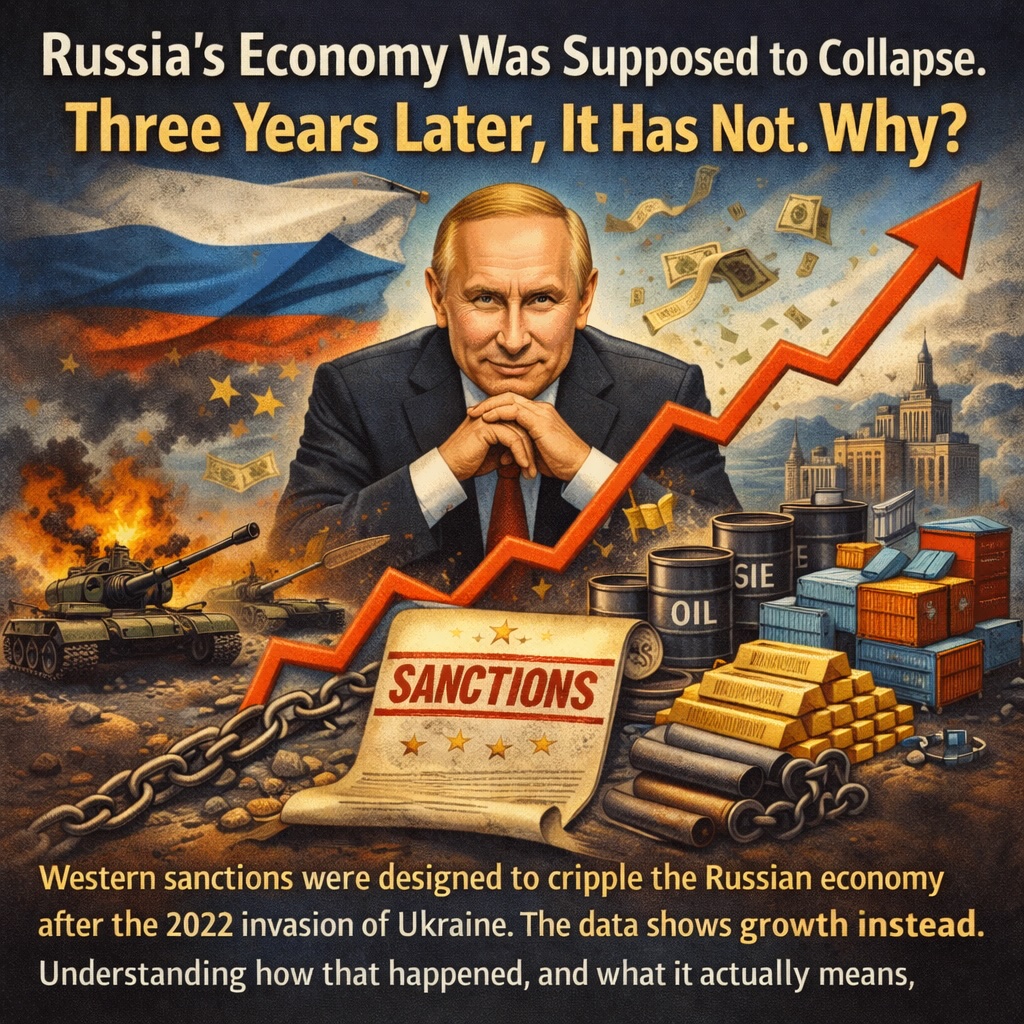
Western sanctions were designed to cripple the Russian economy after the 2022 invasion of Ukraine. The data shows growth instead. Understanding how that happened, and what it actually means, matters far beyond this war.
Published: 7 April 2026 | Last Updated: 7 April 2026
Global War News Editorial
In the days after Russia launched its full-scale invasion of Ukraine in February 2022, some of the world’s most respected economic institutions made confident predictions. The International Monetary Fund projected an 8.5 percent drop in Russian GDP for 2022, followed by a further 2.3 percent decline in 2023, according to the Center for European Policy Analysis at CEPA. The Bank of Russia, bracing for the worst, prepared for a GDP contraction of up to 10 percent. Western officials spoke publicly about an economy that would be brought to its knees.
None of that happened.
According to the International Monetary Fund, in real GDP terms the Russian economy suffered a modest 1.2 percent decline in 2022, with 3.6 percent growth in 2023. The Russian government announced further growth of 4.1 percent in 2024. Center for Strategic and International Studies
By June 2024, the World Bank had confirmed that Russia had overtaken Germany and Japan to become the fourth-largest economy in the world, using the purchasing power parity method of GDP calculation. International Banker
These numbers are real. They require a real explanation. The question is not whether to acknowledge them but what they actually tell us about how war economies work, how sanctions can be circumvented, and what this all means for the future. That is what this article attempts to answer.
First, What Did Sanctions Actually Target?
Understanding why Russia’s economy did not collapse requires understanding what the sanctions were designed to do and where the design had gaps.
Following the invasion, Western governments moved to cut Russia off from global financial infrastructure, restrict technology exports, limit its ability to sell oil and gas, freeze approximately $300 billion in central bank reserves held in European institutions, and remove major Russian banks from the SWIFT international payment network, according to the European Council’s published record of its own measures.
These were serious actions. They were not trivial. Russia’s imports collapsed in 2022. Foreign companies left. Access to Western-manufactured technology dried up overnight in many sectors. The ruble fell sharply before recovering. The departure of more than 1,200 foreign companies, while reducing options for Russian consumers and damaging Russia’s image, had an unintended side effect: it increased profits for Russian companies, bolstered demand for Russian-made goods, and gave the regime a wellspring of capital to redistribute to politically loyal interests. CEPA
That last point is important. The design of sanctions assumed that cutting Russia off from the West would produce economic pain that would translate into political pressure on the Kremlin to stop the war. The assumption had two weak links. The first was that Russia could not replace what it lost. The second was that economic pain, even if achieved, would translate into political change in an authoritarian state. Both assumptions proved questionable.
The War Economy Engine
The single most important factor behind Russia’s GDP growth is one that is hiding in plain sight in the data: the government spent an enormous amount of money on the war.
According to draft budget documents, Russian defence spending was set to rise to 13.5 trillion roubles, approximately $145 billion, in 2025, which would represent a 25 percent increase on the 2024 budget. At 6.3 percent of GDP, national defence spending’s share of the economy in 2025 would be comparable to figures recorded during the Soviet period of the late 1980s. International Banker
Military spending has increased by 31 percent compared to 2023 and has roughly tripled compared to the first year of the war in 2022. In practical terms, this means that for every two rubles of tax revenue collected by the Russian government, roughly one ruble is being spent on the military and weapons procurement. Eurasia Review
This spending created activity. Weapons factories hired workers. Defence contractors placed orders with suppliers. The state paid soldiers, and when soldiers died, it paid their families. Government spending was transferred to the general public and businesses via state contracts, budget transfers, and social handouts. Salaries started to grow in 2023 after a slump in 2022, and in 2024, salaries went up 17.8 percent in nominal terms and 8.7 percent in real terms compared to the previous year. Center for Strategic and International Studies
Rising wages meant people spent more. More consumer spending pushed GDP higher. The numbers went up. Economists sometimes call this dynamic military Keynesianism. It is a form of government stimulus spending, the kind that any government can use to inflate activity in the short term. The difference is that normal stimulus spending produces hospitals, roads, and schools. War spending produces guns and casualties. The GDP effect can look similar on paper. The underlying reality is very different.
Boris Grozovski, an expert on the Russian economy from the Wilson Center think tank, told Newsweek that “the Russian government has poured huge amounts of money into the military-industrial complex. So the production of tanks, guns and grenades is growing rapidly, while the production of civilian industries is stagnating.” Newsweek
By the end of 2024, total industrial output was 10.2 percent higher than in 2021, but excluding war-related industries, it grew by only 3 percent, according to a government-linked think tank. Wilson Center GDP growth, in other words, was heavily concentrated in the parts of the economy that produce weapons. The civilian economy was being left behind.
How Russia Kept Selling Its Oil
The second pillar of Russia’s economic survival was energy revenue. Western sanctions targeted Russia’s largest single source of government income, and here too the results diverged from expectations.
The G7 nations imposed an oil price cap of $60 per barrel in December 2022, designed to allow Russia to keep producing oil, which would prevent a global energy price shock, while limiting the revenue it could earn. The mechanism required shipping and insurance companies under G7 jurisdiction to refuse service to cargoes priced above the cap. In theory, this would squeeze Russia’s margins without removing supply from global markets.
In practice, Russia built around it. Russia began purchasing tankers to bypass sanctions immediately after the $60-per-barrel price cap was introduced in 2022. Since the start of the full-scale invasion, shipowners from 21 out of the 35 sanctioning countries sold at least 230 tankers to Russia’s shadow fleet. Estimates suggest Russia spent over $10 billion assembling this fleet. Tdcenter
The shadow fleet is a network of aging oil tankers operating under opaque ownership structures. Between mid-2023 and 2024, the fleet’s size doubled, allowing Russia to continue exporting oil outside Western oversight. New Eastern Europe
The geographic shift in where that oil went was equally significant. Europe’s share of Russian oil exports fell almost tenfold, while India capitalised on the emergent market vacuum and rose from a minor export partner to absorbing over a third of all Russian crude oil exports. China has become increasingly central to Russia’s trade, receiving nearly 33.8 percent of all Russian exports in 2024, of which approximately 75 percent are oil and gas. VoxUkraine
China has been the largest purchaser of Russian oil since the month after the price cap was imposed, accounting for 35 percent of sales as of November 2025. Russia surpassed Saudi Arabia as China’s largest crude oil supplier in 2023. USCC
In 2024, China imported $62.6 billion worth of Russian oil, compared to India’s $52.7 billion. Institute for Energy Research
While the volume of oil exports declined somewhat in 2024, total oil revenue grew by $3.8 billion as world prices rose and new markets in Asia emerged. Russia made approximately $192 billion from oil exports in 2024 alone. New Eastern Europe
The price cap, in other words, reduced the price Russia got per barrel. It did not stop Russia selling barrels. The volume held roughly steady while demand from Asia absorbed the supply that Europe stopped buying.
The Technology Workaround
Alongside energy, Russia needed to keep importing the components that its military-industrial complex required. Western sanctions targeted dual-use technology, microchips, and precision manufacturing equipment. The assumption was that cutting these off would degrade Russia’s ability to produce sophisticated weapons over time.
Russia found workarounds here too. Approximately 75 percent of American microchips reach Russia through Hong Kong and China. In 2023, EU member states exported over $14 billion worth of microchips, manufacturing equipment, and dual-use goods to countries involved in re-export schemes to Russia. Tdcenter
India became the second-largest provider of restricted technology to Russia and a primary transshipment hub for high-value US-trademarked chips. Atlantic Council The Atlantic Council, which tracks sanctions implementation, noted that longer, multiparty trade routes created new loopholes that proved more complicated to enforce than the original restrictions anticipated.
Russia also developed what became known as parallel imports, a system allowing Russian companies to import goods through intermediary countries without the manufacturer’s consent. This was formalised as a legal framework inside Russia, effectively permitting what most Western countries would classify as trademark violation to become official state policy.
Analysis: What the GDP Numbers Do and Do Not Tell Us
The following section represents editorial analysis of the reported facts above. It should be read as such.
The GDP growth figures are real. But GDP is a measure of economic activity, not economic health. The distinction matters enormously here.
When a government pours money into a war machine, economic activity rises. Workers get paid. Factories run. Money circulates. But that money is not building roads that will carry goods in twenty years. It is not producing the next generation of engineers. It is not creating the kind of private investment that builds long-term prosperity. It is building weapons that get destroyed, and paying soldiers who may not come home.
The Russian economy has been overheating since late 2023. Demand is outpacing supply and economic activity has been growing at an unsustainable rate. Stubbornly high inflation forced the Central Bank of Russia to raise interest rates to a peak of 21 percent. The unemployment rate sits at just above 2 percent, less than half of its pre-pandemic levels, which in addition to boosting inflation betrays the economy’s limited room left to grow. Atlantic Council
The Central Bank’s primary monetary tools now have only limited impact on the Russian economy. Higher interest rates primarily affect the civilian sector, which lacks government funding or preferential treatment. Loans to citizens and businesses have stagnated, yet inflation persists, driven by escalating war costs. Businesses are discouraged from investing in expansion, finding it more profitable to place funds in bank deposits earning 20 percent. Wilson Center
The greatest losers in this overheated economy are Putin’s core supporters: public sector workers, including teachers, doctors, law enforcement personnel, and pensioners. Their wages and benefits are tied to official inflation rates of around 9 percent, but real inflation for many households may exceed 20 percent. Carnegie Endowment for International Peace
The National Wealth Fund, Russia’s sovereign reserve that serves as a buffer against economic shocks, has been drawn down significantly. Russia’s National Wealth Fund fell from $117 billion in 2021 to $31 billion in November 2024. Russia Matters
Early 2025 data confirmed a sharp shift in momentum: GDP growth fell from an annual pace of 1.4 percent in the first quarter to 0.6 percent in the third quarter. Government forecasts were revised downward, with the finance ministry reducing its expected full-year 2025 growth rate from 2.5 percent to 1.5 percent, while the IMF adopted an even more pessimistic view, predicting growth of only 0.6 percent. In February 2026, President Vladimir Putin stated that GDP growth for the entire year of 2025 was only 1 percent. GIS Reports
The war economy produced a boom in the years immediately following the invasion. That boom is now slowing. The structural costs are accumulating. New sanctions or a drop in oil prices could trigger a recession. Stiftung Wissenschaft und Politik
Russia’s long-term perspectives look much worse. Structural and institutional weaknesses, including adverse demographic trends and continued dependence on hydrocarbon revenues, represent fundamental constraints that the current economic model does not address. Bruegel
What This Means for Sanctions as a Policy Tool
The Russian experience does not prove that sanctions do not work. It proves that sanctions work imperfectly, at different speeds in different sectors, and require enforcement mechanisms that were not fully in place when they were introduced.
The IMF’s chief economist noted when reviewing Russia’s growth figures that they were “somewhat preliminary” as the fund attempts to verify Russian statistics. Agathe Demarais, senior policy fellow on geoeconomics at the European Council on Foreign Relations, has argued that the Kremlin’s figures about the Russian economy’s resilience may be overstated. Newsweek There are genuine questions about the reliability of Russian official data, particularly for a government that stopped publishing detailed breakdowns of its own budget in 2022.
There is also a longer timeline to consider. Sanctions on Iran and North Korea took years or decades to produce significant economic pressure, in both cases with mixed political results. Those advocating for patience on Russia sanctions argue that the structural damage is real even if it is not yet visible in headline figures. Those sceptical of sanctions as a tool point to the three-year record and ask whether the political goal, changing Russian behaviour on the war, is achievable through economic pressure alone in a state that does not face democratic accountability.
What is not seriously in dispute is that Russia has paid a price. It has spent down reserves, diverted investment from the civilian economy, driven away skilled workers through emigration, and produced an inflation crisis that is visibly eroding living standards for ordinary people, even as headline wages appear to rise. The question observers continue to debate is whether that price is high enough, and whether it will ever translate into the political pressure it was designed to create.
What This Means Beyond Russia
The Russian case has become a reference point for how any large, resource-rich country might respond to economic warfare. The lessons are being studied in Beijing and Tehran, among other capitals.
The key enabling factors for Russia’s survival were: a large domestic energy base that provided revenue independent of Western markets; a willing set of large trading partners, primarily China and India, that were not bound by Western sanctions; a government willing to subordinate every other economic priority to sustaining the war; and enough institutional competence in its central bank to manage the monetary consequences of extreme fiscal stress.
Not every country targeted by sanctions has all of those factors. But the Russian case has demonstrated that a country with significant natural resources and alternative trading partners can withstand a sanctions regime that would have been expected to be decisive. Russia’s economic resilience resulted from a combination of increased state spending, authoritarian friend-shoring of trade, and import substitution, which together boosted consumption and investment and kept capital in the country. CEPA
That is a lesson with implications well beyond the Ukraine war. The world is moving toward greater economic fragmentation. The tools of economic coercion, sanctions, price caps, technology restrictions, are being used more frequently. The Russian case suggests those tools are blunter than their architects believed, more dependent on global enforcement than they are designed for, and more capable of being routed around than any single coalition of countries can easily prevent.
Where Things Stand Now
Russia’s economy in 2026 is not what Western analysts predicted in February 2022. It is also not what Russian officials claim when they describe an economy confidently withstanding Western pressure.
It is an economy that has sustained a major war through massive military spending, energy export revenues redirected to Asia, and a set of sanctions workarounds that Western enforcement efforts have only partially closed. Growth is real but narrowing, concentrated in sectors that produce weapons rather than wealth. Inflation is persistent. The civilian economy is being squeezed between high interest rates and a government that prioritises guns over everything else.
Russia remains vulnerable to large budget deficits due to rising military expenditure and declining oil and gas revenues. A potential end to hostilities in Ukraine could increase recession risks in the short term by reducing output in defence-related industries and lowering household incomes tied to military payments. Nestcentre
The collapse did not happen on schedule. But the structural bill is accumulating. Whether it comes due before or after the war in Ukraine ends is one of the central economic questions of this decade.
Sources Used
International Monetary Fund (IMF), World Economic Outlook data and forecasts, 2022 to 2025 editions.
World Bank, GDP and classification data, including 2024 reclassification of Russia.
European Council of the European Union, official record of sanctions measures against Russia.
Center for Strategic and International Studies (CSIS), “Down But Not Out: The Russian Economy Under Western Sanctions,” May 2025.
Center for European Policy Analysis (CEPA), “Addicted to War: Undermining Russia’s Economy,” February 2025.
Atlantic Council, “The Russian Economy in 2025: Between Stagnation and Militarization,” December 2025.
Atlantic Council, Russia Sanctions Database, November 2024.
Wilson Center, “The Risks of Russia’s Two Speed Economy in 2025.”
Carnegie Endowment for International Peace, “Russia’s Economic Gamble: The Hidden Costs of War-Driven Growth,” December 2024.
GIS Reports Online, “Russia’s Economy Faces Years of Low Growth,” February 2026.
Stiftung Wissenschaft und Politik (SWP), “The Russian Economy at a Turning Point,” November 2024.
Nest Centre, “The Price of Stability: What Awaits Russia’s Economy in 2026?”, February 2026.
Eurasia Review, “The Russian Economy Under Wartime Pressures,” January 2026.
CEPA, “Russia’s Bankers Fight Inflation and the Kremlin’s War Addiction,” August 2025.
VoxUkraine, “Shadow Fleet, Sanctions, and the Demand for Russian Crude Oil,” March 2026.
Middle East Institute, “How Iran, China, and Russia Use the Shadow Fleet to Evade US Sanctions,” February 2026.
US-China Economic and Security Review Commission, “China’s Facilitation of Sanctions and Export Control Evasion.”
Transatlantic Dialogue Center, “Closing the Gaps: A Smarter Sanctions Strategy for Russia,” November 2025.
New Eastern Europe, “Beating the Blockade: Why Western Sanctions Failed to Cripple Russia,” May 2025.
International Banker, “Sanctions Notwithstanding, Russia’s Economy Continues to Outperform,” October 2024.
Russia Matters (Harvard Kennedy School), “Is Russia’s Economy Collapsing?”, 2025.
Newsweek, reporting on IMF 2024 GDP forecast revisions with comment from Boris Grozovski, Wilson Center, February 2024.
Swedish Defence Research Agency (FOI), “The Central Bank of Russia and the Wartime Economy,” November 2025.
PeaceRep, “Against the Clock? Why Russia’s War Economy Is Running Out of Time,” 2025.
Bruegel, working paper on the Russian economy after four years of war, December 2025.
This article is based on publicly available data, named international institutions, and attributed expert analysis. All projections and forward-looking statements are labelled as such and attributed to the institution or analyst making them. Analysis sections represent the editorial interpretation of reported facts and do not constitute advocacy for any party to the described conflict. This publication does not take political positions on active military conflicts.
The featured image, if displayed, was generated using AI image generation tools and does not depict any real event or individual. Final editorial review, fact-checking, and publication approval by the Global War News editorial team. All data points have been verified by human analysts against named primary and secondary sources prior to publication.