
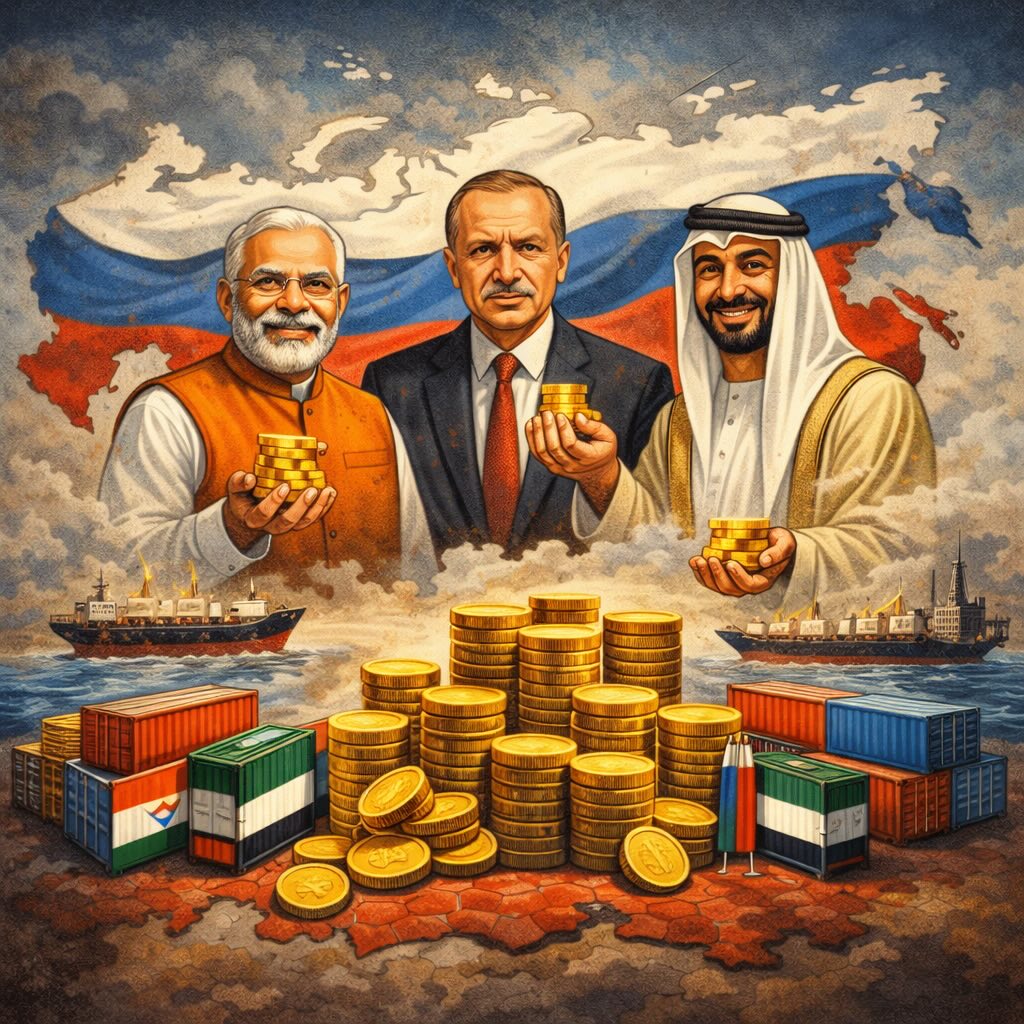
India, Turkey, and the UAE have all deepened their economic ties with Russia since 2022. The data is public. The beneficiaries are rarely named in the same article. Here is what the numbers show, what governments have said, and what remains contested.
Published: 7 April 2026 | Last Updated: 7 April 2026
Global War News Editorial
Editorial note: This article reports on trade relationships and economic activities that have been documented by named governments, international institutions, and research organisations. All allegations relating to sanctions violations are attributed to the specific authorities or investigations that have made them. Where governments have denied or disputed characterisations of their trade activities, those responses are included. This is a report on documented economic patterns, not an accusation against any country or government.
The Western sanctions coalition against Russia is, on paper, the broadest ever assembled. More than 35 countries have imposed restrictions on Russian trade, finance, and technology since February 2022. The list includes the United States, the European Union, Japan, South Korea, Australia, and the United Kingdom.
The countries that have not joined it are numerous. Three of them, India, Turkey, and the United Arab Emirates, have attracted particular scrutiny from Western governments, researchers, and trade analysts because of what the data shows about how their trade with Russia changed after the invasion began.
None of the three is under any legal obligation to join the sanctions regime. All three have offered public explanations for their trade relationships with Russia. All three governments have, at various points, pushed back against Western characterisations of their role. Those positions are included in this article.
What this article attempts to do is put the trade data, the official statements, the documented sanctions enforcement actions, and the contested questions in one place. Readers and policymakers rarely see all of it together.
India: The Refinery in the Middle
Before February 2022, India bought almost no Russian oil. The country sourced the majority of its crude from the Middle East, primarily Iraq and Saudi Arabia. Russia ranked roughly tenth on India’s supplier list, accounting for approximately 2 percent of imports, according to India’s Ministry of Commerce and Industry data cited in analysis by Japan’s Sasakawa Peace Foundation.
That changed quickly. By 2024-25, Russia had become India’s top crude oil import source, with a 35 percent share. The value of imports from Russia surged from $1.1 billion to $50.2 billion during this period. The Diplomat
The reason was straightforward. Russia was offering oil at a discount because Western sanctions had cut off its traditional European customer base. India’s refiners, which have among the largest processing capacity in the world, could buy cheap and sell the refined products at competitive prices.
Indian refiners, including Reliance Industries and Nayara Energy, leveraged the discounted prices of Russian crude oil to ramp up imports, refining the oil into products like diesel and jet fuel for export to European markets. The Diplomat
The scale of what followed became a significant point of contention between India and Western governments. India became the second biggest buyer of Russian crude oil since the invasion, with purchases rising from less than one percent of the total oil imported in the pre-Ukraine war period to almost 40 percent of the country’s total oil purchases. Business Standard
The Refinery Loophole
Here is where the story becomes more politically charged. The G7 oil price cap, imposed in December 2022, restricted the use of Western shipping and insurance services for Russian crude priced above $60 per barrel. It did not restrict what could be done with Russian crude after it had been refined into diesel, jet fuel, or other petroleum products.
A lack of a policy on refined oil produced from Russian crude meant that countries not imposing sanctions could import large volumes of Russian crude, refine them into oil products and legally export them to the price-cap coalition countries. Swarajyamag
India exploited this gap at scale. India’s export of fuels such as diesel to the European Union jumped 58 percent in the first three quarters of 2024, with a bulk of them coming from refining discounted Russian oil, according to the Centre for Research on Energy and Clean Air (CREA), a European think tank. Business Standard
Before Russia’s invasion of Ukraine, Europe imported an average of 154,000 barrels per day of diesel and jet fuel from India. That figure nearly doubled. India became the EU’s largest supplier of refined fuels. Swarajyamag
CREA estimated that, in the 13 months since the oil price cap took effect, over one-third of India’s exports of oil products to sanctioning countries was derived from Russian crude, valued at approximately EUR 6.16 billion. Centre for Research on Energy and Clean Air
Those European imports were, by the letter of the sanctions regime, entirely legal. Europe had banned Russian crude and refined products arriving directly from Russia. It had not banned Indian refined products that happened to be made from Russian crude. The gap was real, it was known, and it was used.
What Governments Said
The EU’s then-foreign policy chief Josep Borrell commented publicly on the situation in May 2023. Borrell told the Financial Times that the EU did not mind increased oil trade between Russia and India, but called for a crackdown on India reselling Russian oil into Europe as refined fuel, including diesel. He said: “That India buys Russian oil, it’s normal. And if, thanks to our limitations on the price of oil, India can buy this oil much cheaper, well the less money Russia gets, the better. But if they use that in order to be a centre where Russian oil is being refined and by-products are being sold to us… we have to act.” Al Jazeera
India’s government has consistently maintained that its energy purchases are guided by its national economic interest and are within international norms. Indian officials reportedly told ANI that refiners continue to procure Russian crude, with decisions guided by price competitiveness, grade requirements, supply logistics and inventory levels, all within the framework of international norms. National Herald
India’s position rests on a legal foundation that is hard to challenge. The country is not a party to the sanctions regime. It has no obligation to join it. Whether the moral and geopolitical implications of its role are something a different question, and one that Western governments have increasingly raised in direct diplomatic exchanges.
Technology: A Separate Concern
Beyond oil, India has attracted scrutiny over technology transfers. The US Treasury Department, in October 2024, sanctioned 275 individuals and entities involved in supplying Russia with advanced technology across 17 jurisdictions. Among the entities sanctioned was India-based Pointer Electronics, which the Treasury stated had sent over 100 shipments to Russia-based end-users since 2023, including electronic integrated circuits and multilayer ceramic capacitors, which are classified as high-priority dual-use technology. U.S. Department of the Treasury
This falls into a different legal and moral category from oil purchases. Dual-use goods with military applications, when knowingly directed toward Russia’s defence supply chain, raise questions that go beyond sovereign energy policy. The US Treasury’s own statement identified these as components found in Russian weapons systems.
Turkey: The NATO Member in the Middle
Turkey’s position is structurally distinct from India’s and the UAE’s because Turkey is a member of NATO, the military alliance that is collectively supporting Ukraine. Its decision not to align with Western sanctions has therefore generated more sustained diplomatic friction than any other non-sanctioning country’s position.
According to the UN Comtrade database, Turkey’s exports to Russia surged in 2022, reaching $9.34 billion compared to $5.8 billion in 2021. Russia simultaneously became Turkey’s number one import partner, with $58.85 billion in imported goods, twice as much as in the same period in 2021. Turkeyanalyst
Economic concerns were the primary reasons why Ankara declined to join Western sanctions against Russia, seeking instead to use the disruption of trade flows as leverage to boost Turkey’s own economic and trade opportunities. Turkeyanalyst
Turkey’s government has publicly and consistently stated that it will not join the sanctions regime but also insists it will not assist Russia in circumventing Western export controls. That stated position and the data on what actually flowed through Turkish companies have not always aligned.
The Dual-Use Question
Turkey recorded approximately EUR 144 million in exports of 45 goods marked as “high priority” by the United States, including microchips, to Russia and five former Soviet countries suspected of acting as intermediaries for Moscow during the first nine months of 2023. This figure was three times higher than the same period the previous year, surpassing the average of EUR 26 million recorded from 2015 to 2021. Euronews
Turkish exports of dual-use goods to Russia reached $158 million in the first nine months of 2023, three times higher than the same period a year earlier. Specific Turkish firms supplied semiconductors, heat-resistant sensors, connectors, and precision measuring instruments to Russian aerospace and defence enterprises. Evidencity
The US Treasury Department repeatedly sanctioned Turkish entities during this period. US Treasury designated two Turkish entities, Margiana Insaat Dis Ticaret Limited Sirketi and Demirci Bilisim Ticaret Sanayi Limited Sirketi, stating that Margiana had made hundreds of shipments including items from the US Commerce Department’s list of high-priority components used in Russian drones, missiles, and other weapons systems. FDD
The US Treasury’s Under Secretary for Terrorism and Financial Intelligence explicitly warned Turkish businesses that “the marked rise over the past year in non-essential Turkish exports or reexports to Russia makes the Turkish private sector particularly vulnerable to reputational and sanctions risks.” Torrestradelaw
Turkey did respond to US pressure. By late 2023, Turkish dual-use exports to Russia showed a measurable decline, dropping 32 percent in November 2023 compared to November 2022. Turkey also adjusted its customs system to block the export of more than 40 items of American origin. Middle East Eye
However, analysts noted that the supply chains adapted rather than stopped. A logistics company director told a Russian news outlet that banned dual-use goods could still be transported to Russia from Turkey through third countries such as Iran and Kyrgyzstan. Middle East Eye
Energy and the Gas Hub Proposal
Turkey’s energy relationship with Russia predates the Ukraine war and carries its own strategic significance. Since the outset of Russia’s invasion of Ukraine, Turkey became one of the biggest importers of Russian hydrocarbons and coal. According to estimates from the Centre for Research on Energy and Clean Air, Turkey became the third-largest consumer of Russia’s fossil fuels after China and Germany. Turkeyanalyst
Turkey also engaged in negotiations with Russia to create a natural gas hub on Turkish territory, a proposal that, if completed, would position Turkey as the entry point for Russian gas into European markets. That proposal has not advanced to completion and remains a subject of diplomatic sensitivity between Ankara and its Western partners.
The broader picture is of a NATO member that has used its geographic and diplomatic position, as well as its non-aligned posture on the war, to extract economic advantage from a crisis that has cost European governments and taxpayers significant amounts in both support for Ukraine and energy market disruption.
The UAE: The Financial Corridor
The UAE’s role is different in character from India’s and Turkey’s. Its contribution is less about refining oil or re-exporting microchips in high volumes and more about serving as a financial and logistical node for Russian capital, companies, and sanctioned individuals seeking to maintain access to global markets.
Russia’s bilateral business with the UAE increased by 68 percent in 2022 to approximately $9 billion, of which Russian exports amounted to $8.5 billion, a 71 percent increase. Tacticsinstitute
Immediately after the United States and European Union imposed sanctions on Russia following the invasion, wealthy Russians and their assets, including several superyachts and private jets, relocated to the UAE, particularly Dubai’s commercial emirate. According to UAE-based property brokers, Russians were the largest single group of non-resident property buyers in the UAE from July to September 2022. The Soufan Center
The Financial Action Task Force listed the UAE on its grey list for money laundering from 2022 to 2024. The influx to the UAE of Russians following the invasion of Ukraine further complicated the country’s anti-money laundering and sanctions efforts. Global Investigations Review
Gold, Technology, and Oil
The UAE’s role spread across several commodity and financial channels.
On gold: UAE exports of semiconductors to Russia rose fifteenfold in 2022. At the same time, more than 75 tonnes of Russian gold were imported into the UAE, compared to just 1.3 tonnes in 2021. Cedar-rose
Russian customs records showed almost a thousand gold freight movements between February 2022 and March 2023. Trading in gold became a significant instrument in Russia’s approach to maintaining financial access. Tacticsinstitute
On technology: UAE exports of electronic components to Russia grew more than sevenfold in 2022, reaching almost $283 million. Exports of microchips alone rose from $1.6 million in 2021 to $24.3 million in 2022. Evidencity
On oil: In January to April 2023, approximately 39 million tonnes of Russian oil were purchased by companies registered in the UAE. Most of the Russian oil purchased by these companies reportedly crossed through the UAE to be re-exported toward Asia, Africa, and South America. Fujairah served as a key transit point. Tacticsinstitute
The US Treasury’s Office of Foreign Assets Control sanctioned multiple UAE-based entities during this period. In November 2023, OFAC reported measures to disrupt the Russian supply chain, targeting UAE-based entities including ARX Financial Engineering Limited, which was alleged to have proposed investment services to Russian investors, including the capacity to transfer Russian financial support into brokerage and bank accounts in the UAE to facilitate their access to the global financial system. Tacticsinstitute
What Changed
UAE regulators did step up enforcement under sustained international pressure. In 2024 alone, authorities shut down over 30 gold refineries found in breach of anti-money laundering requirements. Regulatory reforms included updates to anti-money laundering legislation, enhanced financial intelligence capabilities, and the creation of a dedicated financial crime court. Cedar-rose
The UAE was removed from the FATF grey list in 2024 after implementing regulatory reforms. Global Investigations Review
However, observers noted that removal from the grey list and genuine closure of sanctions evasion pathways are not the same thing. International observers noted that many UAE enforcement efforts remain reactive and driven by diplomatic pressure from Western governments rather than proactive enforcement. Cedar-rose
The UAE government has not publicly characterised its trade relationship with Russia as sanctions evasion. It maintains that it enforces its own legal frameworks and that companies acting illegally are subject to consequences. The US Treasury’s continued designation actions in the region through 2024 and 2025 suggest Washington’s assessment of the pace of enforcement has remained mixed.
Analysis: What This Pattern Means
The following section represents editorial analysis of the reported facts above. It should be read as such.
The three countries examined in this article are very different from each other. India is a democratic republic of 1.4 billion people managing energy security for the world’s most populous nation. Turkey is a NATO member navigating the most complex geopolitical position of any alliance member. The UAE is a small Gulf state built on international trade and financial openness, with a carefully managed foreign policy designed to avoid choosing sides in great power competition.
What they share is the strategic choice not to join the Western sanctions coalition, and the economic gains that followed from that choice.
Those gains are not imaginary or trivial. For India, cheap Russian crude improved trade balances, boosted refinery margins, and generated significant export revenue from sales of refined products to Europe. For Turkey, the trade boom with Russia partially offset the inflation and currency pressures that have plagued its economy since before the war. For the UAE, Russian capital and Russian companies brought investment, real estate activity, and commercial volume to an economy built to attract exactly that kind of mobile wealth.
The harder question is what this means for the sanctions regime’s stated purpose: limiting Russia’s ability to fund a war.
The honest answer, supported by the evidence, is that it limited that ability less than the architects expected. Russia continued selling oil, at a discount, to willing buyers. It continued accessing technology, through longer and more expensive routes, via intermediary countries. Its financial elite continued operating, through hubs that were not bound by the freeze imposed in Western markets.
None of the three countries examined here is responsible for Russia’s decision to invade Ukraine. None bears legal responsibility for the failure of sanctions to achieve their goals, because none was party to those sanctions. The moral and political dimensions of their choices are genuinely contested, as reflected in the positions of their governments.
What is less contested is the structural reality: a sanctions regime applied by 35 countries, when the world has approximately 195 of them, will always have routing options for a country with something significant to sell. Russia had oil. It had natural gas. It had gold. It had enough to offer to countries that had reasons of their own to keep the trade flowing.
The current Hormuz crisis, involving some of the same countries in overlapping supply chains, is already demonstrating that these patterns do not resolve themselves when a new conflict begins. They evolve. The corridors shift. The intermediaries adapt. And the calculus of who profits from disruption and who pays for it continues to be written in trade data that most headlines do not read carefully enough.
Sources Used
UN Comtrade Database on international trade, bilateral trade flow data referenced via Trading Economics and direct institutional reporting.
Centre for Research on Energy and Clean Air (CREA), monthly analysis of Russian fossil fuel exports and sanctions, November 2025, and earlier reports referenced in secondary sources.
The Diplomat, “India’s Russian Oil Dilemma,” August 2025.
Business Standard, “Russian oil finds way to Europe; India now biggest exporter of fuel to EU,” November 2024.
Swarajya Magazine, CREA data summary on Indian fuel exports to the EU, November 2024.
Al Jazeera, “EU to curb Indian fuel imports made with Russian oil,” May 2023, quoting Josep Borrell.
National Herald India, “India continues Russian oil imports, contrary to Trump’s claims,” August 2025.
Sasakawa Peace Foundation (SPF), “The Oil Policies of India are Torn Between the United States and Russia,” September 2025.
Turkey Analyst, “Turkey will not give up on its lucrative trade with Russia,” referencing UN Comtrade bilateral data.
Euronews, “Turkey faces scrutiny as exports to Russia surge,” November 2023.
Middle East Eye, “Turkey starts to reduce dual-use exports to Russia,” January 2024.
Foundation for Defense of Democracies (FDD), “US Sanctions Turkish Entities for Fueling Russia’s War Machine,” September 2023.
Foundation for Defense of Democracies (FDD), “UK Sanctions Turkish Entities Supplying Electronics to Russia,” August 2023.
Foundation for Defense of Democracies (FDD), “Treasury Lifts Sanctions on Turkish National Who Aided Russia’s Illegal War on Ukraine,” March 2026.
Torres Trade Law, analysis of US Treasury Under Secretary Brian Nelson’s remarks in Turkey, February 2023.
US Department of the Treasury, Office of Foreign Assets Control (OFAC), press release on 275 designations targeting Russian supply networks, October 2024. Available at treasury.gov.
The Soufan Center, “Russia Using the United Arab Emirates as a Sanctions Evasion Hub,” January 2023.
Tactics Institute for Security and Counter-Terrorism, “Why the UAE is Becoming a Liability: The Case of Russian Sanctions Evasion,” November 2025.
Cedar-Rose Intelligence, “Challenges of Sanctions Circumvention in MEA Financial Hubs,” August 2025.
Global Investigations Review, “United Arab Emirates: a shifting landscape of risk and reform,” 2025.
Evidencity, “How Russian companies circumvent sanctions through Turkey and the UAE,” January 2026.
Atlantic Council, Russia Sanctions Database, November 2024.
International Affairs Review, “India becomes Russia’s second largest trade partner,” April 2024.
This article is based on publicly available trade data, named government statements, official sanctions designations by the US Treasury Department, and attributed reports from named research institutions. Claims regarding alleged sanctions violations are attributed to the specific authorities or investigations that made them, and are not presented as this publication’s independent findings. The governments of India, Turkey, and the UAE have each offered their own characterisations of their trade relationships with Russia, which are included in this article. Analysis sections represent editorial interpretation of reported facts and do not constitute advocacy for any party to the described conflict. This publication does not take political positions on active military conflicts.
The featured image, if displayed, was generated using AI image generation tools and does not depict any real event or individual. Final editorial review, fact-checking, and publication approval by the Global War News editorial team. All data points have been verified by human analysts against named primary and secondary sources prior to publication.