
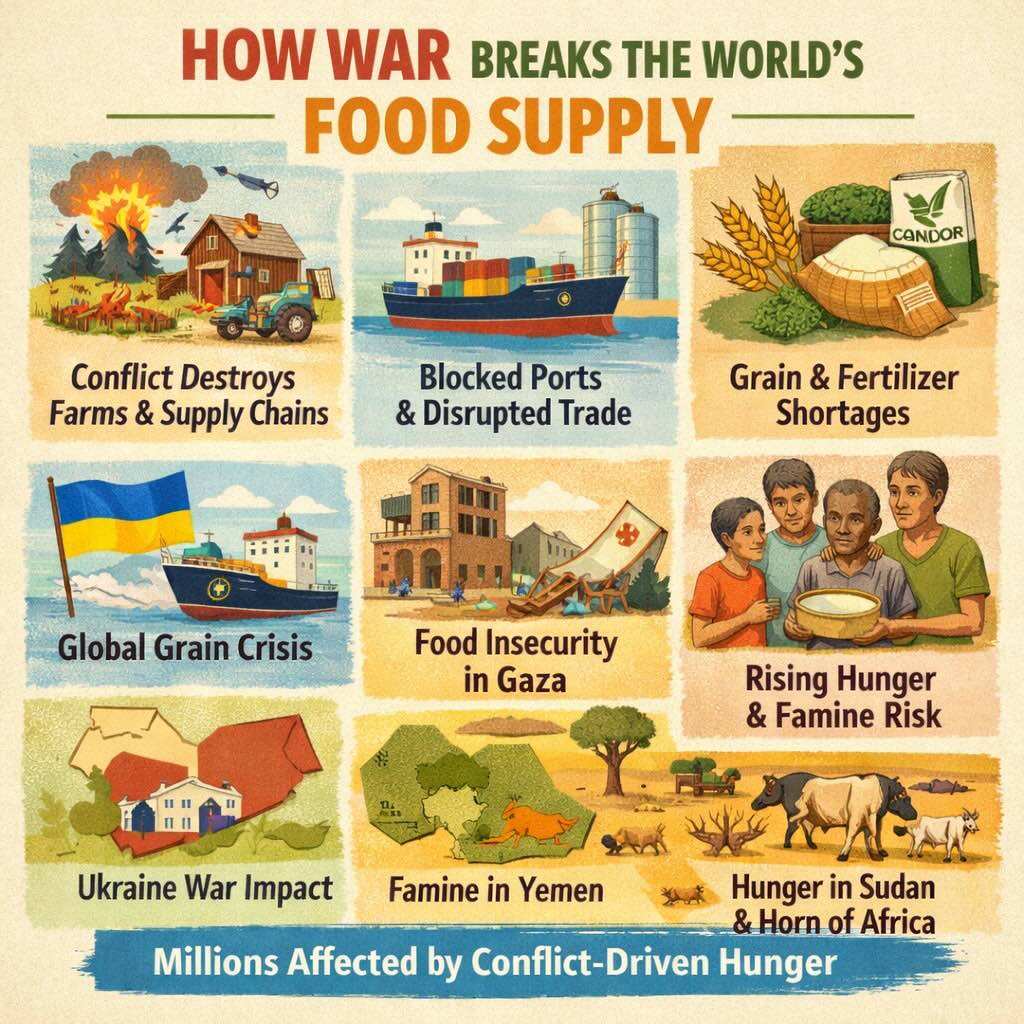
Armed conflict is now the leading driver of acute hunger globally. This is how it works, where it is happening, and what the numbers show.
Published: April 11, 2026 Last Updated: April 11, 2026 Byline: Global War News Editorial
What This Article Covers
This article examines how armed conflict disrupts the global food system, from the farm to the shelf. It draws on data from the United Nations Food and Agriculture Organisation, the World Food Programme, the World Bank, UNICEF, UNRWA, and the Integrated Food Security Phase Classification system. All statistics are attributed to their source. Where data is incomplete due to access constraints in active conflict zones, this is noted explicitly.
This is not a humanitarian appeal. It is an economic and systems analysis of how war translates into hunger, price rises, and supply chain failure at a global scale.
The Basic Mechanism
Food systems are more fragile than most people realise. They depend on a continuous chain of inputs, production, storage, transport, and distribution, and each link in that chain can be severed by conflict.
Start at the beginning. Farmers need seeds, fertiliser, and fuel to plant. They need functioning roads and markets to sell what they grow. They need to be physically present on their land to tend and harvest it. Armed conflict removes all of these conditions simultaneously. Fields become unsafe. Farmers become refugees. Roads become military corridors or sites of ambush. Storage facilities become military targets or sites of looting. Markets collapse when buyers and sellers can no longer move freely.
The World Food Programme describes the sequence this way in its published documentation: conflict disrupts food production, forces people from their homes and their sources of income, and often blocks humanitarian access to those who need it most.
The United Nations Food and Agriculture Organisation adds the input layer. In Sudan, following the outbreak of fighting in April 2023, FAO documented that markets had been looted, supply chains severed, and roads rendered unsafe, leaving families unable to reach or afford seeds, fertiliser, and fuel. Prices for basic goods rose sharply while incomes collapsed.
This pattern repeats in every active conflict zone in this article. The details differ. The mechanism is the same.
Ukraine: When a Breadbasket Goes to War
Before Russia’s full-scale invasion in February 2022, Ukraine was one of the most significant agricultural exporters on the planet. According to FAO trade data, Ukraine accounted for approximately six percent of global wheat exports and, combined with Russia, the two countries supplied roughly 24 percent of global wheat exports by value. Together they also supplied more than half of the world’s sunflower oil exports.
When the invasion began, fear of port blockades drove world wheat prices to levels not seen in decades. The FAO Food Price Index reached an all-time record in March 2022, according to FAO’s own published data. The majority of Ukraine’s 2021 to 2022 harvest, approximately 51 million tonnes, had moved through its Black Sea ports in the eight months before the invasion. Post-invasion blockades initially trapped enormous stocks inside the country, with no way to move grain to the markets that needed it.
Satellite imagery and field documentation confirmed what the price data was signalling: grain silos and storage infrastructure across Ukraine were being struck by missiles. The war was not simply disrupting trade. It was physically destroying the infrastructure that food systems depend on.
By late 2022 global wheat markets had partially stabilised. The World Bank reported that wheat prices fell back by the end of 2022 and that alternative sourcing and the resilience of bulk shipping had prevented catastrophic global shortfalls. But stabilisation is not the same as resolution. According to FAO country data, Ukrainian cereal exports in 2025 remained approximately 20 percent below pre-war levels due to ongoing transport and storage constraints.
The fertiliser dimension has proved equally significant. Russia and Ukraine together account for approximately 30 percent of global nitrogen fertiliser trade, according to World Bank data. Fertiliser prices spiked by roughly 30 percent by early 2022, building on an 80 percent rise already recorded in 2021. The pressure has not eased. In March 2026, according to the FAO Food Price Index report, global urea prices jumped 46 percent in a single month as Middle East conflict pushed up energy costs and disrupted regional ammonia supply pipelines.
The consequence is straightforward. When fertiliser prices rise sharply, farmers in price-sensitive markets reduce application or cut planted area. FAO has documented cases of US farmers considering reductions in fertiliser-intensive crops in response to price spikes. The production impact does not appear in the statistics immediately. It appears in the harvest several months later, and in food prices after that.
The Black Sea Grain Initiative: What It Did and What Happened When It Ended
In July 2022, the United Nations and Turkey brokered an agreement that has since become one of the clearest illustrations of how diplomatic intervention can interrupt the food-conflict chain, and of how quickly the chain reasserts itself when that intervention fails.
The Black Sea Grain Initiative guaranteed safe passage for ships exporting grain from Ukraine’s major Black Sea ports. According to UN documentation, the initiative enabled Ukraine to export almost 33 million metric tonnes of wheat, maize, and other agricultural products over the twelve months it operated. More than 1,000 shipments left Ukrainian ports, carrying food to 45 countries across three continents. The UN credits the initiative with contributing to a significant decline in global agricultural commodity prices during the period it operated.
Russia withdrew from the agreement on July 17, 2023. Within days, Russian forces struck Ukrainian port infrastructure. Wheat futures spiked immediately on international markets. At least one major cargo insurer suspended coverage for Black Sea shipments following Russia’s withdrawal, according to reporting by Reuters and IFPRI analysis.
The IFPRI assessment of the initiative’s collapse noted that its termination immediately choked off the export volumes that had been helping to stabilise global food prices. The 33 million tonnes that had moved through the corridor in one year stopped moving.
Ukraine has since developed alternative export routes through its western land borders and through smaller Danube river ports. These routes have partially compensated for the loss of Black Sea access but have not restored export volumes to pre-war levels. The 20 percent deficit noted in the FAO data reflects the ongoing gap.
Gaza: Famine Confirmed
In August 2025, the World Health Organisation, the Food and Agriculture Organisation, and the World Food Programme issued a joint statement confirming famine in Gaza. It was, according to that statement, the first time famine had been confirmed in Gaza in recorded history.
The figures behind that confirmation are stark. According to IPC analysis published in September 2025, approximately 640,000 people in Gaza were classified in IPC Phase 5, the highest classification in the scale, defined as Catastrophe or Famine conditions. A further 1.14 million people were classified in IPC Phase 4, defined as Emergency. Out of a total Gaza population of approximately 2.3 million, this means that the overwhelming majority of the population was at the most severe levels of food insecurity documented by international methodology.
UNRWA surveys conducted in mid-2025 recorded acute malnutrition among children in Gaza City at approximately 28.5 percent. The international emergency threshold for acute malnutrition is 15 percent. Gaza was nearly double that threshold.
The WFP, UNICEF, and UNRWA attribute the famine conditions to three compounding factors: the prolonged military campaign, which has destroyed agricultural land, markets, and distribution infrastructure; the siege conditions, which have restricted the movement of food and other goods into the territory; and blockades on humanitarian aid, which have prevented relief organisations from reaching the people who most need assistance.
The World Food Programme noted in its Global Food Crisis reporting that the Gaza famine represented one of the fastest deteriorations in food security ever recorded for a defined population. A territory of 2.3 million people moved from food insecurity to confirmed famine conditions within approximately 18 months of the conflict’s onset.
Yemen: A Decade of Hunger
Yemen’s civil war began in 2015. It is now entering its second decade. The food system consequences of that duration are documented across years of UN reporting.
A joint assessment by FAO, WFP, and UNICEF published in mid-2025 found that nearly five million people in government-controlled areas of southern Yemen faced IPC Phase 3 or worse food insecurity, including 1.5 million classified in IPC Phase 4 Emergency conditions. Without continued large-scale humanitarian intervention, UN projections suggested that number could rise to 5.38 million by early 2026.
Two points require explicit acknowledgment here. First, the mid-2025 assessment covers southern Yemen, the area under internationally recognised government control. Reliable current IPC data for northern Yemen, controlled by Houthi forces, is limited by access constraints. UN agencies note this gap explicitly. The full national picture is therefore incomplete, and the figures cited here likely understate the total scale of food insecurity across the country.
Second, Yemen is not experiencing a food crisis caused by a bad harvest or a drought. Yemen imports approximately 90 percent of its food under normal conditions, according to FAO country data. It is a country that has always depended on functioning trade to feed itself. The war has destroyed the port access, the import financing, and the distribution infrastructure that food imports require. The hunger is not a natural event. It is a direct consequence of the conflict’s effect on the systems that deliver food to people.
UN agencies have warned continuously since 2017 that Yemen stands on the edge of a national famine. That famine has so far been averted through large-scale humanitarian intervention. FAO has documented that 20 of Yemen’s 22 governorates are at IPC Phase 3 or above.
Sudan: The Fastest-Moving Food Catastrophe
Sudan’s civil war between the Sudanese Armed Forces and the Rapid Support Forces began in April 2023. In less than three years it has produced what the FAO describes as one of the world’s worst humanitarian emergencies.
According to WFP figures published in late 2025, approximately 21.2 million Sudanese face high levels of acute food insecurity at IPC Phase 3 or above. FAO and WFP have confirmed active famine in multiple areas, specifically in El Fasher in Darfur and in Kadugli in South Kordofan. Across Sudan as a whole, approximately 30.4 million people, roughly 65 percent of the entire population, require urgent humanitarian assistance according to FAO and WFP joint reporting.
IPC projections for the February to May 2026 lean season suggest approximately 19.1 million Sudanese, around 41 percent of the population, could face IPC Phase 3 or worse conditions if humanitarian access does not improve significantly.
The mechanisms are the same ones documented at the beginning of this article, but operating at a national scale and at speed. Markets have been looted. Supply chains have been severed. Roads have been made unsafe. Farmers have been displaced. Humanitarian aid convoys have been blocked. Sudan grew enough food to feed significant portions of its population before the war. It no longer does, not because the land has changed, but because the systems that turn land into food and food into meals have been destroyed.
The Horn of Africa: Conflict Compounding Climate
Somalia and Ethiopia present a different configuration. Both countries face intersecting crises in which conflict and climate shocks reinforce each other in ways that make it difficult to separate their effects.
In Somalia, a United Nations assessment published in February 2026 warned that approximately 6.5 million Somalis, roughly one third of the entire population, would face IPC Phase 3 or worse food insecurity by March 2026. This represented an increase of approximately 1.7 million people compared to early 2025. The same assessment projected approximately 1.84 million Somali children would suffer acute malnutrition in 2026. Conflict with Al-Shabaab restricts humanitarian access to significant portions of the country, compounding the climate-driven drought conditions that are the primary trigger.
Ethiopia has been consistently classified as a major hunger hotspot in FAO and WFP assessments through 2024 and 2025. Conflict in the Tigray region, and intercommunal violence in Amhara and Oromia, has intersected with climate shocks to create acute food insecurity across large areas. Reliable current national IPC figures for Ethiopia are constrained by access limitations, and UN agencies have noted this gap explicitly in their published assessments.
The Horn of Africa illustrates a pattern that analysts increasingly flag across all conflict zones: climate shocks that might be manageable in peacetime become unmanageable when the institutions and infrastructure needed to respond to them have been destroyed by conflict.
The Global Picture
The 2025 Global Report on Food Crises, published by the Food Security Information Network and the World Food Programme, found that more than 295 million people in 53 countries faced acute food insecurity at IPC Phase 3 or worse in 2024. This represented an increase of approximately 14 million people compared to 2023.
Conflict is the dominant driver. WFP analysis estimates that nearly 70 percent of the acutely food-insecure people counted in 2025 were living in fragile or conflict-affected countries. Climate shocks account for a significant share of the remainder, though UN agencies increasingly note that the two drivers overlap: conflict destroys the adaptive capacity that allows communities to manage climate stress.
Looking ahead, WFP has warned that the ongoing Ukraine war alone could push up to 45 million additional people into acute hunger by mid-2026 through knock-on effects on global commodity markets. These projections are forward-looking estimates, not confirmed outcomes, and carry the inherent uncertainty of all conflict projections. They are cited here as institutional assessments, not as predictions.
Analysis: The Chain From Conflict to Empty Plate
The following section represents editorial analysis of the documented facts above. It is not advocacy for any party.
The data in this article points to a structural reality that goes beyond any individual conflict.
Food systems are global. A war in Ukraine affects bread prices in Cairo. A fertiliser pipeline disrupted by fighting in the Middle East affects planting decisions on farms in the American Midwest. A port blockade in the Black Sea reduces the food available in Horn of Africa markets six months later. The chain between conflict and hunger is not always direct or immediately visible. But it is consistent and documented.
The second structural point is about the relationship between conflict duration and food system recovery. Short conflicts can produce temporary supply disruptions that markets absorb. Prolonged conflicts, defined here as those lasting more than two years, systematically destroy the infrastructure, the agricultural knowledge, the market relationships, and the human capital that food systems depend on. Yemen has been at war for a decade. Sudan is approaching three years of full-scale fighting. Gaza moved from food insecurity to confirmed famine in under eighteen months. The longer a conflict runs, the longer the recovery takes, and for some populations, the IPC data suggests, recovery may not come at all without sustained external intervention.
The third point concerns the gap between what the numbers show and what the international response has delivered. UN agencies have been warning about Yemen for nearly a decade. The warnings have been consistent, credible, and well-sourced. The famine has been averted, so far, not by peace but by continuous humanitarian spending. That is not a stable or permanent solution. It is a holding pattern.
Where Things Stand
As of April 2026, more than 295 million people were classified in acute food insecurity at the most recent full global assessment, with the majority of that number living in active or recent conflict zones. Famine has been confirmed in Gaza and in multiple areas of Sudan. Yemen remains on the edge of national famine, averted by humanitarian operations rather than by any resolution of the underlying conflict. Somalia’s hunger crisis is worsening. Fertiliser prices have spiked again following Middle East conflict disruption.
The food system does not recover while the wars continue. That is not analysis. It is what the data shows.
Sources
United Nations Food and Agriculture Organisation. FAO Food Price Index, March 2026. FAO GIEWS Country Brief on Ukraine.
World Food Programme. Global Hunger Crisis documentation. Sudan country page. Global Report on Food Crises 2025, Food Security Information Network and WFP.
World Bank. Global wheat shipments and the Russia-Ukraine invasion analysis. Food Security Update. Fertiliser price data, March 2026.
FAO, WFP, and WHO. Joint press release confirming famine in Gaza, August 2025.
FAO, WFP, and UNICEF. Joint press release on Yemen food security, mid-2025.
Integrated Food Security Phase Classification. Gaza IPC analysis, September 2025. Sudan acute food insecurity situation, September 2025 and projections to May 2026.
UNRWA and UNICEF. Child malnutrition surveys, Gaza, mid-2025.
IFPRI. Analysis of Russia’s termination of the Black Sea Grain Initiative, July 2023.
WFP. Somalia humanitarian crisis warning, February 2026.
Reuters. Reporting on Black Sea Grain Initiative collapse and cargo insurance suspension, July 2023.
Nature Communications Earth and Environment. International cooperation and wheat price stabilisation following the Russian invasion of Ukraine, 2024.
Federal Reserve Bank of St. Louis. Russia-Ukraine war and record fertiliser prices, 2022.
This article is based on publicly available reporting from named international news agencies and attributed official statements. All claims about ongoing events are attributed to their original sources. Analysis sections represent the editorial interpretation of reported facts and do not constitute advocacy for any party to the described conflict. This publication does not take political positions on active military conflicts.