
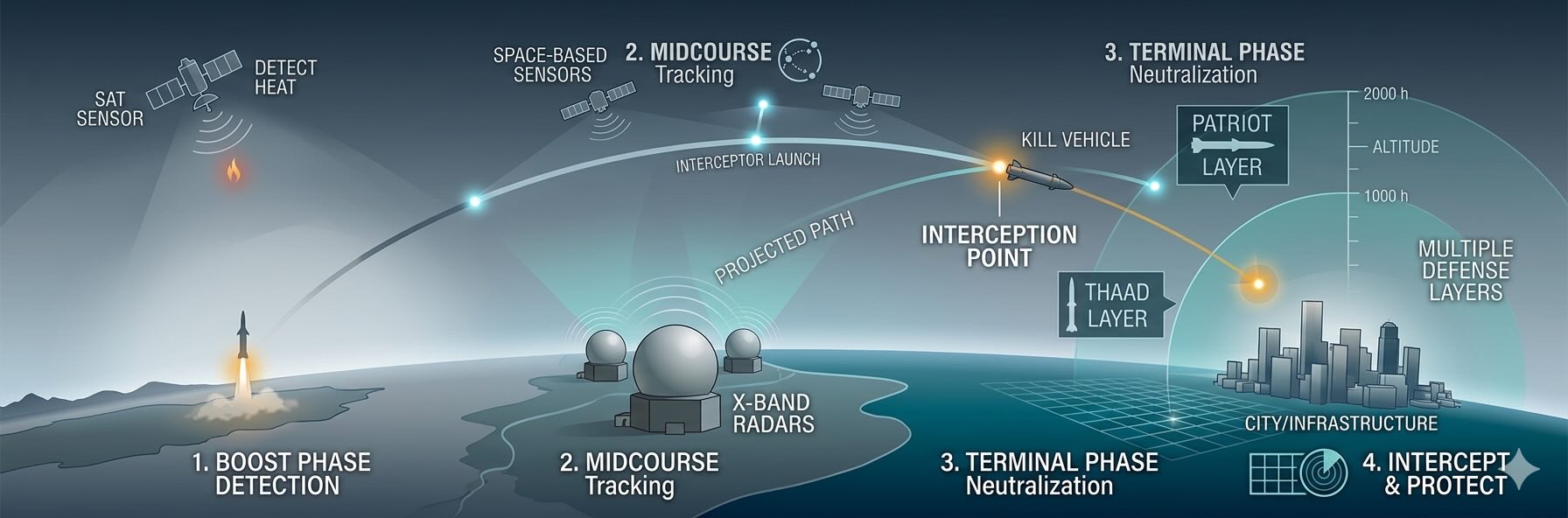
From detection to impact, understanding the multi-layered technology shielding sovereign airspace.
Publication Date: April 14, 2026
Last Updated: April 14, 2026
Byline: Global War News Editorial
The proliferation of ballistic and cruise missile technology has made integrated air defense systems a cornerstone of national security for states worldwide. These systems are not a single piece of equipment but a complex “network of networks” designed to find, track, and destroy incoming threats before they reach their targets.
At its core, missile defense is often described by aerospace engineers as “hitting a bullet with a bullet.” Success requires a seamless sequence of events occurring in seconds, involving satellite surveillance, high-powered ground radar, and high-velocity interceptors.
The Four Stages of Interception
According to technical specifications released by defense manufacturers like Raytheon and Lockheed Martin, and verified by analysts at the International Institute for Strategic Studies (IISS), a successful interception follows a standardized four-phase process.
1. Detection and Early Warning
The process begins with the identification of a launch. Space-based infrared sensors, such as those in the US Space Force’s Satellite Early Warning System, detect the heat signature of a missile’s engine. This data is instantly transmitted to command centers to determine the projected flight path and target area.
2. Tracking and Discrimination
Once a threat is identified, ground-based or sea-based X-band radars take over. These radars provide high-resolution data to “discriminate” between the actual warhead and “clutter,” such as spent rocket stages or intentional decoys.
3. Engagement and Launch
If the system determines the missile poses a threat, the Fire Control System (FCS) calculates an intercept point. A battery commander or an automated system then launches an interceptor missile.
4. Interception
Modern systems generally use one of two methods for the final kill:
- Blast Fragmentation: The interceptor explodes near the target, shredding it with shrapnel.
- Hit-to-Kill: The interceptor uses pure kinetic energy, physically colliding with the target at hypersonic speeds to vaporize the warhead.
Layers of Defense: Terminal, Midcourse, and Boost
Military analysts note that no single system can stop every threat. Instead, defense is structured in “layers” based on which phase of flight the missile is in.
- Boost Phase: Intercepting the missile while its engine is still firing and it is moving relatively slowly. This is technically difficult as the interceptor must be positioned very close to the launch site.
- Midcourse Phase: Intercepting the missile in space at the peak of its trajectory. Systems like the Ground-based Midcourse Defense (GMD) are designed for this, though their effectiveness remains a subject of debate among independent researchers.
- Terminal Phase: Intercepting the missile as it re-enters the atmosphere and nears its target. The Terminal High Altitude Area Defense (THAAD) and the Patriot (PAC-3) systems operate in this layer.
Analysis: The Economic and Strategic Cost of Shielding
While these systems offer a vital security layer, observers note that the “cost-exchange ratio” often favors the attacker. According to data from the Center for Strategic and International Studies (CSIS), a single interceptor missile can cost between $2 million and $15 million, whereas the drones or short-range missiles they intercept may cost only a fraction of that amount.
This economic reality has led to a shift in defense strategy. Governments are increasingly looking toward “Directed Energy” weapons—lasers—which, in theory, offer a “near-zero” cost per shot. However, these technologies remain largely in the testing phase and are not yet a replacement for traditional kinetic interceptors.
Beyond the financial cost, the deployment of these systems often carries significant geopolitical weight. Analysts suggest that the placement of advanced radar and interceptors can be perceived by neighboring states as an attempt to neutralize their own deterrent capabilities, sometimes triggering localized arms races.
Current Outlook
As of early 2026, global investment in missile defense continues to rise, driven by the increased use of drone swarms and hypersonic missiles in regional conflicts. The challenge for modern systems is now evolving from stopping single, predictable ballistic paths to managing “maneuverable” threats that can change direction at five times the speed of sound.
Sources Disclosure:
- Technical specifications from Raytheon Technologies and Lockheed Martin.
- Strategic reports from the Center for Strategic and International Studies (CSIS).
- Analysis of current conflict trends from the International Institute for Strategic Studies (IISS).
- Official public statements from the US Department of Defense and the Israeli Ministry of Defense regarding the “Iron Dome” and “Arrow” systems.
This article is based on publicly available reporting from named international news agencies and attributed official statements. All claims about ongoing events are attributed to their original sources. Analysis sections represent the editorial interpretation of reported facts and do not constitute advocacy for any party to the described conflict. AI tools may be utilized for image generation to assist in explaining complex concepts, as well as for refining grammar, spelling, and other linguistic enhancements. However, all original content is produced, fact-checked, and revised by the editorial team. This publication does not take political positions on active military conflicts.