
Humanitarian agencies warn of a “forgotten catastrophe” as displacement figures surpass all other global crises combined.
Published: April 14, 2026
Last Updated: 17:45 GMT
By Global War News Editorial
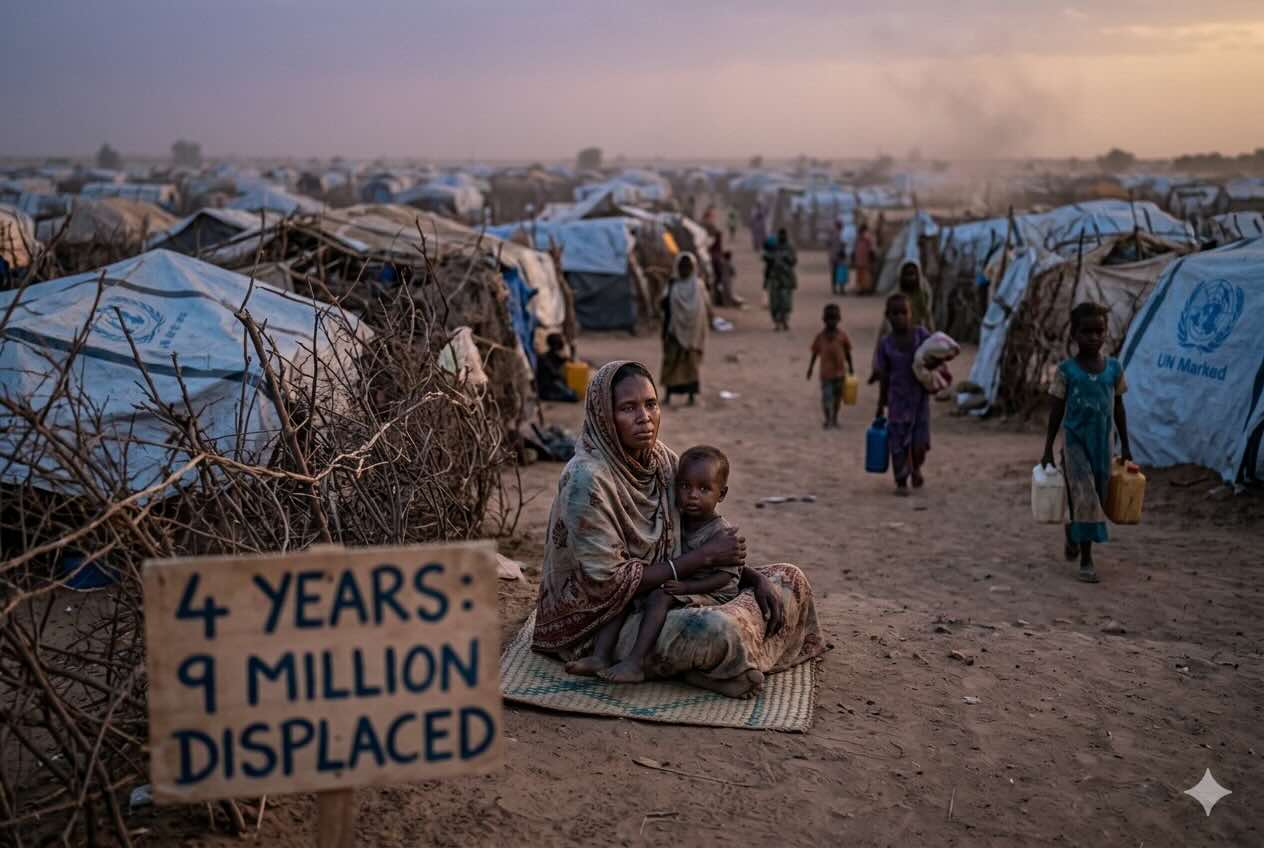
The civil war in Sudan has officially entered its fourth year, marked by a grim milestone: the United Nations now classifies the country as the site of the world’s largest internal displacement crisis. According to a joint report released Tuesday by the International Organization for Migration (IOM) and the UN Refugee Agency (UNHCR), approximately 9 million people are now internally displaced within Sudan’s borders, with an additional 2.5 million having fled to neighboring Chad, Egypt, and South Sudan.
The conflict, which began in April 2023 between the Sudanese Armed Forces (SAF) and the Rapid Support Forces (RSF), has shifted from a localized power struggle in Khartoum to a fragmented, nationwide war of attrition. Humanitarian coordinators on the ground report that the breakdown of the rule of law has led to a catastrophic surge in targeted violence, particularly in the Darfur and Kordofan regions.
Escalation of Gender-Based Violence
One of the most concerning developments in the fourth year of fighting is the systematic use of gender-based violence (GBV) as a tool of war. UN Women and Human Rights Watch have documented a significant rise in reports of sexual violence used to terrorize civilian populations and force displacement.
“The scale of the atrocities is staggering,” stated a representative from the World Health Organization (WHO) in Port Sudan. “We are seeing a consistent pattern where sexual violence is utilized to break the social fabric of communities.” Due to the collapse of the national healthcare system, fewer than 15% of victims have access to emergency medical care or psychological support. Relief agencies note that these figures likely represent only a fraction of the actual total, as social stigma and the lack of safe reporting channels keep many survivors in the shadows.
A State of Total Displacement
The displacement of 9 million people has created a logistical nightmare for aid organizations.
- Food Insecurity: The Integrated Food Security Phase Classification (IPC) recently warned that nearly 5 million people are at risk of “catastrophic” hunger (Phase 5), the highest level of food insecurity.
- Urban Collapse: Cities that once served as safe havens, such as Wad Madani, have been overtaken by fighting, forcing families to move three or four times within a single year.
- Funding Gap: As of April 2024, the UN’s Humanitarian Response Plan for Sudan remains less than 20% funded. Officials from the World Food Programme (WFP) have stated that without an immediate infusion of international capital, they will be forced to cut rations for millions of displaced civilians.
Analysis: The Geopolitics of Neglect
Analysts suggest that the Sudan conflict has become a “forgotten war” as international diplomatic attention remains fixed on the Middle East and Eastern Europe. Observers note that the lack of a unified international mediation effort has allowed regional actors to continue funneling weapons to both sides, prolonging the stalemate.
The “Economic Impact” section of recent reports indicates that Sudan’s GDP has contracted by an estimated 40% since the start of the war. The destruction of the agricultural heartland in the Gezira State means that Sudan, once envisioned as a potential breadbasket for Africa, is now almost entirely dependent on dwindling international aid. This economic collapse is not just a national tragedy; it is destabilizing the broader Sahel region, pushing thousands of migrants toward Mediterranean routes.
What to Watch
As the conflict moves into its fourth year, the primary concern is a full-scale famine in the coming months. Diplomatic efforts in Jeddah and Addis Ababa have largely stalled, with neither the SAF nor the RSF showing a willingness to return to the negotiating table without significant territorial gains. Humanitarian groups are now calling for “cross-border” aid corridors that do not require central government approval—a move that would be legally complex but may be the only way to reach those in the hardest-hit areas of Darfur.
Sources: United Nations Refugee Agency (UNHCR), International Organization for Migration (IOM), Reuters, Al Jazeera, Human Rights Watch, World Food Programme (WFP) Situation Report.
This article is based on publicly available reporting from named international news agencies and attributed official statements. All claims about ongoing events are attributed to their original sources. Analysis sections represent the editorial interpretation of reported facts and do not constitute advocacy for any party to the described conflict. AI tools may be utilized for image generation to assist in explaining complex concepts, as well as for refining grammar, spelling, and other linguistic enhancements. However, all original content is produced, fact-checked, and revised by the editorial team. This publication does not take political positions on active military conflicts.