
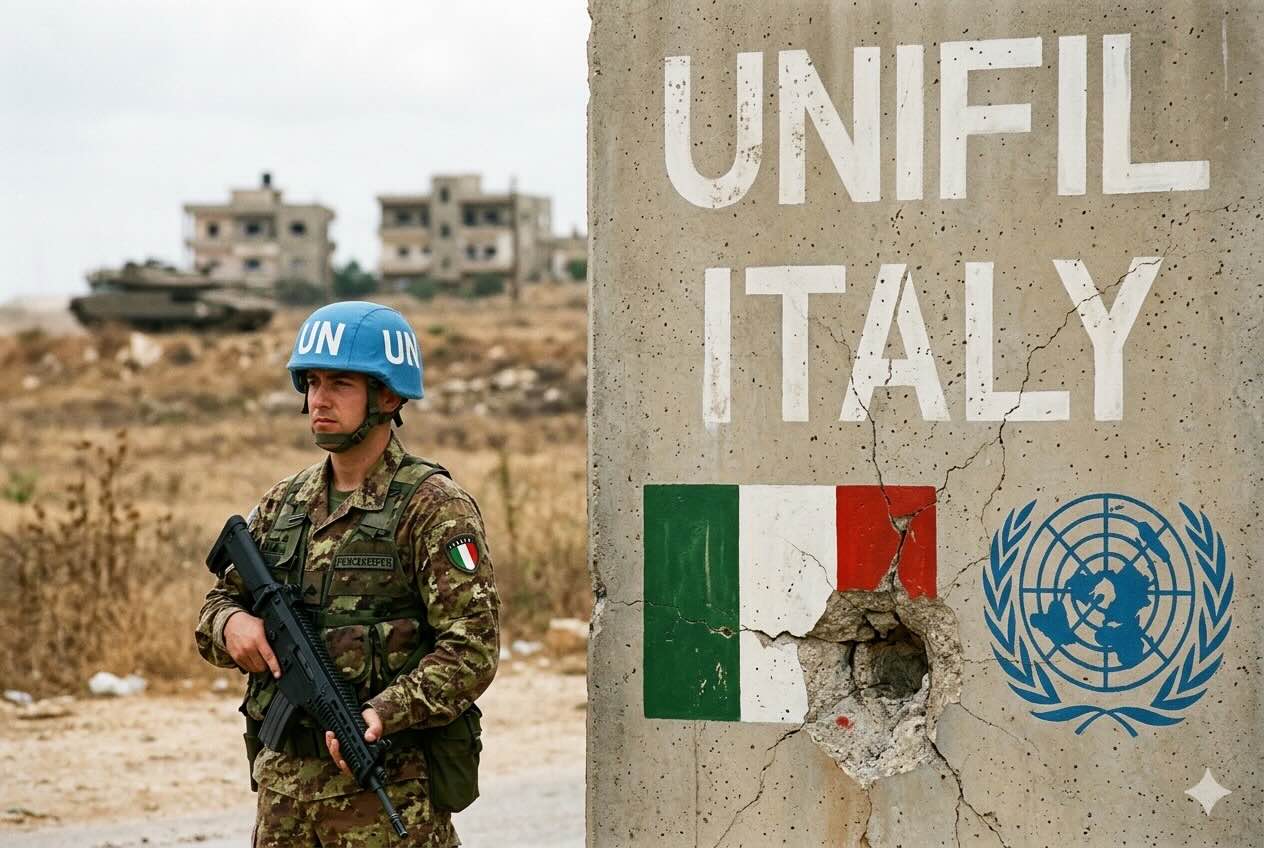
Prime Minister Meloni orders immediate freeze on arms exports and military training following “unacceptable” attacks on UNIFIL positions.
Published: April 14, 2026 Last Updated: 17:55 GMT
By Global War News Editorial
The Italian government has officially suspended all defense cooperation agreements with Israel, marking the most significant diplomatic rift between the two Mediterranean nations in decades. Prime Minister Giorgia Meloni announced the decision late Monday following a series of artillery strikes and incursions that affected United Nations Interim Force in Lebanon (UNIFIL) positions, where over 1,000 Italian soldiers are currently stationed.
The suspension, which takes effect immediately, includes the freezing of all pending arms export licenses and the cancellation of joint military exercises scheduled for the summer of 2026. In a statement to the Chamber of Deputies, Prime Minister Meloni characterized the military strikes on UN-mandated peacekeepers as “unacceptable and a clear violation of international law.”
The UNIFIL Incident
The diplomatic crisis was triggered by reports from UNIFIL headquarters in Naqoura, which detailed several incidents over the last 48 hours where Israeli Defense Forces (IDF) fire allegedly struck observation towers and perimeter walls of UN bases.
- Direct Impact: According to reports from the Italian Ministry of Defence, two Italian peacekeepers sustained minor injuries when an administrative building was damaged by tank fire.
- The IDF Position: In a statement issued by the Israeli Government Press Office, the IDF maintained that its forces were targeting Hezbollah positions located “in close proximity” to UNIFIL installations and suggested that UN troops were being used as “human shields” by the militant group.
- The UN Response: UN Secretary-General António Guterres stated that deliberate attacks on peacekeepers may constitute war crimes, a sentiment echoed by Italian Foreign Minister Antonio Tajani during an emergency meeting with the Israeli Ambassador in Rome.
Strategic and Industrial Fallout
Italy has historically been one of Israel’s most consistent defense partners in Europe. The suspension carries heavy weight for both nations’ defense sectors.
- Arms Exports: According to data from the Stockholm International Peace Research Institute (SIPRI), Italy has been a key supplier of helicopter components and naval artillery systems to Israel.
- Aerospace Cooperation: The freeze is expected to stall the “M-346” advanced trainer jet support program, which is a cornerstone of Israeli pilot training.
- Intelligence Sharing: While the primary focus is on hardware, Italian officials suggested that intelligence sharing regarding Mediterranean maritime security would also be “re-evaluated” until safety guarantees for UNIFIL are provided.
Analysis: A Shift in European Consensus
Observers note that Italy’s move signals a potential fracture in the European Union’s approach to the conflict. While nations like Germany have maintained a stance of staunch support for Israel’s right to self-defense, Italy’s decision—led by a right-leaning government traditionally friendly to Jerusalem—suggests that the safety of European peacekeepers has become a “red line” that transcends traditional political alliances.
Analysts at the European Council on Foreign Relations (ECFR) suggest that Italy may be attempting to lead a broader European effort to enforce a “code of conduct” in southern Lebanon. If other major UNIFIL contributors, such as France or Spain, follow Rome’s lead, Israel could face a coordinated European defense embargo, significantly complicating its long-term procurement strategy.
What to Watch
The primary indicator of the depth of this rift will be the upcoming UN Security Council vote on the renewal of the UNIFIL mandate. If Italy continues to withhold defense cooperation, it may leverage its position to demand stricter enforcement of Resolution 1701. Domestically, the Meloni government faces pressure from both the opposition and members of its own coalition to ensure that Italian “blue helmets” are not caught in the crossfire of a full-scale regional escalation.
Sources: Reuters, ANSA (Italy), The Jerusalem Post, UNIFIL Official Press Statement, Stockholm International Peace Research Institute (SIPRI), BBC News.
This article is based on publicly available reporting from named international news agencies and attributed official statements. All claims about ongoing events are attributed to their original sources. Analysis sections represent the editorial interpretation of reported facts and do not constitute advocacy for any party to the described conflict. AI tools may be utilized for image generation to assist in explaining complex concepts, as well as for refining grammar, spelling, and other linguistic enhancements. However, all original content is produced, fact-checked, and revised by the editorial team. This publication does not take political positions on active military conflicts.