
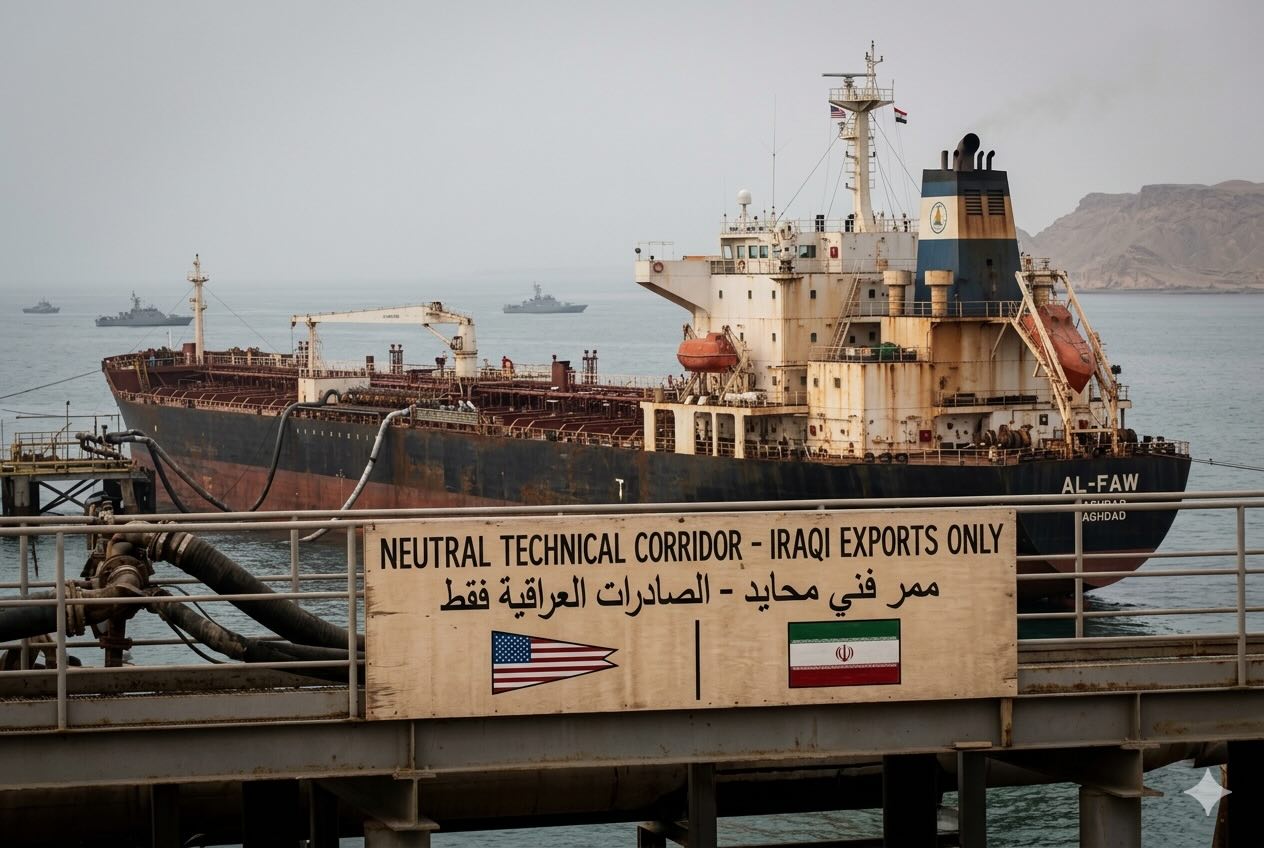
Iraqi officials negotiate a “technical corridor” to stabilize global markets as the Strait of Hormuz remains a high-risk zone.
Published: April 14, 2026
Last Updated: 18:15 GMT
By Global War News Editorial
The Iraqi Ministry of Oil announced on Tuesday that it has reached “preliminary understandings” with both Washington and Tehran to allow for the continued export of Iraqi crude oil despite the ongoing naval blockade of the Strait of Hormuz. The announcement, if verified by all parties, could provide a vital pressure valve for global energy markets that have seen prices surge past $100 per barrel in recent days.
According to a statement from Baghdad, the proposed arrangement involves a “neutral technical corridor” that would permit tankers carrying Iraqi oil to transit the Gulf without being intercepted by the U.S. naval blockade or targeted by Iranian maritime forces. While the U.S. State Department has yet to officially confirm the specific terms, a spokesperson noted that the U.S. remains committed to “minimizing collateral economic damage” to regional partners.
A Precarious Balancing Act
Iraq occupies a unique and difficult position in the current conflict, maintaining deep security ties with the United States while sharing an extensive border and energy infrastructure with Iran.
- The “Corridor” Concept: Reports from the Iraqi News Agency (INA) suggest the deal involves rigorous tracking and verification protocols. Tankers would be required to undergo third-party inspections to ensure they are not carrying Iranian cargo under Iraqi flags, a move designed to satisfy U.S. sanctions requirements.
- The Tehran Factor: Iranian officials have reportedly signaled that they will not disrupt Iraqi exports provided that Baghdad continues to facilitate certain regional trade humanitarian exemptions. However, analysts at the International Energy Agency (IEA) warn that this “understanding” remains highly informal and subject to immediate reversal.
Economic Stakes for Baghdad and the World
The blockade of the Strait of Hormuz is particularly devastating for Iraq, which relies on the waterway for approximately 90% of its oil exports.
- Revenue Crisis: Before this reported understanding, Iraq’s South Gas Company had warned of a “near-total shutdown” of export capacity, which threatened the country’s ability to pay public sector salaries.
- Global Supply: Iraq is OPEC’s second-largest producer. The total removal of Iraqi crude from the market would likely trigger a secondary price shock, potentially pushing Brent crude toward the $130 mark.
- Alternative Routes: Baghdad is simultaneously working to increase the capacity of the Kirkuk-Ceyhan pipeline to Turkey, though technical bottlenecks and security concerns in northern Iraq currently limit this route to a fraction of the country’s total output.
Analysis: Iraq as a Diplomatic Bridge
Observers note that this development highlights Baghdad’s evolving role as a regional mediator. By securing concessions from both sides, Iraq is attempting to shield its economy from a conflict it cannot control.
However, analysts from the Atlantic Council suggest that this “understanding” may be a calculated move by both the U.S. and Iran to test de-escalation. For the U.S., allowing Iraqi oil to flow prevents a global economic meltdown that could undermine domestic support for its naval operations. For Iran, the deal maintains a degree of economic stability in a neighboring state where it holds significant influence. The risk remains that a single “kinetic incident”—a misfired missile or a ship collision—could shatter this fragile arrangement instantly.
What to Watch
The success of this deal hinges on the first “test tankers” scheduled to depart from the Al-Basra Oil Terminal within the next 48 hours. Market traders are watching for satellite confirmation of these vessels safely clearing the Strait of Hormuz. If successful, this could serve as a blueprint for other regional producers, such as Kuwait, to seek similar “neutrality” agreements, potentially cooling the overheated global energy market.
Sources: Iraqi News Agency (INA), Reuters, Bloomberg Energy, International Energy Agency (IEA), Al-Monitor, U.S. State Department Daily Briefing.
This article is based on publicly available reporting from named international news agencies and attributed official statements. All claims about ongoing events are attributed to their original sources. Analysis sections represent the editorial interpretation of reported facts and do not constitute advocacy for any party to the described conflict. AI tools may be utilized for image generation to assist in explaining complex concepts, as well as for refining grammar, spelling, and other linguistic enhancements. However, all original content is produced, fact-checked, and revised by the editorial team. This publication does not take political positions on active military conflicts.