
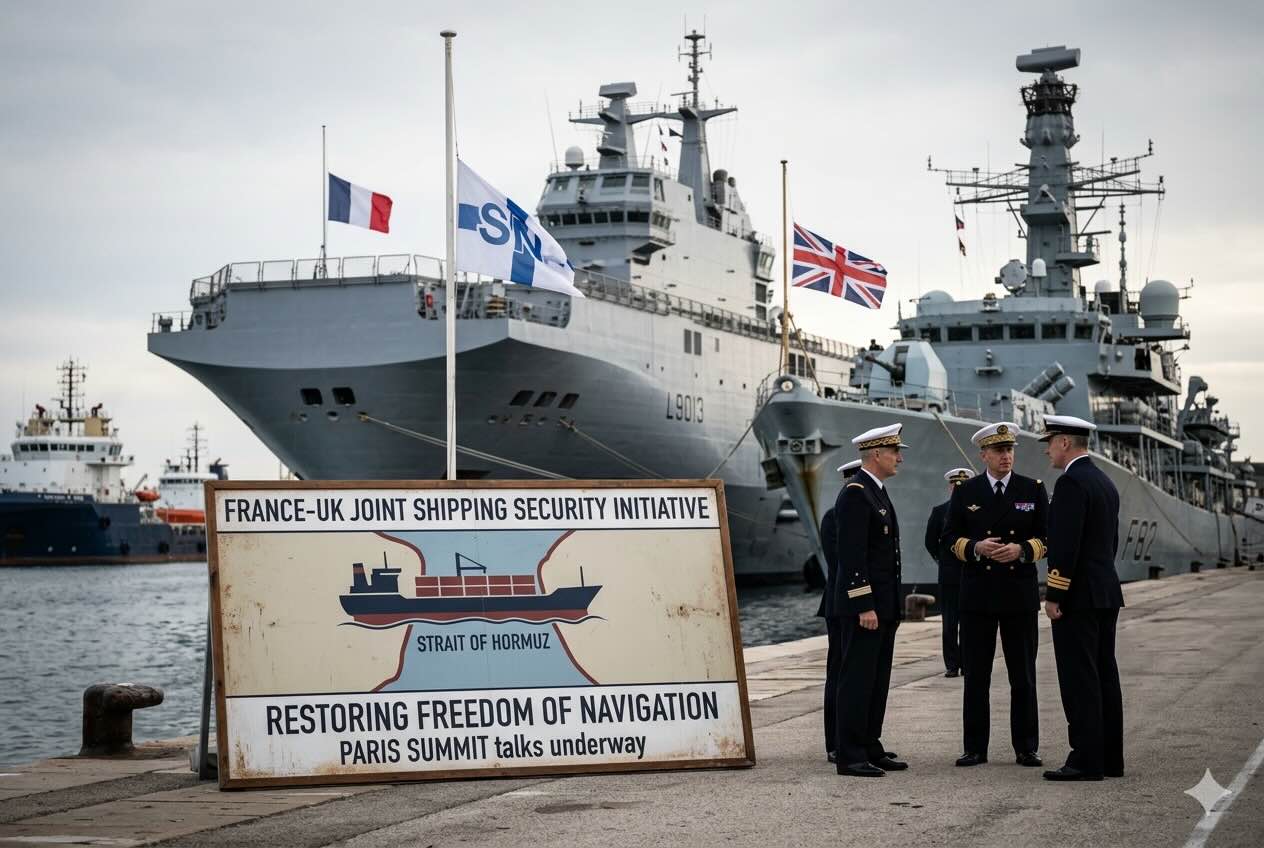
London and Paris seek “Coalition of the Willing” to restore freedom of navigation in the Strait of Hormuz.
Published: April 14, 2026
Last Updated: 19:15 GMT
By Global War News Editorial
The governments of France and the United Kingdom announced on Tuesday that they will co-host an emergency summit in Paris to address the escalating maritime crisis in the Middle East. The “Shipping Security Initiative 2026” aims to establish a coordinated naval framework to protect commercial vessels transiting the Strait of Hormuz, which has become effectively impassable following the U.S.-led blockade of Iranian ports and subsequent Iranian threats.
In a joint statement released by the Quai d’Orsay and the British Foreign Office, officials emphasized that “freedom of navigation is a non-negotiable pillar of international law.” The summit, scheduled for April 17, is expected to bring together defense ministers from over 15 nations, including regional stakeholders and major European maritime powers.
Addressing the “Double Blockade”
The move comes as the international shipping community expresses growing alarm over the “double blockade” currently paralyzing the Persian Gulf.
- The Stalemate: While the U.S. Navy is enforcing a blockade of Iranian-bound cargo, Tehran has countered by declaring the Strait a “hostile zone” for ships from nations supporting the U.S. position.
- Carrier Resistance: Major shipping conglomerates, including Maersk and MSC, have reportedly suspended most transits through the region, leading to a massive backlog of tankers and a sharp spike in maritime insurance premiums.
- The European Proposal: Unlike the direct blockade enforcement practiced by the U.S., the Franco-British proposal focuses on “protective escort missions” designed to de-escalate tensions by providing a neutral security presence for non-combatant commercial vessels.
Divergent Western Strategies
The decision by London and Paris to host their own summit highlights a significant divergence from Washington’s “maximum pressure” tactics.
- Strategic Autonomy: French President Emmanuel Macron has stated that while France stands in solidarity with allies, it seeks a “de-escalatory path” that prevents a full-scale naval war.
- The UK Position: British Foreign Secretary David Lammy noted that the UK’s primary interest is the stabilization of global energy prices, which have directly impacted the British domestic cost of living.
- Regional Participation: A critical question for the Paris talks will be the level of participation from regional powers such as Saudi Arabia and Oman. Omani officials have reportedly acted as intermediaries, warning that a heavy-handed Western naval presence could inadvertently trigger a “kinetic engagement.”
Analysis: The Cost of a Closed Strait
Economists at the OECD have warned that every week the Strait of Hormuz remains restricted, global trade growth is reduced by approximately 0.2%.
- Energy Insecurity: With several European nations still transitioning away from Russian energy, the Middle Eastern supply route is critical.
- Insurance Shocks: “War risk” premiums for tankers have increased by over 400% in the last month alone, according to Lloyd’s of London.
- A “Code of Conduct”: Analysts suggest the summit will attempt to draft a “Maritime Code of Conduct” that Iran might be persuaded to respect, provided it distinguishes between U.S. military operations and general international commerce.
What to Watch
The success of the emergency talks will be measured by whether a formal “Joint Escort Task Force” is established. If major Asian economies—specifically India and Japan—join the initiative, it would provide the coalition with broader international legitimacy. However, if Tehran views the initiative as a “European extension” of the U.S. blockade, the risk of drone and swarm-boat attacks against these escorts will remain high.
Sources: Agence France-Presse (AFP), Reuters, The Guardian, Le Monde, Lloyd’s List Intelligence, OECD Economic Outlook.
This article is based on publicly available reporting from named international news agencies and attributed official statements. All claims about ongoing events are attributed to their original sources. Analysis sections represent the editorial interpretation of reported facts and do not constitute advocacy for any party to the described conflict. AI tools may be utilized for image generation to assist in explaining complex concepts, as well as for refining grammar, spelling, and other linguistic enhancements. However, all original content is produced, fact checked, and revised by the editorial team. This publication does not take political positions on active military conflicts.