
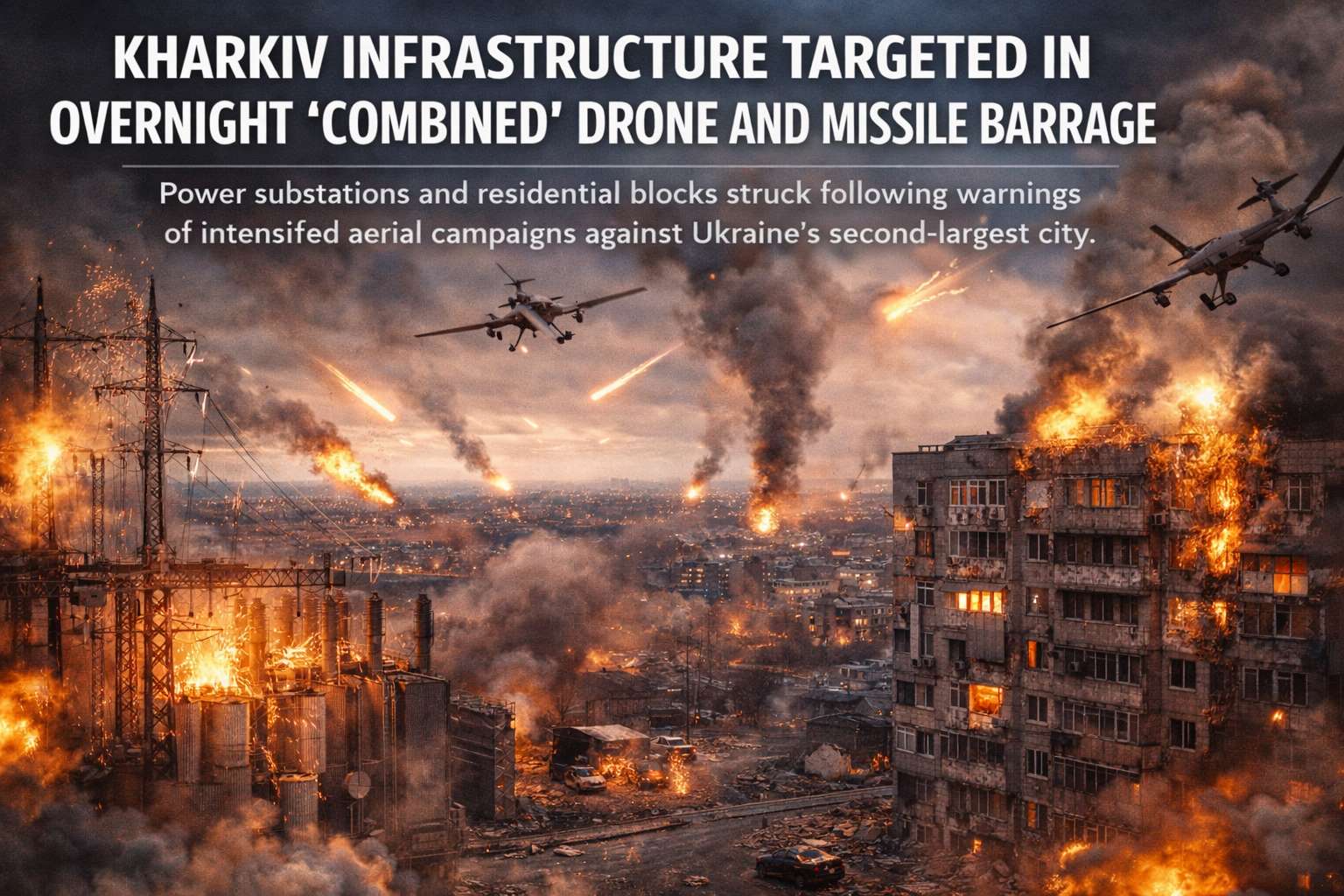
Power substations and residential blocks struck following warnings of intensified aerial campaigns against Ukraine’s second-largest city.
Published: April 15, 2026
Last Updated: April 15, 2026
By Global War News Editorial
Authorities in Kharkiv have reported a significant wave of overnight strikes targeting the city’s critical energy infrastructure and residential areas. The “combined” attack, involving both unmanned aerial vehicles (UAVs) and guided missiles, follows a public warning issued by President Volodymyr Zelenskyy on April 14 regarding the vulnerability of the region’s logistics and power networks.
The strikes have reportedly damaged multiple power substations and high-rise civilian apartment blocks in the Shevchenkivskyi and Kyivskyi districts. While air defense systems were active throughout the night, local officials confirmed that several projectiles breached the city’s perimeter, leading to localized blackouts and fires.
Coordinated Aerial Strikes
According to the Kharkiv Regional Military Administration, the attack utilized a mixture of “Shahed” and “Molniya” drones alongside cruise missiles. Oleh Syniehubov, the regional governor, stated publicly that the enemy targeted “one of the most important critical facilities in the region,” referring to infrastructure critical for both the city’s power grid and water supply.
In the Shevchenkivskyi district, a combat drone reportedly struck the upper floors of a multi-story residential building. While smoke was observed and structural damage was significant, early reports from Mayor Ihor Terekhov suggested there were no immediate fatalities in that specific strike, though a 44-year-old woman was treated for an acute stress reaction.
Damage to the Energy Grid
The primary tactical focus of the barrage appeared to be the regional energy sector. Ukrainian news agencies reported that six guided aerial bombs were launched at the Pechenihy dam and reservoir area—a facility described by officials as “critically vital” for the energy and water security of Kharkiv.
This latest escalation aligns with broader trends noted by independent monitors. The Institute for the Study of War (ISW) reported that Russian forces have conducted a series of strikes across Chernihiv, Kharkiv, and Sumy cities over the last 48 hours, aimed at degrading civilian and administrative infrastructure.
Context: The April 14 Warning
The timing of the strike is notable, coming less than 24 hours after President Zelenskyy outlined the precarious state of Ukraine’s infrastructure. In a statement on April 14, Zelenskyy focused on the efforts to restore energy pipelines and storage facilities, noting that while work was underway, the systems remained vulnerable to “deliberate targeting.”
Kharkiv has remained a primary target for aerial campaigns throughout 2026. Data from the DiXi Group research institution indicates that the scale of missile and drone usage has increased significantly this year compared to the early stages of the conflict, with a specific focus on substations that link generating plants to the national grid.
Analysis: Tactical Intent and Humanitarian Risk
Analysts suggest that the use of “combined” strikes—mixing slow-moving drones with high-speed missiles—is a deliberate tactic to saturate and exhaust air defense responses. By targeting both power substations and the Pechenihy dam, the campaign appears designed to create cascading failures in municipal services, including heating and water filtration.
Observers note that such strikes on dual-use infrastructure carry a high risk of civilian harm. While the stated military objective often involves “military-industrial” targets, the reality on the ground in Kharkiv shows consistent damage to apartment complexes and medical facilities. It remains unclear whether the recent strikes will trigger the same level of long-term heating emergency seen earlier this year when over 100,000 homes were left without power.
Current Situation
Repair crews from Ukrenergo have reportedly begun assessing the damage to the substations, though their work is frequently interrupted by ongoing air raid alerts. Local authorities have urged residents to utilize “invincibility points”—heated community centers—should the localized blackouts persist into the evening.
Sources:
This report is based on official statements from the Kharkiv Regional Military Administration, Mayor Ihor Terekhov, and the President’s Office. Additional data and factual reporting were provided by Ukrinform, Gwara Media, and the Institute for the Study of War (ISW).
This article is based on publicly available reporting from named international news agencies and attributed official statements. All claims about ongoing events are attributed to their original sources. Analysis sections represent the editorial interpretation of reported facts and do not constitute advocacy for any party to the described conflict. AI tools may be utilized for image generation to assist in explaining complex concepts, as well as for refining grammar, spelling, and other linguistic enhancements. However, all original content is produced, fact-checked, and revised by the editorial team. This publication does not take political positions on active military conflicts