
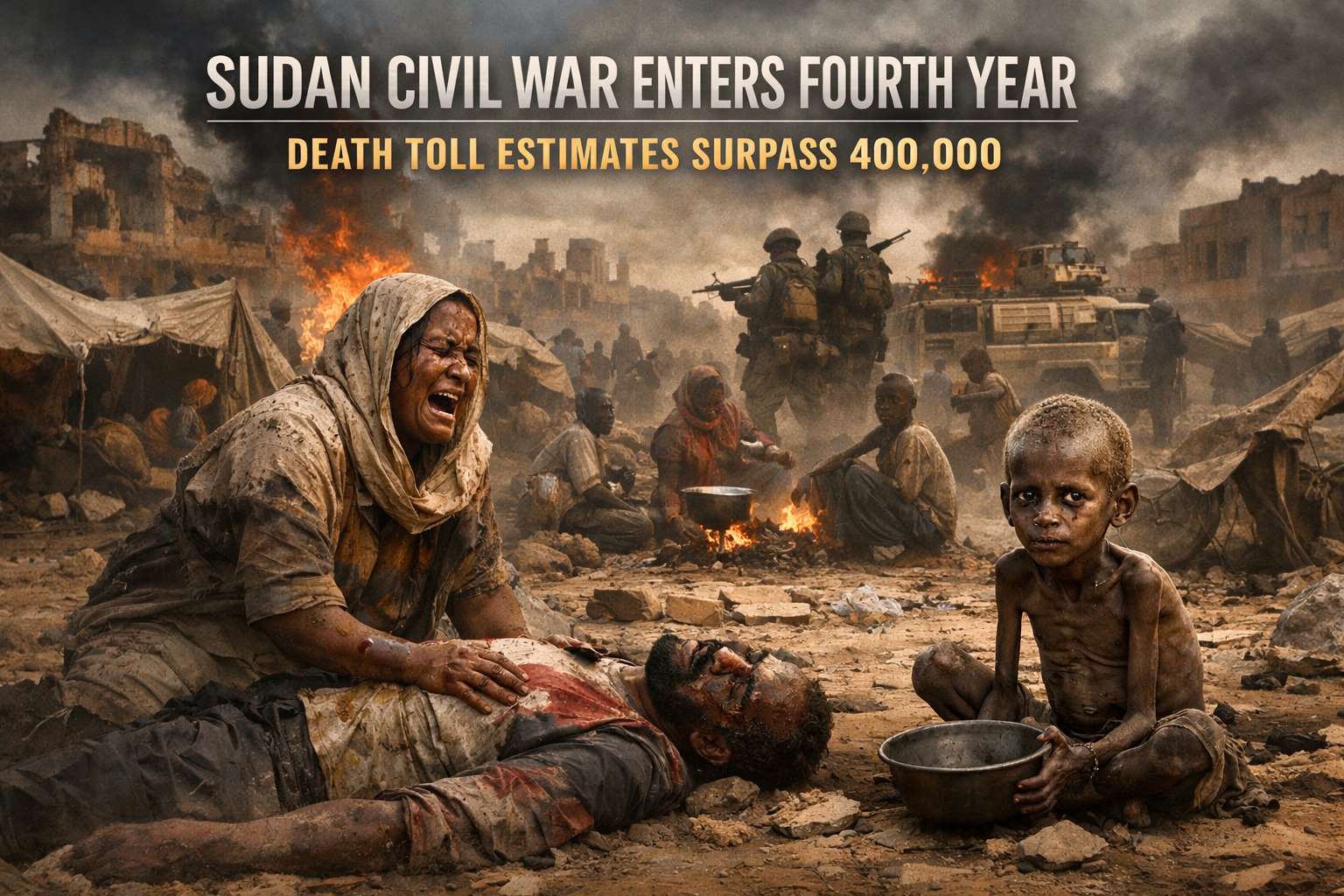
As the conflict marks its third anniversary, a combination of direct violence and “food weaponization” has created the world’s largest displacement and hunger crisis.
Published: April 15, 2026
Last Updated: April 15, 2026
By Global War News Editorial
Three years after the first shots were fired in Khartoum on April 15, 2023, the war between the Sudanese Armed Forces (SAF) and the paramilitary Rapid Support Forces (RSF) has transformed into a protracted catastrophe of global proportions. New data released to coincide with the anniversary suggests the human cost has reached a grim milestone, with combined fatality estimates from direct combat and war-induced starvation now surpassing 400,000.
What began as a power struggle between two generals—General Abdel Fattah al-Burhan of the SAF and Mohamed Hamdan “Hemedti” Dagalo of the RSF—has effectively fractured the state. Today, Sudan is divided into competing fiefdoms where the lines of control are increasingly dictated by the ability to control the movement of food and essential medicine.
The Rising Toll of a “Forgotten War”
Pinning down an exact death toll in Sudan remains a challenge due to the systematic destruction of communication networks and the targeting of healthcare staff. However, several international monitoring groups have significantly revised their figures upward this month.
According to recent assessments from the Council on Foreign Relations (CFR) and reports cited by the UN, the death toll has surged past 150,000 in direct combat, while child mortality due to acute malnutrition is estimated to have exceeded 522,000 since the conflict’s inception. In Darfur specifically, the UN High Commissioner for Refugees (UNHCR) has warned that the current violence mirrors the 2003-2005 genocide, with ethnically driven killings targeting the Masalit community contributing to the staggering numbers.
“Food Weaponization” and Famine
The hallmark of the conflict’s third year has been the systematic use of food as a tactical tool. The Food and Agriculture Organization (FAO) and the World Food Programme (WFP) confirmed this week that famine conditions have officially taken hold in El Fasher (North Darfur) and Kadugli (South Kordofan).
Humanitarian agencies have accused both warring parties of obstructing aid. “Conflict still decides who eats and who does not,” the FAO stated in its April 2026 analysis.
- The RSF has been accused of besieging key cities and looting agricultural stores in regions like Al Jazirah—formerly Sudan’s breadbasket.
- The SAF has reportedly restricted cross-border aid deliveries from Chad and other neighbors, citing concerns that shipments could contain supplies for paramilitary forces.
The result is a man-made famine affecting over 24.6 million people. In areas like North Kordofan, residents are reportedly trapped under siege, with no access to markets or humanitarian corridors.
Current Territorial Control
As of April 15, 2026, the country remains sharply divided:
- The SAF retains control over the north, the east (including the vital Port Sudan), and parts of the southeast.
- The RSF maintains a firm grip on most of Khartoum and large swaths of Darfur and Kordofan. The fall of El Fasher in late 2025 consolidated RSF dominance in the west, though pockets of resistance remain.
- Neutral Groups, such as the SLM-AW and SPLM-N-al-Hilu, continue to hold mountainous territories in Jebel Marra and parts of Blue Nile state, serving as a buffer but also adding to the political fragmentation.
Analysis: The Stalemate of Attrition
Observers note that neither side appears capable of a total military victory. Instead, the conflict has devolved into a war of attrition where civilians are the primary targets. Analysts suggest the “SAF-RSF-centric template” of international mediation has failed to produce results over the last three years because it overlooks the proliferation of local militias and foreign backing that keeps both sides funded and armed.
The weaponization of the economy—including the seizure of the strategic Heglig oil field by the RSF in late 2025—has deprived the state of essential revenue, making a return to civilian governance increasingly remote. Without a fundamental shift in diplomatic pressure, including enforcement of arms embargos, observers fear the war could continue into a fourth year of further disintegration.
What to Watch
The International Conference on Sudan in Berlin, beginning today, represents a renewed attempt by the AU, EU, and US to address the crisis. However, with global attention often diverted by conflicts in the Middle East and Eastern Europe, the success of this summit will depend on whether it can secure “unhindered” aid access. For the 12 million displaced Sudanese, the immediate priority is not political reform, but the simple arrival of a wheat shipment.
Sources:
This report is based on data and official statements from the United Nations Food and Agriculture Organization (FAO), the World Food Programme (WFP), the Council on Foreign Relations (CFR), Amnesty International, and the European Union Agency for Asylum (EUAA). Combat and control updates were cross-referenced with reporting from the Associated Press and the Institute for the Study of War (ISW).
This article is based on publicly available reporting from named international news agencies and attributed official statements. All claims about ongoing events are attributed to their original sources. Analysis sections represent the editorial interpretation of reported facts and do not constitute advocacy for any party to the described conflict. AI tools may be utilized for image generation to assist in explaining complex concepts, as well as for refining grammar, spelling, and other linguistic enhancements. However, all original content is produced, fact-checked, and revised by the editorial team. This publication does not take political positions on active military conflicts.