
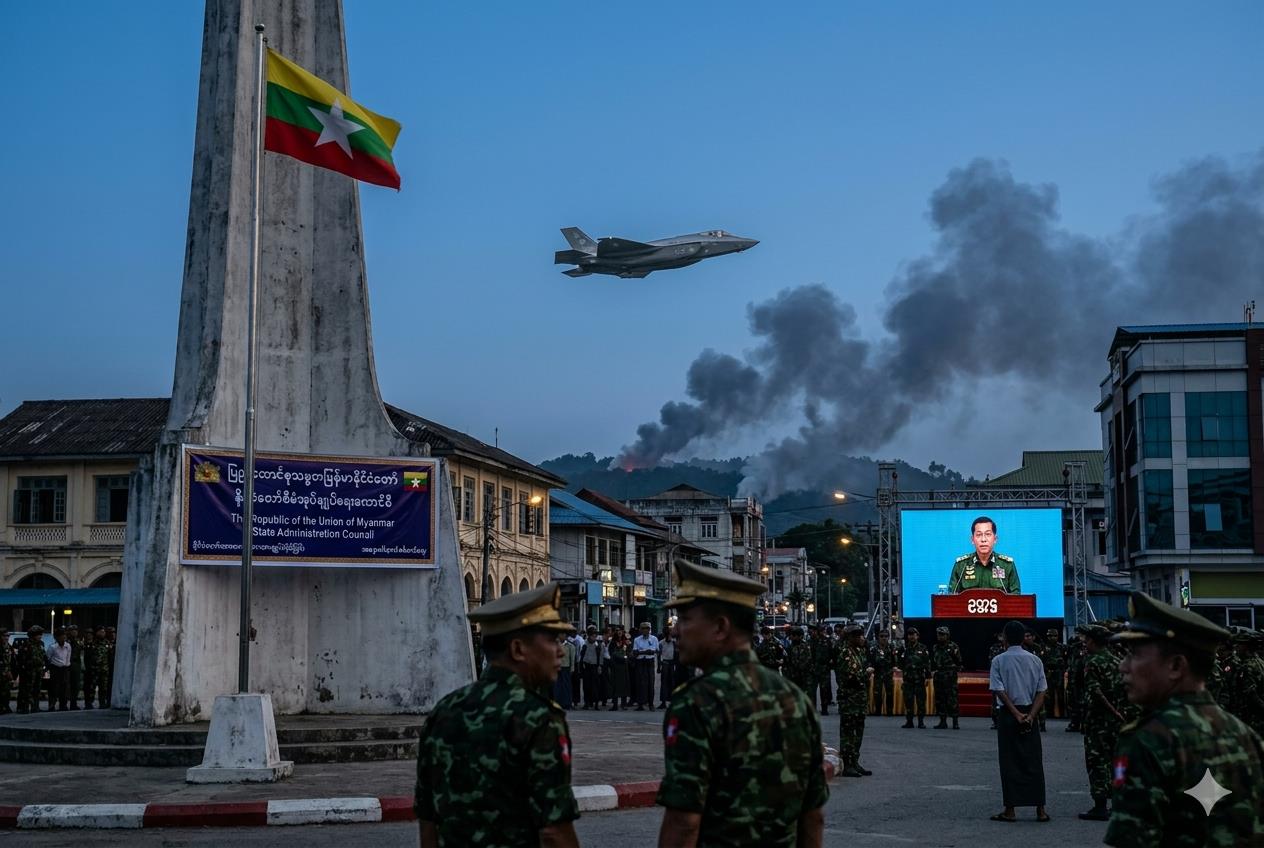
Senior General Min Aung Hlaing assumes presidency as military forces intensify aerial operations against ethnic resistance in the west.
April 15, 2026
Last Updated: 12:45 PM
By Global War News Editorial
The Myanmar military administration has formalised a significant internal restructuring, with Senior General Min Aung Hlaing officially assuming the role of Acting President. This consolidation of political authority occurs as the military, known as the Tatmadaw, reportedly intensifies its use of airpower to combat the Arakan Army (AA) in Rakhine State, where territorial control remains highly contested.
According to official state media reports from Naypyidaw, the transition was framed as a necessary measure to “ensure administrative continuity” during the ongoing national state of emergency. However, the move has been widely interpreted by international observers as an effort to solidify the military’s legal standing ahead of proposed, though frequently delayed, national elections.
On the ground, the humanitarian situation in western Myanmar continues to deteriorate. Local sources and human rights organisations have reported a surge in airstrikes targeting townships around Sittwe, though these reports have not been independently confirmed by international agencies.
The Presidency and Political Realignment
The assumption of the presidency by Min Aung Hlaing follows a series of extensions to the emergency rule that began in February 2021. According to a statement released by the National Defence and Security Council (NDSC), the General will hold the post to oversee “peace and stability operations” across the country.
The United Nations Special Rapporteur on the situation of human rights in Myanmar noted in a recent briefing that the central government’s control appears increasingly concentrated within the military leadership as it faces unprecedented challenges from a coalition of ethnic armed organisations (EAOs) and People’s Defence Forces (PDFs).
Conflict Escalation in Rakhine State
In Rakhine State, the conflict between the military and the Arakan Army has reached a critical phase. According to Reuters, the AA has claimed control over several key trade routes near the border with Bangladesh. In response, the military has increasingly relied on its air force to strike suspected rebel positions.
The Associated Press reported that as many as 20,000 civilians have been displaced in the last week alone due to the proximity of aerial bombardments to residential areas. While the military government states its operations only target “terrorist infrastructure,” the high frequency of strikes has led to significant damage to civilian property.
The Arakan Army, in a statement published on their official media channels, alleged that the military is using “scorched earth” tactics to prevent the group from establishing a parallel administration. These claims remain contested by the state, which maintains that it is restoring the rule of law.
Analysis: A Strategy of Concentration
The decision to consolidate the presidency and the military command into a single office suggests a narrowing of the government’s political strategy. By unifying these roles, Min Aung Hlaing may be attempting to present a single face of authority to international partners, such as those within ASEAN, while maintaining absolute control over the armed forces.
However, analysts note that this political consolidation does not necessarily translate to military success. This raises questions about whether the reliance on airstrikes indicates a lack of sufficient ground troops to hold territory in Rakhine and other border states. Observers suggest that while the military can strike from the air, the loss of ground-level administrative control to ethnic groups like the AA continues to erode the government’s tax revenue and territorial integrity.
It remains unclear if the military’s current trajectory will lead to the promised elections or if the “acting” nature of the presidency will become a permanent fixture of the regime.
What to Watch
The international community will be closely monitoring the upcoming ASEAN summit for any change in the regional stance toward Myanmar’s new leadership structure. Additionally, the potential for the conflict in Rakhine to spill over into neighbouring Bangladesh remains a high-risk factor. For now, the focus is on whether the Arakan Army can maintain its administrative hold over captured territories in the face of sustained aerial pressure from the military government.
Sources: Myanmar State Media (Global New Light of Myanmar), Reuters, Associated Press, United Nations Special Rapporteur Reports, ASEAN Secretariat Statements.
This article is based on publicly available reporting from named international news agencies and attributed official statements. All claims about ongoing events are attributed to their original sources. Analysis sections represent the editorial interpretation of reported facts and do not constitute advocacy for any party to the described conflict. AI tools may be utilized for image generation to assist in explaining complex concepts, as well as for refining grammar, spelling, and other linguistic enhancements. However, all original content is produced, fact-checked, and revised by the editorial team. This publication does not take political positions on active military conflicts.