
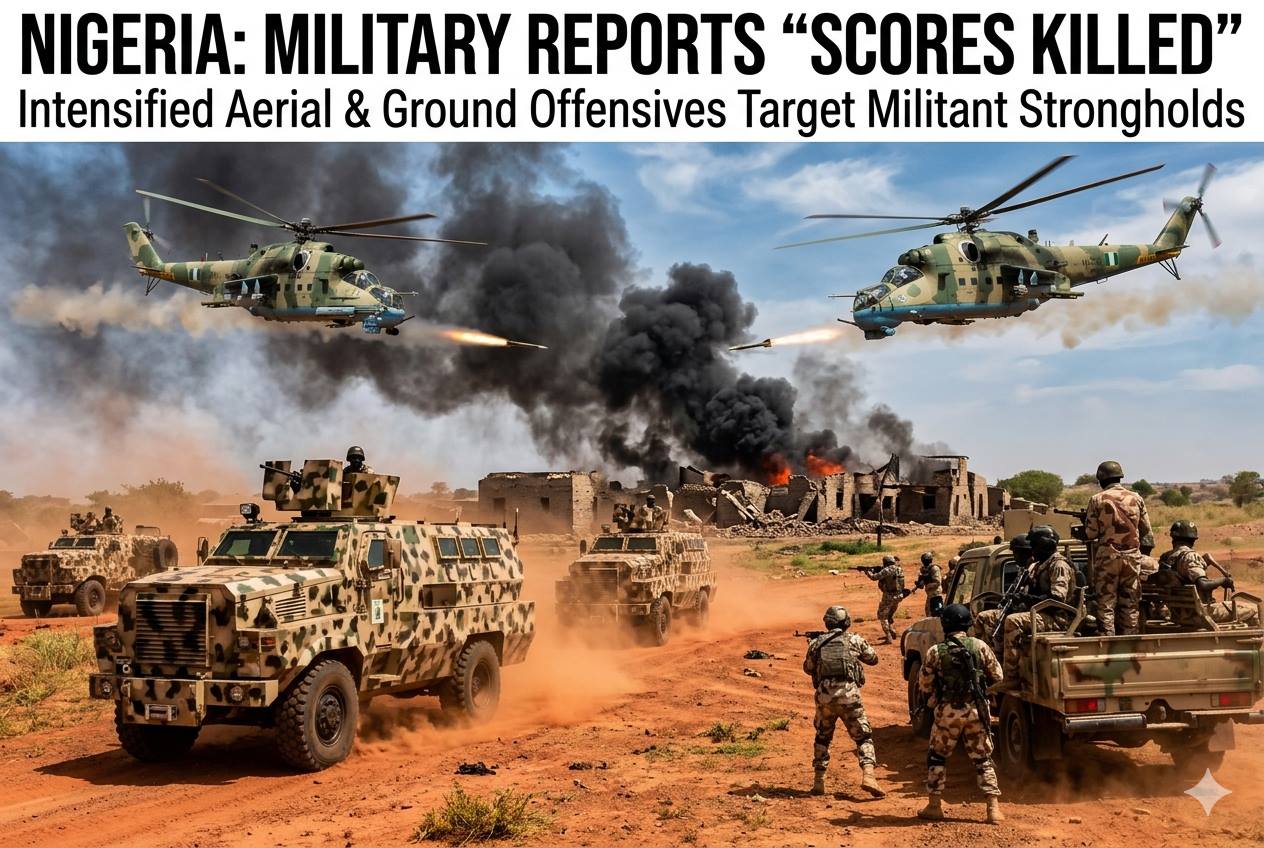
Armed forces ramp up aerial and ground offensives in the northern regions following a spike in insurgent activity and attacks on security personnel.
Published: April 15, 2026
Last Updated: April 15, 2026
By Global War News Editorial
The Nigerian Defence Headquarters has reported that “scores” of insurgents were neutralized during a series of high-intensity operations conducted between April 13 and April 14, 2026. The strikes, concentrated in the northern Borno and Yobe states, represent an escalation in the military’s effort to degrade the operational capabilities of Boko Haram and the Islamic State West Africa Province (ISWAP).
The operations follow a period of heightened tension in the region, including a deadly ambush on a military base in Borno earlier this month that resulted in the death of a senior army general. In response, the Air Component of the Joint Task Force (North East) has focused its efforts on “notorious hubs” and logistics centers used by militant groups to facilitate attacks on civilian and military targets.
Precision Strikes in the Jilli Axis
A primary focus of the recent campaign was the Jilli general area, a border community between Gubio in Borno State and Geidam in Yobe State. On April 11 and continuing through the weekend of April 13, the Air Component of Operation Hadin Kai conducted precision airstrikes on what military officials described as an insurgent enclave.
Borno State Governor Babagana Zulum confirmed the strikes on the Jilli market area, stating publicly that the location had become a “notorious hub” for insurgents and their logistics suppliers. While the government officially closed the market years ago, unverified reports suggested it had continued to operate as a black-market exchange for fuel and food redirected to forest hideouts.
Conflicting Reports on Civilian Impact
As with many recent aerial campaigns in the North West and North East, reports concerning the nature of the casualties differ. While the Nigerian military maintains that those killed were “terrorists” embedded in the enclaves, local sources and rights groups have raised concerns about potential civilian presence.
According to reporting from the New York Times and ACLED, some local residents claimed that airstrikes in nearby sectors had hit busy market areas, resulting in the deaths of non-combatants. The Nigerian Defence Headquarters has consistently denied targeting civilians, asserting that all strikes are based on verified intelligence regarding militant movements.
The Evolving Insurgent Landscape
The intensified operations come as Nigeria continues to grapple with a multi-front security crisis. The 2026 Global Terrorism Index recently ranked Nigeria fourth globally for terrorist attacks, noting that despite consistent military pressure, groups like ISWAP have adapted by embedding more deeply within local communities and exploiting ungoverned spaces.
Recent developments include:
- The Rise of Lakurawa: A newer insurgent group known as “Lakurawa” has reportedly begun operating in the border regions near Niger, complicating the security map.
- Foreign Mercenary Involvement: Some reports suggest the Nigerian government has explored the use of specialized tactical groups to augment state forces in the Lake Chad basin.
- Infrastructure Sabotage: Beyond direct combat, militants have increasingly targeted telecommunications and power infrastructure to isolate rural communities.
Analysis: The Strategy of Attrition
Military analysts suggest that the current “intensified” phase is an attempt to prevent insurgent groups from reorganizing following a series of high-profile losses earlier in the year. Observers note that by targeting logistics hubs like Jilli, the military aims to starve militant factions of the fuel and medical supplies necessary to sustain operations during the upcoming rainy season.
However, the “scores killed” metric remains a contested measure of success. Critics argue that without a significant increase in ground-holding forces to occupy “liberated” territories, the vacuum created by airstrikes is often quickly filled by splinter cells. This raises questions about whether the current momentum can be translated into long-term regional stability.
What to Watch
The military hierarchy has signaled that operations will continue throughout the week, with a specific focus on the Sambisa Forest and the Tumbuktu Triangle. Key indicators of progress will be the reopening of safe corridors for displaced persons and the ability of the state to maintain a permanent security presence in the border towns currently under heavy bombardment.
Sources:
This report is based on official statements from the Nigerian Defence Headquarters, the Borno State Government, and the Federal Ministry of Information. Additional data and contextual reporting were provided by the Global Terrorism Index 2026, Amnesty International, the New York Times, and DW News.
This article is based on publicly available reporting from named international news agencies and attributed official statements. All claims about ongoing events are attributed to their original sources. Analysis sections represent the editorial interpretation of reported facts and do not constitute advocacy for any party to the described conflict. AI tools may be utilized for image generation to assist in explaining complex concepts, as well as for refining grammar, spelling, and other linguistic enhancements. However, all original content is produced, fact-checked, and revised by the editorial team. This publication does not take political positions on active military conflicts.