
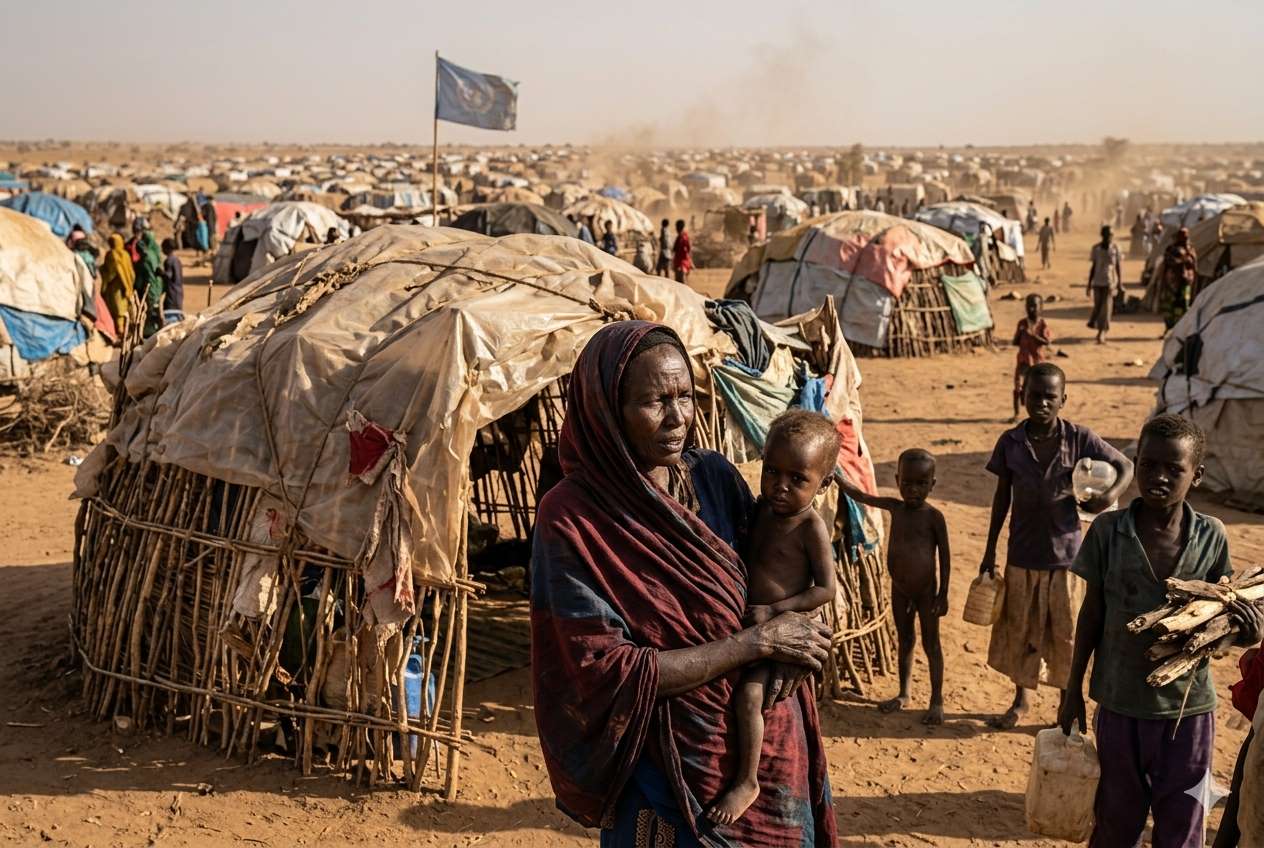
UN reports warn of an “abandoned crisis” with mass displacement and confirmed famine conditions in North Darfur.
April 16, 2026
Last Updated: 11:15 AM
By Global War News Editorial
The security situation across Sudan’s Greater Darfur region remains profoundly unstable as the national conflict enters its fourth year. According to the United Nations and international humanitarian agencies, recent escalations in North and South Darfur have driven a new wave of displacement, pushing the total number of internally displaced persons (IDPs) in Sudan toward 9 million. UN Humanitarian Coordinator Denise Brown recently described the situation as an “abandoned crisis,” citing a grim pattern of repeated abuses and a significant lack of international attention.
The instability is most acute in North Darfur, where the Rapid Support Forces (RSF) have reportedly advanced into new localities, including Um Baru and Kernoi. These movements have forced thousands of civilians to flee toward the Chadian border or into rural areas where basic services are non-existent. Verified reports from the UN indicate that the epicentre of the catastrophe remains El Fasher, where large-scale killings were reported following an RSF assault late last year, leaving the remaining population trapped in a city facing catastrophic food shortages.
Escalation of Violence and Famine Conditions
The security vacuum in Darfur has led to what humanitarian groups describe as a “systemic dismantling” of civilian life. According to a recent alert from the Integrated Food Security Phase Classification (IPC), famine thresholds for acute malnutrition have been surpassed in several localities. Famine has been confirmed in El Fasher and Kadugli, with risk levels rising in surrounding areas as active fighting prevents the planting and harvesting of crops.
According to UNICEF, the first 90 days of 2026 have seen a 50 percent increase in child casualties compared to the same period last year. The agency reported that at least 160 children were killed and 85 maimed between January and March, with the highest casualties recorded in Darfur and Kordofan. UNICEF Executive Director Catherine Russell stated that the ongoing violence reflects a “collective failure” to protect basic human rights as schools and hospitals continue to come under attack.
Humanitarian Access and Border Constraints
Logistical challenges are severely hindering relief efforts. ReliefWeb reports indicate that humanitarian access in Darfur is “persistently elevated” but slowed by continued attacks on aid operations. The closure of shared borders, specifically the Adré and Tine crossing points by Chad, has added a layer of bureaucratic and logistical constraint to the supply chain. While the UN continues to negotiate for cross-border aid movements, the security of humanitarian convoys is frequently compromised by the increasing use of aerial drone warfare.
In eastern Chad, the pressure is reaching a breaking point. The UN Refugee Agency (UNHCR) and the World Food Programme (WFP) warned on April 9, 2026, that more than a million Sudanese refugees face “immediate and life-threatening cuts” to food and water due to a $428 million funding shortfall. One in three people in eastern Chad is now a refugee, placing an immense strain on the host country’s already fragile resources.
Analysis: The Regional Power Dynamic
Analysts suggest that the current stability of Darfur is being undermined by a shift in supply routes and outside patronage. The RSF’s reported capture of the tri-border region linking Sudan with Egypt and Libya has allowed for a more direct supply route from southern Libya, reducing reliance on eastern Chad for logistics. This maneuver suggests that the paramilitary group is consolidating its control over the western corridor, potentially preparing for a prolonged administrative hold over the region.
Observers note that the fragmentation of the political landscape in Sudan has made mediation efforts exceptionally difficult. Both the Sudanese Armed Forces (SAF) and the RSF appear to believe in the possibility of a military victory through attrition, leading to a rejection of would-be mediators. This cycle of escalation is exacerbated by external backers, which analysts from the Crisis Group suggest has locked the parties into a “war of position” that prioritizes territorial control over civilian safety.
Current Outlook
As an international conference on Sudan convenes in Berlin this week, the immediate outlook for Darfur remains bleak. Humanitarian agencies are appealing for nearly $3 billion in funding for 2026, yet as of mid-April, less than 10 percent of the required resources have been received. Without a cessation of hostilities and a significant scale-up in aid, the UN warns that preventable deaths from hunger and disease will continue to rise exponentially in the coming months.
Sources: This article is based on reports and public statements from the UN Humanitarian Coordinator (OCHA), UNICEF, UNHCR, the World Food Programme (WFP), the International Organization for Migration (IOM), Médecins Sans Frontières (MSF), and the International Crisis Group.
This article is based on publicly available reporting from named international news agencies and attributed official statements. All claims about ongoing events are attributed to their original sources. Analysis sections represent the editorial interpretation of reported facts and do not constitute advocacy for any party to the described conflict. AI tools may be utilized for image generation to assist in explaining complex concepts, as well as for refining grammar, spelling, and other linguistic enhancements. However, all original content is produced, fact-checked, and revised by the editorial team. This publication does not take political positions on active military conflicts.