
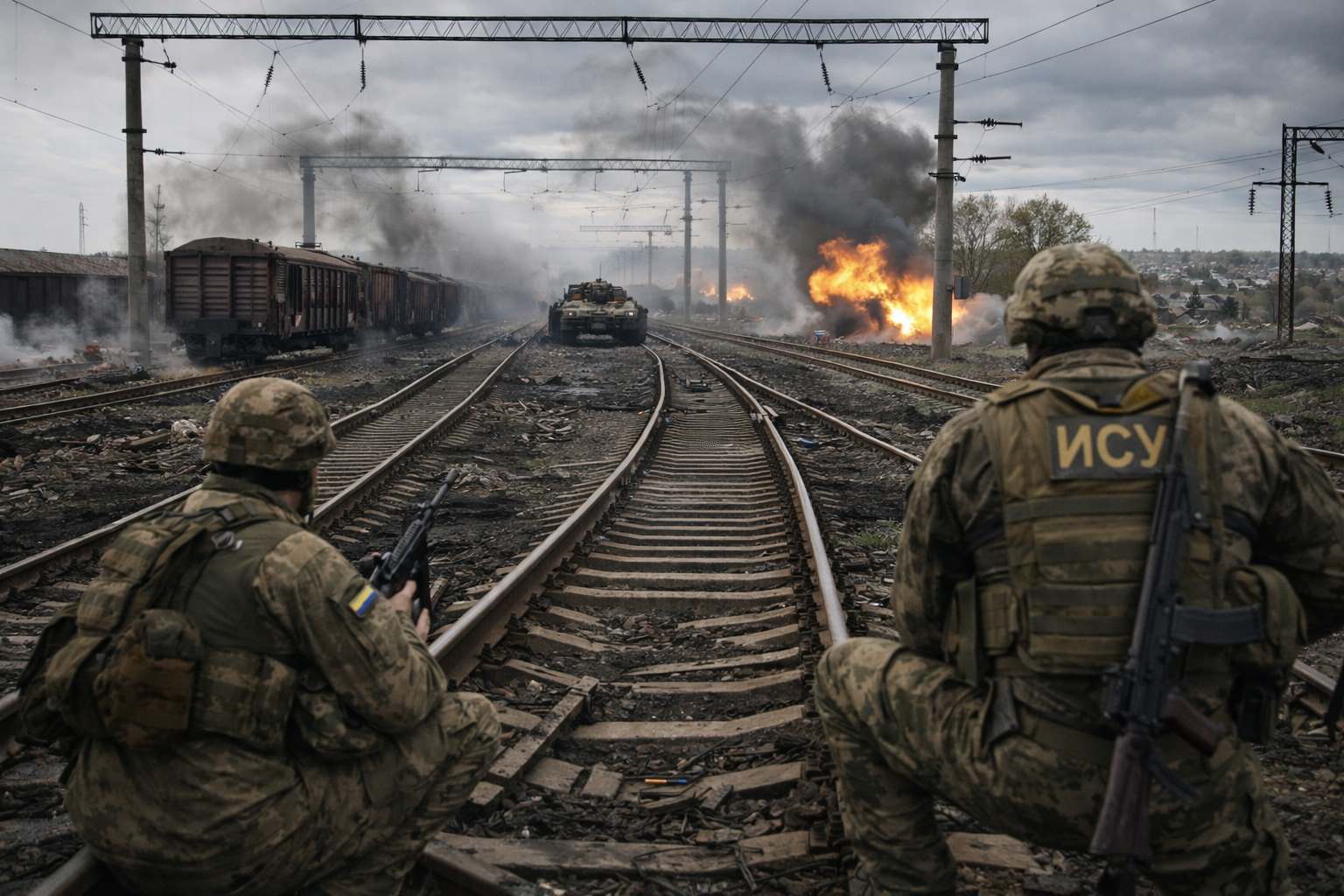
As frontlines stabilize near the Pokrovsk-Myrnohrad sector, the battle for railway infrastructure has become the primary driver of regional economic and military sustainability.
April 16, 2026
Last Updated: 04:30 PM
By Staff Writer, Global War News
In the industrial heartland of the Donbas, the current tactical situation has evolved into a high-stakes struggle for the control of railway junctions and “heavy” logistics lines. According to the latest battlefield mapping data from the Institute for the Study of War (ISW) and geolocated updates from regional military observers, the conflict is increasingly characterized by “junction warfare”—strikes and maneuvers specifically designed to sever or secure the rail networks that sustain large-scale troop movements and resource extraction.
The focus remains on the strategic “fortress belt” consisting of Druzhkivka, Kostiantynivka, Kramatorsk, and Sloviansk. According to official Ukrainian regional administration briefings, this belt represents the strongest defensive line remaining in the Donetsk region, primarily due to its integrated rail infrastructure. However, reports from the Russian Ministry of Defence suggest a concerted effort to bypass frontal assaults in favor of cutting the supply arteries that feed these urban centers.
The Battle for the Pokrovsk-Myrnohrad Hub
Pokrovsk has emerged as the central logistical anchor for defending forces in the southern Donbas. According to analysis by RBC-Ukraine, the city serves as the primary gateway for rail-borne supplies arriving from the Dnipropetrovsk region. Military observers note that the recent Russian advances into the outskirts of Myrnohrad aim to place the main Pokrovsk-Kostiantynivka rail line within range of standard tube artillery.
Verified geolocated footage published on April 15 indicates that while the rail station in Pokrovsk remains under Ukrainian control, the frequency of “interdiction strikes”—aerial attacks intended to disrupt moving trains—has reached a monthly high. According to data from the Armed Conflict Location & Event Data Project (ACLED), the first week of April saw 13 distinct strikes on railway assets across the eastern front, a figure significantly higher than the 2025 average.
Railway Sabotage and Interdiction
The “War of Junctions” is not limited to the frontlines. According to reports from the Ukrainian Railways (Ukrzaliznytsia), at least 41 railway assets were damaged by drone and missile strikes between April 1 and April 14. These strikes have not only complicated military logistics but have also crippled the movement of coal and industrial goods, which remain vital to the local war economy.
According to a spokesperson for the Ukrainian Joint Forces Task Force, the tactical shift toward “logistics-based combat” is a response to the static nature of the trenches. The spokesperson stated that by targeting railway substations and loading docks, opposing forces aim to create “supply droughts” that force withdrawals without the need for high-casualty urban fighting.
Analysis: The Logistics-Strategy Disconnect
Military analysts suggest that the emphasis on rail control reflects a fundamental reality of Donbas geography. The region’s heavy industry was built around a dense railway grid; without these tracks, the ability to move heavy artillery ammunition and armored reinforcements is severely diminished.
However, observers note a disconnect between tactical gains and logistical sustainability. While Russian forces have reportedly made incremental gains near Kostiantynivka, the high casualty rate—estimated by some Ukrainian officials at over 300 personnel per square kilometer of advance in early 2026—suggests that the cost of securing these rail hubs is becoming prohibitive. Conversely, the Ukrainian defense relies on a “distributed logistics” model, using smaller truck convoys to mitigate the impact of rail strikes, though this is less efficient for moving the heavy tonnages required for sustained defense.
Economic Implications for the Donbas
The systematic targeting of rail links has had a devastating impact on the regional economy. According to data from the World Bank, the cessation of heavy rail traffic in contested zones has led to a 60% drop in industrial output from the remaining functional factories in the Donetsk region.
- Supply Chain Disruptions: The severing of the Siversk-Bakhmut line has effectively isolated small-scale mining operations, leading to localized economic collapses.
- Humanitarian Access: UN humanitarian coordinators have warned that the degradation of rail infrastructure makes the delivery of bulk aid—such as heating fuel and grain—increasingly dangerous and expensive.
Current Status and Outlook
As of mid-April, the “fortress belt” remains intact, but the logistics routes sustaining it are under the greatest pressure since the start of the 2024 winter offensive. Battlefield mapping indicates that the “gray zones” are increasingly moving toward the railway embankments themselves.
The immediate outlook suggests a continued focus on Myrnohrad and Kostiantynivka. If the rail link between these two hubs is severed, defending forces will be forced to rely on a single secondary road network, significantly increasing the vulnerability of their supply chain to drone and artillery interdiction.
Sources: This article is based on geolocated mapping data from the Institute for the Study of War (ISW), ACLED conflict monitoring, official statements from the Ukrainian Ministry of Infrastructure and the Russian Ministry of Defence, and reporting from RBC-Ukraine and Reuters.
This article is based on publicly available reporting from named international news agencies and attributed official statements. All claims about ongoing events are attributed to their original sources. Analysis sections represent the editorial interpretation of reported facts and do not constitute advocacy for any party to the described conflict. AI tools may be utilized for image generation to assist in explaining complex concepts, as well as for refining grammar, spelling, and other linguistic enhancements. However, all original content is produced, fact-checked, and revised by the editorial team. This publication does not take political positions on active military conflicts.