
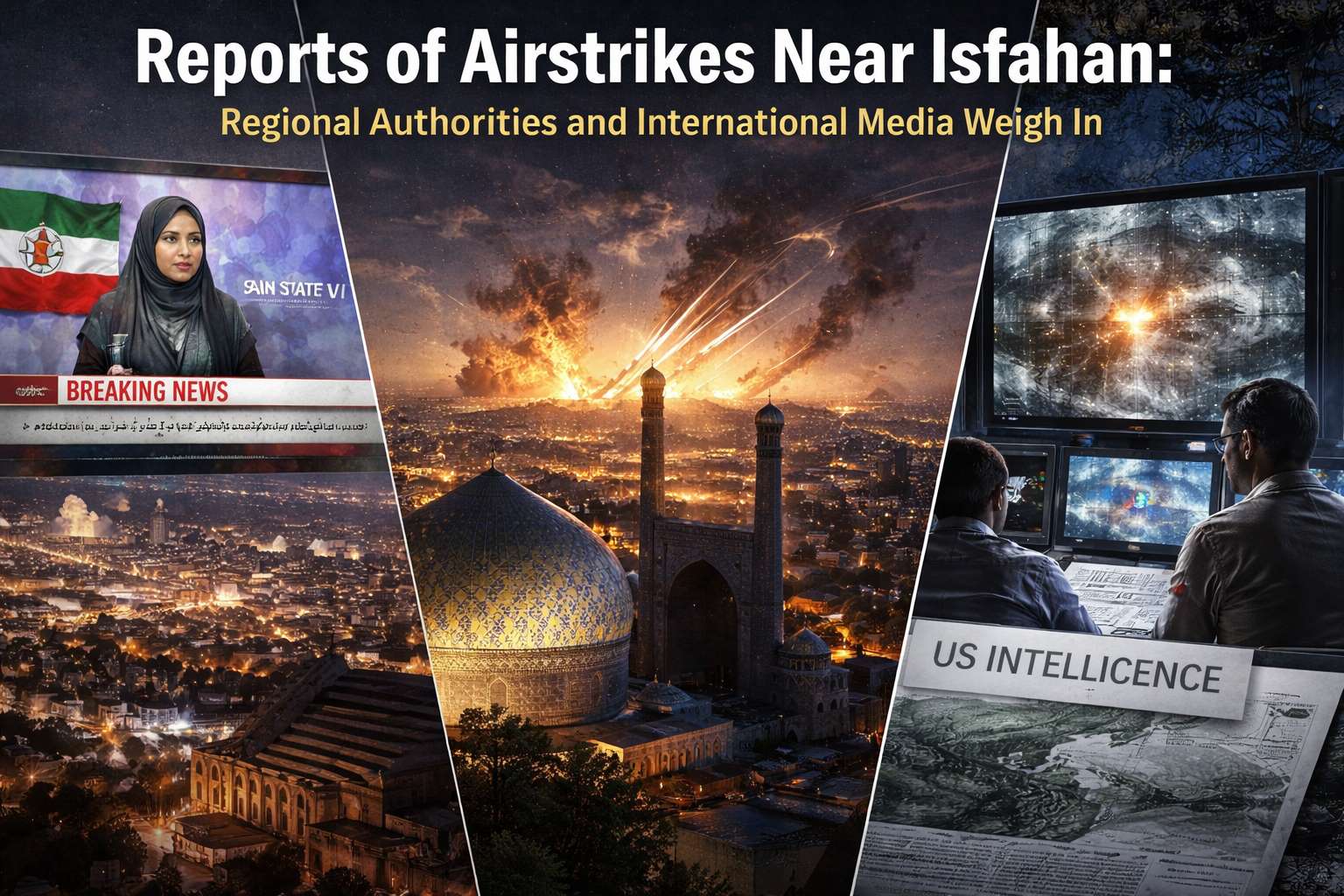
Attributing claims from Iranian state media and US intelligence officials regarding recent overnight activity.
Publication date: April 17, 2026
Last updated: April 17, 2026
Byline: Staff Writer, Global War News
The city of Isfahan, a central hub for Iran’s military and nuclear infrastructure, has reportedly been the site of significant overnight activity amid a fragile and increasingly tense ceasefire. While regional authorities in Iran describe the incident as a successful defense against a limited infiltration attempt, international media outlets, citing United States intelligence officials, suggest a more complex military operation.
These reports emerge just days after the collapse of diplomatic negotiations in Islamabad on April 12. The city remains a point of intense global focus due to the presence of the Isfahan Nuclear Technology Center (ENTC), which international monitors believe houses the majority of Iran’s highly enriched uranium.
Conflicting Accounts of the Incident
Iranian state media, including the Islamic Republic News Agency (IRNA), reported that air defense batteries were activated south of the city in the Mahyar area. According to a statement from Brigadier General Mohammad Akraminia, a spokesman for the Iranian army, the activity was a response to an “infiltration attempt” by hostile aircraft.
General Akraminia confirmed that four Iranian servicemen, including General Masoud Zare, a senior commander at the Air Defense Faculty, were killed during the engagement. The Iranian account asserts that their forces targeted a US Lockheed C-130 Hercules with a shoulder-fired missile, forcing what they described as “enemy forces” to retreat.
Conversely, US intelligence officials, speaking to international news agencies on the condition of anonymity, provided a different narrative. These officials indicated that the activity was part of a high-priority “rescue and recovery” operation. According to these claims, the mission was launched to retrieve the crew of an American F-15E fighter jet that had been shot down earlier in the month. US President Donald Trump later stated on social media that two crew members were successfully rescued during the operation.
Strategic Importance of the Isfahan Complex
The intensity of the engagement in Isfahan is tied directly to the strategic value of the local infrastructure. Analysts note that Isfahan is home to some of Iran’s most critical defense and research assets.
- Nuclear Technology Center (ENTC): Independent monitors from the Institute for Science and International Security have reported that this facility likely serves as the primary repository for Iran’s stockpile of highly enriched uranium.
- Khatam al-Anbiya Air Defense Base: This site coordinates the protection of central Iran’s airspace and has been a frequent target during the 40-day campaign that preceded the current ceasefire.
- Missile Production Sites: Isfahan’s industrial periphery is believed to house facilities linked to the production of the “Khordad 15” surface-to-air missile systems.
Analysis: The Fragility of the April Ceasefire
The overnight clashes in Isfahan highlight the extreme fragility of the ceasefire that took effect on April 8. While both sides have officially refrained from launching new large-scale offensive campaigns, the definition of “defensive” or “recovery” operations remains a point of violent contention.
Observers note that the collapse of the Islamabad talks has left a diplomatic vacuum. Israeli Prime Minister Benjamin Netanyahu recently stated that any enriched material remaining in Isfahan “will leave Iran,” either by agreement or renewed force. This suggests that the overnight activity may not be an isolated incident, but rather a precursor to a new phase of the conflict focused specifically on the Iranian nuclear stockpile.
From an economic perspective, the persistent threat of strikes in central Iran continues to destabilize global energy markets. Although Isfahan is not a primary oil production site, its proximity to major transit routes and its role in national defense means that any escalation there signals a broader risk to regional stability.
Context and Background: The “Midnight Hammer” Campaign
To understand the current tension, it is necessary to recall the “Midnight Hammer” operations conducted in early 2026. This joint US-Israeli campaign targeted over 4,000 sites across Iran, significantly degrading the country’s conventional air defenses and command-and-control networks.
The current atmosphere in Isfahan is a direct legacy of this campaign. Iranian forces are reportedly in a state of “full readiness,” with local commanders emphasizing that any perceived ground or air infiltration will be met with immediate kinetic force.
Looking Ahead
As the current ceasefire approaches its expiration date, the international community is monitoring Isfahan for any signs of movement at the nuclear complex. Satellite imagery analyzed by independent experts has previously shown flatbed trucks and blue containers at the site, fueling speculation about the relocation of nuclear materials. Until a new diplomatic framework is established, Isfahan remains the most likely flashpoint for a return to full-scale hostilities.
Sources: This report utilizes data and attributed statements from the Iranian state news agency IRNA, US Central Command (CENTCOM), the Institute for Science and International Security, the Institute for the Study of War (ISW), Reuters, and the Associated Press.
This article is based on publicly available reporting from named international news agencies and attributed official statements. All claims about ongoing events are attributed to their original sources. Analysis sections represent the editorial interpretation of reported facts and do not constitute advocacy for any party to the described conflict. AI tools may be utilized for image generation to assist in explaining complex concepts, as well as for refining grammar, spelling, and other linguistic enhancements. However, all original content is produced, fact-checked, and revised by the editorial team. This publication does not take political positions on active military conflicts.