
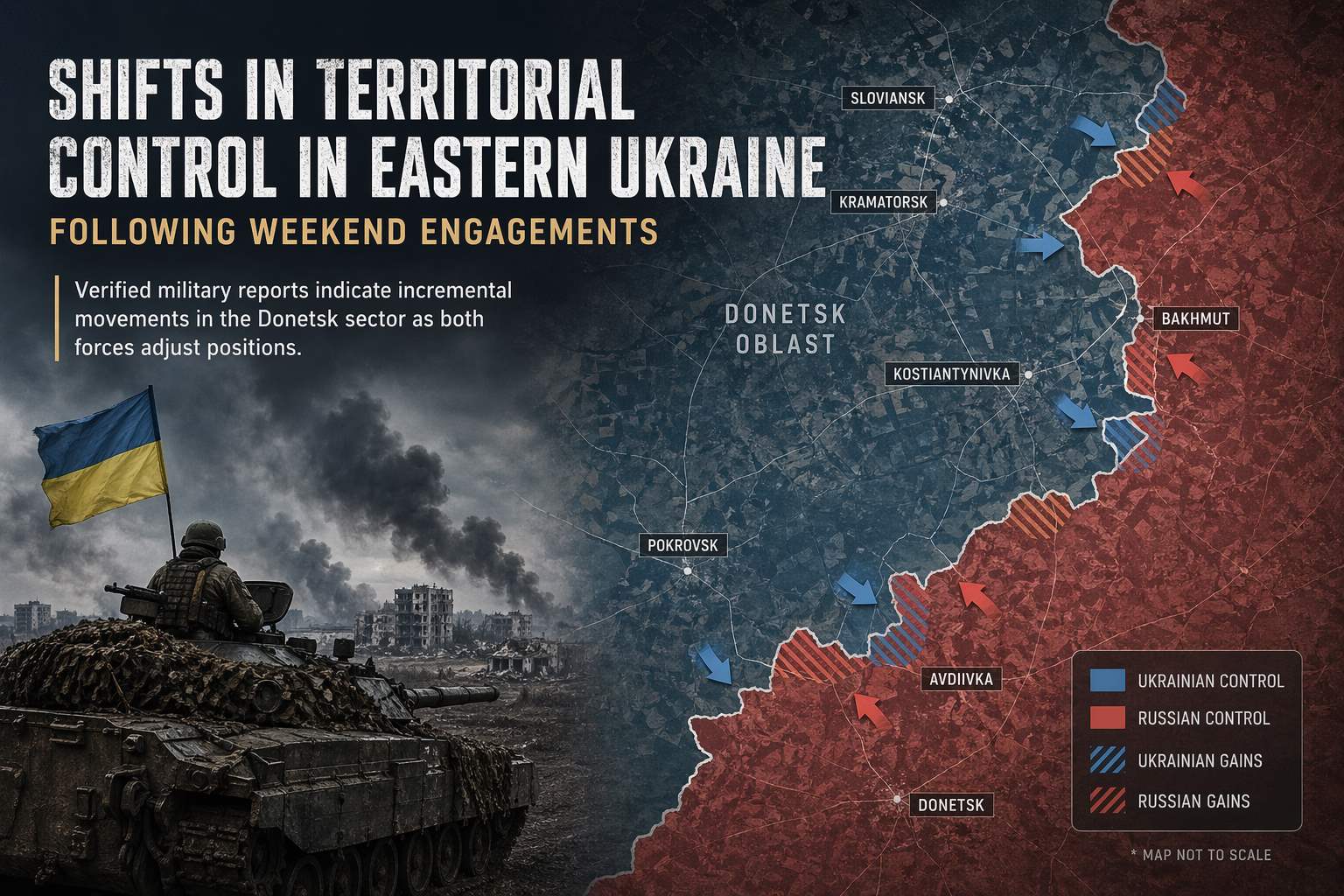
Verified military reports indicate incremental movements in the Donetsk sector as both forces adjust positions.
April 21, 2026
By Global War News Editorial
Renewed military activity across the Donetsk sector over the past 48 hours has resulted in localized changes to the frontline. According to official briefings from both the Ukrainian General Staff and the Russian Ministry of Defence, the engagements focused on established flashpoints where defensive lines have been under persistent pressure for several weeks.
The weekend’s developments do not indicate a broad collapse of defensive perimeters but rather a series of tactical shifts. Reports suggest that while Russian units have made incremental gains in the outskirts of key logistics hubs, Ukrainian forces have successfully repositioned to secondary defensive lines to maintain structural integrity.
The strategic focus remains on the supply corridors and elevated terrain surrounding central Donetsk. As the spring thaw begins to affect ground mobility, the nature of these engagements is shifting from rapid maneuvers to concentrated artillery exchanges and localized infantry assaults.
Reported Developments in the Donetsk Sector
According to the morning briefing from the Ukrainian General Staff, their units repelled over 20 attacks in the vicinity of the Bakhmut and Avdiivka axes. The statement noted that Ukrainian forces conducted “planned maneuvers” to move to more advantageous positions in specific sub-sectors, a term often used to describe tactical withdrawals under pressure.
Simultaneously, the Russian Ministry of Defence claimed in its daily bulletin that its units had “improved their forward edge” in the direction of Chasiv Yar. The ministry asserted that several defensive strongpoints had been neutralized, though these claims have not been independently verified by international observers on the ground.
Independent open-source intelligence (OSINT) analysts, including those from the Institute for the Study of War, noted that geolocated footage confirms minor Russian advancements in the industrial zones of the southern Donetsk front. However, these analysts also emphasized that the rate of territorial change remains slow, with gains measured in hundreds of meters rather than kilometers.
Logistics and Fortification
The significance of the weekend’s movements lies in the proximity of the fighting to critical rail and road links. If Russian forces continue to consolidate control over the high ground in the Donetsk sector, the ability of Ukrainian forces to resupply forward positions may be compromised.
Conversely, the Ukrainian military stated that their defensive fortifications further west are fully manned. Reports from local regional administrations, as cited by national news agencies, indicate that engineering units have been working to reinforce these secondary lines throughout the winter months.
Economic Impact of Prolonged Engagements
The continued intensity of the fighting in the Donbas region has immediate implications for the broader Ukrainian economy. According to a recent assessment by the World Bank, the destruction of industrial infrastructure in the East continues to hamper national steel and mining output.
Furthermore, the regional instability affects global grain markets. While the primary export hubs are in the South, the labor and logistics resources diverted to the Eastern front create bottlenecks in the domestic supply chain. Analysts from the IMF have suggested that the cost of maintaining these defensive lines remains the single largest factor in Ukraine’s current fiscal deficit.
Analysis: What This Could Mean
The weekend’s shifts suggest a period of high-intensity attrition rather than a decisive breakthrough for either side. Observers note that the Russian strategy appears to be focused on stretching Ukrainian reserves by attacking multiple points along the Donetsk arc simultaneously.
This raises questions about the sustainability of current defensive postures. If the Ukrainian military continues to trade space for time, the focus will eventually shift to the defense of larger urban centers further west. It remains unclear whether the reported Russian gains are sustainable or if they will lead to a culminating point where offensive momentum is lost due to high equipment and personnel losses.
Closing Summary
As of April 21, 2026, the frontline in eastern Ukraine remains fluid but largely defined by incremental changes. The focus now turns to whether Ukrainian forces can stabilize the new positions or if the Russian military will seek to exploit the weekend’s gains before the ground becomes too soft for heavy armor. We are monitoring official statements from both ministries for further updates on territorial control.
Sources: This report relies on official daily briefings from the General Staff of the Armed Forces of Ukraine and the Ministry of Defence of the Russian Federation. Additional context was provided by reports from Reuters, the Associated Press, and independent data from the Institute for the Study of War. Economic figures are sourced from public IMF and World Bank assessments.
This article is based on publicly available reporting from named international news agencies and attributed official statements. All claims about ongoing events are attributed to their original sources. Analysis sections represent the editorial interpretation of reported facts and do not constitute advocacy for any party to the described conflict. AI tools may be utilized for image generation to assist in explaining complex concepts, as well as for refining grammar, spelling, and other linguistic enhancements. However, all original content is produced, fact-checked, and revised by the editorial team. This publication does not take political positions on active military conflicts.