
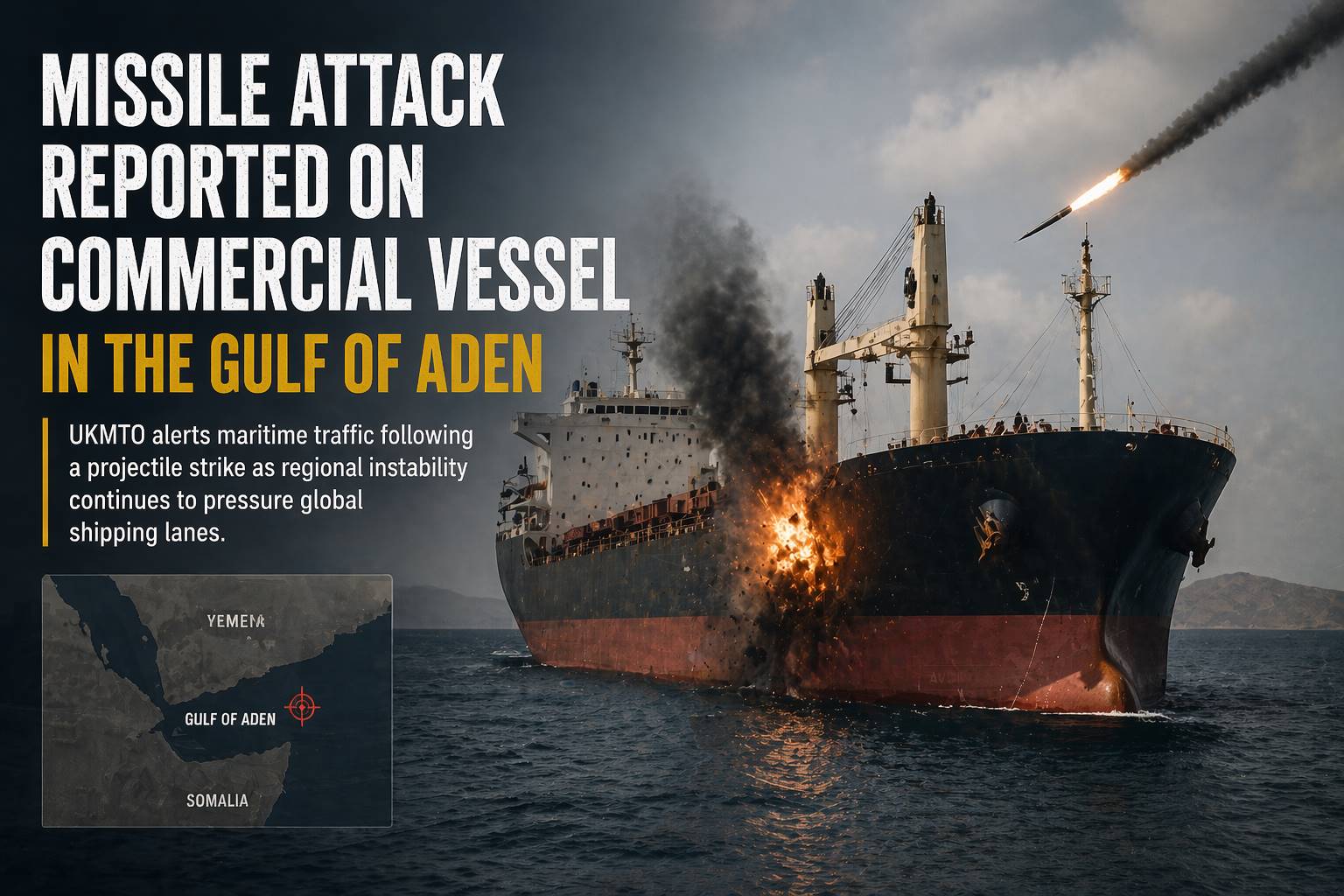
UKMTO alerts maritime traffic following a projectile strike as regional instability continues to pressure global shipping lanes.
April 21, 2026
By Staff Writer, Global War News
A commercial vessel transiting the Gulf of Aden was reportedly targeted by a missile on Tuesday, according to an advisory from the United Kingdom Maritime Trade Operations (UKMTO). The incident, which occurred in a high-traffic corridor approximately 70 nautical miles southwest of Aden, marks a significant disruption in a region that has faced persistent maritime security threats for over three years.
Initial reports from the vessel’s master indicate that a projectile struck the ship, though no casualties among the crew have been reported. Military authorities are currently investigating the origin of the strike. While no group has immediately claimed responsibility, the geographical location and method of attack are consistent with previous operations attributed to Houthi militants based in Yemen.
Details of the Maritime Engagement
According to UKMTO Warning 041-2026, the vessel was struck while transiting eastbound. The master reported an explosion in close proximity to the hull, followed by a direct hit that caused localized structural damage above the waterline. The crew successfully implemented emergency protocols, and the vessel is reportedly continuing its voyage to its next port of call under its own power.
This incident follows a series of similar reports in April. On April 18, the UKMTO documented an attack on a container ship 25 nautical miles northeast of Oman, where unknown projectiles caused damage to cargo containers. The frequency of these events suggests that despite international naval presence, including the US-led Operation Prosperity Guardian, commercial shipping remains vulnerable to asymmetric missile and drone strikes.
Maritime Security Environment in 2026
The Gulf of Aden and the Bab el-Mandeb Strait remain designated as “Critical” threat zones by the Joint Maritime Information Center (JMIC). Security analysts note that the risk profile for 2026 has expanded to include a wider range of vessels.
- Targeting Criteria: According to the US Maritime Administration (MARAD), vessels with perceived links to Israel, the United Kingdom, or the United States remain at the highest risk. However, collateral damage from “splash” incidents—where missiles land near unrelated vessels—continues to be a major concern for the industry.
- Tactical Shifts: Reports from early 2026 indicate an increased use of unmanned surface vehicles (USVs) and low-altitude cruise missiles, which are more difficult for standard commercial radar systems to detect.
Economic Impact: Insurance and Rerouting
The continued volatility in the Gulf of Aden has direct consequences for the cost of global trade. Shipping analysts from Suaid Global suggest that as of April 2026, maritime insurance premiums for Red Sea transits remain at “war risk” levels, often exceeding 1% of the vessel’s total value per transit.
For many global carriers, the risk remains unpalatable. Approximately 12-15% of global trade typically passes through this corridor. In response to the persistent threat, major shipping lines have continued to divert a significant portion of their fleets around the Cape of Good Hope. This detour adds approximately 3,500 nautical miles and 10-14 days to voyages between Asia and Europe, leading to:
- Increased Fuel Costs: Longer routes result in higher carbon emissions and fuel consumption.
- Supply Chain Delays: Industries relying on “just-in-time” manufacturing face persistent inventory shortages.
- Freight Rate Inflation: Analysts project that Asia-to-Europe freight rates could remain 25-40% higher than pre-crisis levels through the remainder of 2026 if the security situation does not stabilize.
Analysis: The Sustainability of the Corridor
The strike on April 21 raises questions about the efficacy of current maritime protection strategies. While some carriers, including Maersk, had begun a cautious return to the Suez Canal route earlier this year, periodic successful strikes serve as a deterrent to a full normalization of trade.
Observers note that the Houthi leadership in Yemen has consistently linked these attacks to broader regional political developments. It remains unclear whether diplomatic efforts can decouple maritime security from land-based conflicts. Analysts suggest that until a durable regional ceasefire is achieved, the Gulf of Aden will likely remain a “restricted” corridor for a large segment of the global merchant fleet, cementing the Cape of Good Hope as the new standard for East-West logistics.
Closing Summary
As of Tuesday afternoon, military authorities continue to monitor the affected vessel. Maritime security firms advise all ships transiting the Gulf of Aden to maintain a high state of vigilance, limit AIS (Automatic Identification System) transmissions where appropriate, and report any suspicious activity immediately to the UKMTO.
Sources: This report is based on official maritime advisories from the United Kingdom Maritime Trade Operations (UKMTO), security bulletins from the US Maritime Administration (MARAD), and data from the Joint Maritime Information Center (JMIC). Economic analysis is supported by reports from Suaid Global and regional shipping news agencies.
This article is based on publicly available reporting from named international news agencies and attributed official statements. All claims about ongoing events are attributed to their original sources. Analysis sections represent the editorial interpretation of reported facts and do not constitute advocacy for any party to the described conflict. AI tools may be utilized for image generation to assist in explaining complex concepts, as well as for refining grammar, spelling, and other linguistic enhancements. However, all original content is produced, fact-checked, and revised by the editorial team. This publication does not take political positions on active military conflicts.