
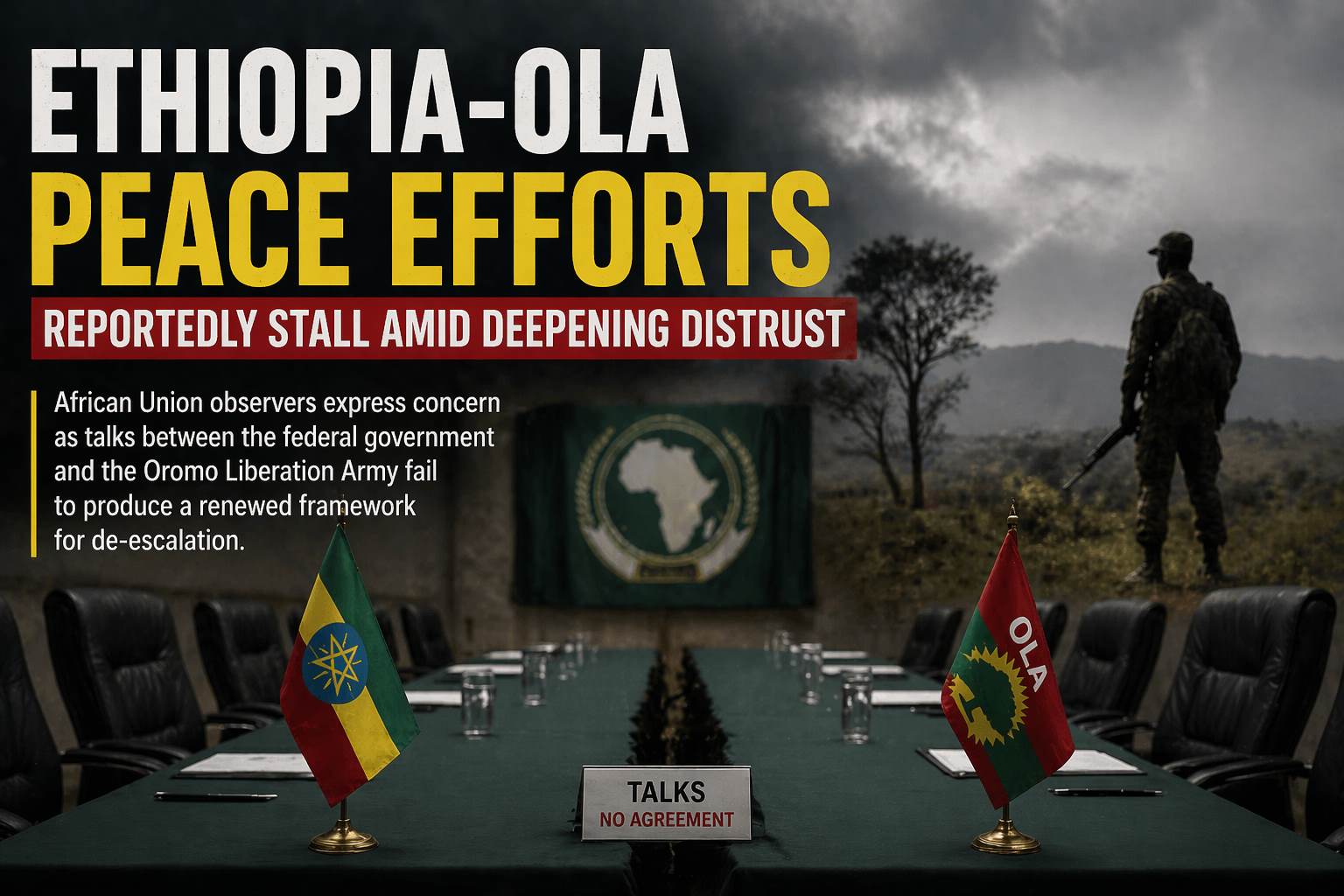
African Union observers express concern as talks between the federal government and the Oromo Liberation Army fail to produce a renewed framework for de-escalation.
April 21, 2026
By Staff Writer, Global War News
Efforts to achieve a diplomatic resolution to the protracted conflict in Ethiopia’s Oromia region have reportedly encountered a significant stalemate. According to briefings from African Union (AU) observers and regional diplomatic sources, recent indirect consultations between representatives of the Ethiopian Federal Government and the Oromo Liberation Army (OLA) have failed to establish a shared agenda for formal negotiations.
The impasse follows a series of unsuccessful high-level talks held over the past three years in Tanzania. While a localized agreement was signed in December 2024 between the Oromia Regional Government and select OLA elements, the central leadership of the OLA, which the Ethiopian parliament designated as a terrorist organization in 2021, remains at odds with Addis Ababa over fundamental political and security guarantees.
Key Obstacles to the Peace Process
According to reports from AU monitors familiar with the mediation efforts, the current deadlock stems from irreconcilable positions on transitional security and regional governance.
- Disarmament vs. Integration: The Ethiopian government maintains that the OLA must undergo full disarmament and demobilization before any political concessions are considered. Conversely, OLA representatives have reportedly demanded the integration of their fighters into regional security structures as a prerequisite for laying down arms.
- Political Legitimacy: The OLA continues to demand a comprehensive “all-inclusive” political dialogue that addresses Oromo self-determination. The federal government, however, views these demands as an infringement on the existing constitutional order and has preferred to treat the OLA primarily as a security challenge rather than a political entity.
- Trust Deficit: Observers note that both sides have accused the other of utilizing previous “lulls” in fighting to regroup and rearm. According to ACLED (Armed Conflict Location & Event Data), localized skirmishes have continued even during periods of purported “quiet” negotiations.
The Human and Economic Toll in Oromia
The failure to reach a ceasefire has sustained a severe humanitarian crisis across several zones in Oromia. Human Rights Watch and other international monitoring bodies have documented persistent reports of civilian casualties, extrajudicial killings, and mass displacements.
- Civilian Impact: According to data from independent monitors, political violence in Oromia resulted in over 1,200 civilian deaths in the preceding year alone. Both government forces and OLA militants have been accused of abuses, though these claims remain difficult to independently verify due to restricted access to conflict zones.
- Economic Disruption: Oromia is a critical agricultural hub for Ethiopia. The instability has disrupted coffee production and internal trade routes. According to the World Bank, the persistent insecurity in Central and Western Oromia is a significant factor contributing to Ethiopia’s slowed GDP growth and rising food inflation.
Regional Implications: The AU’s Role
The African Union, headquartered in Addis Ababa, has found itself in a delicate position. While the AU’s “Silencing the Guns” initiative prioritizes the peaceful resolution of internal conflicts, its observers have noted that the lack of a formal mediator with clear enforcement power has allowed the Ethiopia-OLA talks to drift into a cycle of “talks about talks.”
During the 39th Ordinary Session of the AU Assembly in February 2026, heads of state expressed “deep concern” over the persistence of internal conflicts within member states. However, the AU’s Peace and Security Council has largely deferred to the Ethiopian government’s internal handling of the OLA issue, emphasizing national sovereignty while encouraging “consensual solutions.”
Analysis: The Prospect of “Frozen” Conflict
Political analysts suggest that the current stalemate may lead to a “frozen” but active conflict, where neither side can achieve a total military victory nor find the political will to compromise. Observers note that the Ethiopian government is simultaneously managing a complex security environment in the Amhara region, which may be stretching its operational capacity and reducing its appetite for significant political concessions in Oromia.
It remains unclear whether a third-party mediator, such as the Intergovernmental Authority on Development (IGAD) or a neutral European power, will be invited to reinvigorate the process. Without such an intervention, analysts warn that the fragmentation of OLA leadership could lead to even more localized and unpredictable violence.
Closing Summary
As of April 21, 2026, there are no scheduled dates for a new round of formal talks. African Union observers continue to monitor the situation from Addis Ababa, but the lack of movement in the diplomatic sphere suggests that the security situation in Oromia will remain volatile for the foreseeable future. We will update this report as further official statements are released by the Prime Minister’s Office or AU representatives.
Sources: This report is based on communiqués from the African Union Peace and Security Council, reporting from Reuters and Al Jazeera, and conflict data provided by ACLED and Human Rights Watch. Additional context on regional agreements was sourced from the Ethiopia News Agency (ENA).
This article is based on publicly available reporting from named international news agencies and attributed official statements. All claims about ongoing events are attributed to their original sources. Analysis sections represent the editorial interpretation of reported facts and do not constitute advocacy for any party to the described conflict. AI tools may be utilized for image generation to assist in explaining complex concepts, as well as for refining grammar, spelling, and other linguistic enhancements. However, all original content is produced, fact-checked, and revised by the editorial team. This publication does not take political positions on active military conflicts.