
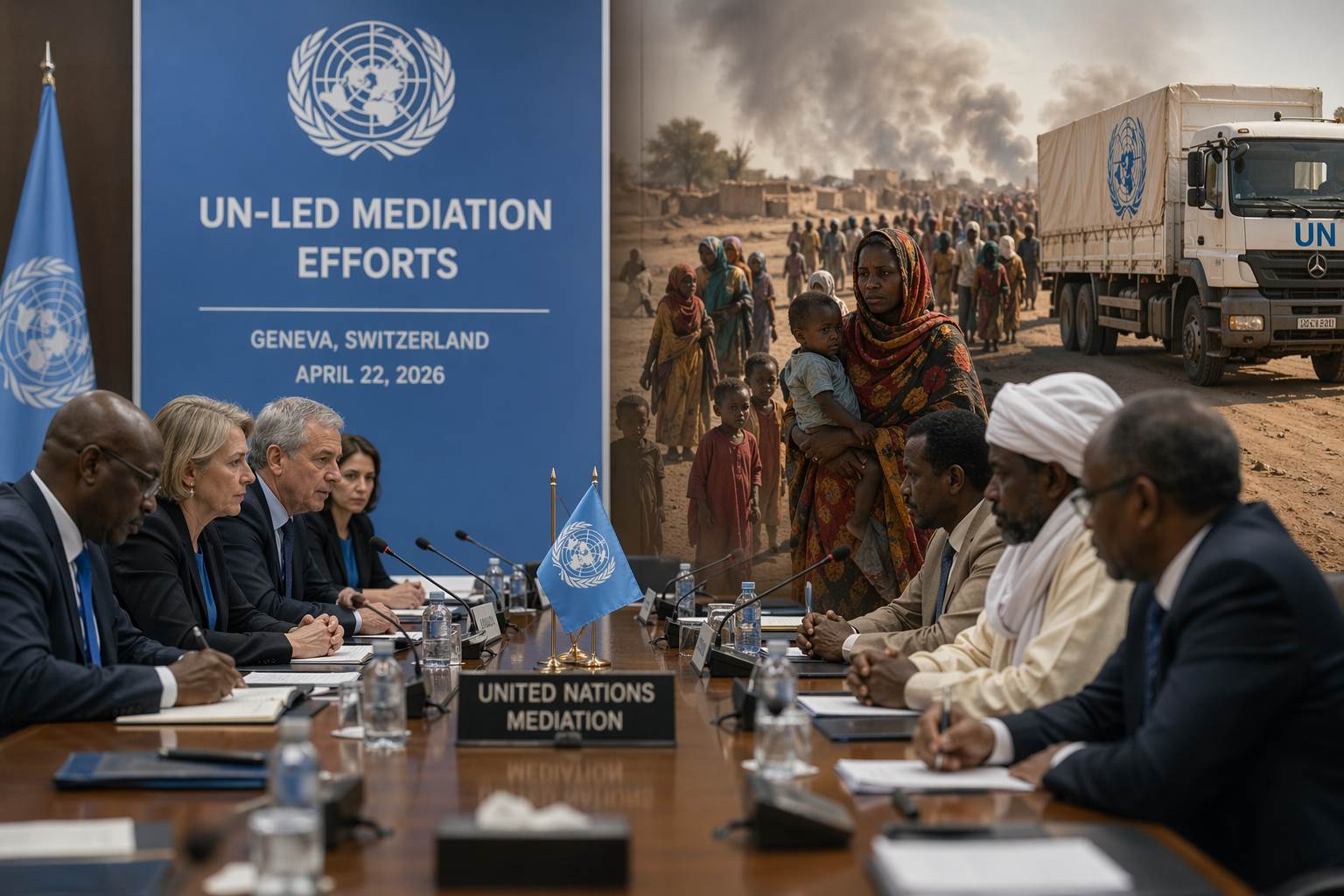
International mediators convene to negotiate safe passage for aid as the conflict enters its fourth year and famine conditions intensify across Darfur and Kordofan.
April 22, 2026
Last Updated: April 22, 2026
By Global War News Editorial
High-level mediation efforts commenced in Geneva this week under the auspices of the United Nations, aimed at securing immediate and unhindered humanitarian access to Sudan’s most isolated conflict zones. The talks, which involve representatives from the African Union and the “ALPS Group” (comprising the US, UAE, Saudi Arabia, Egypt, and Switzerland), focus on establishing “corridors of life” to reach millions facing starvation.
According to a statement from the UN Office for the Coordination of Humanitarian Affairs (OCHA), more than 33 million people in Sudan now require urgent assistance, the highest figure currently recorded globally. The primary objective of the Geneva sessions is to move beyond temporary truces toward enforceable arrangements that guarantee the safety of aid convoys and medical personnel.
The diplomatic push comes exactly three years after the outbreak of the civil war between the Sudanese Armed Forces (SAF) and the paramilitary Rapid Support Forces (RSF), a conflict that has displaced approximately 13 million people and triggered what the UN calls the world’s most severe man-made humanitarian disaster.
The Geography of Access: Key Corridors
The mediation focuses on three critical transit routes that have been largely paralyzed by active fighting or administrative blockages. According to reporting from Reuters, the “Adré crossing” from Chad into West Darfur remains a primary point of contention, as its control is vital for reaching populations in areas where famine conditions were recently confirmed.
A second priority is the corridor connecting Port Sudan on the Red Sea to the central and western regions. While the SAF maintains control over the northeast, aid organizations report that checkpoints and “bureaucratic obstacles” frequently delay food and medicine shipments for months.
Thirdly, the talks seek to address the siege-like conditions in North Kordofan and parts of Darfur. Following the RSF takeover of Al-Fasher in late 2025, humanitarian hubs in the city were severely disrupted. The UN reports that currently only about 26% of households in North Darfur have received any form of assistance this year.
Historical Context: Three Years of Impasse
The conflict began on April 15, 2023, as a power struggle between General Abdel Fattah al-Burhan of the SAF and Mohamed Hamdan “Hemedti” Dagalo of the RSF. Since then, previous mediation tracks—including the Jeddah Declaration and various regional initiatives—have struggled to translate high-level signatures into safety for civilians on the ground.
Analysis of the current situation suggests that the collapse of state infrastructure, including the healthcare and telecommunications systems, has made the delivery of aid almost impossible without explicit military cooperation. According to data from the International Organization for Migration (IOM), the conflict has led to the total collapse of the rule of law in vast parts of the country, leaving a governance vacuum that complicates even basic logistics.
Analysis: Why Geneva Matters Now
Analysts suggest that the Geneva talks represent a shift in strategy by the international community. Rather than pursuing a comprehensive political settlement—which has proven elusive—the current focus is on “humanitarian de-confliction.” This approach treats the opening of corridors as a technical military necessity rather than a political concession.
However, observers note that significant challenges remain. “The absence of direct, face-to-face negotiations between the top warring generals continues to be the primary hurdle,” says a senior researcher at a Geneva-based think tank. “The delegations present are often technical staff without the authority to make binding military commitments on the frontlines.”
Furthermore, the economic impact of the war has reached a critical threshold. With the national economy effectively stalled and agricultural production at record lows, the population is almost entirely dependent on external aid. If the Geneva mediation fails to secure consistent access by the start of the next planting season, international donors warn that the death toll from starvation could eventually surpass that of the battlefield.
Current Status and Next Steps
The talks are expected to continue for several days. Swiss officials hosting the event have emphasized that the focus is on practical outcomes: the removal of specific checkpoints, the safety of cross-border operations from Chad, and the protection of essential infrastructure like water and power grids.
While the SAF and RSF have issued separate statements acknowledging the humanitarian crisis, they continue to trade blame for the blockages. The UN Security Council is reportedly monitoring the Geneva outcomes to determine if further sanctions or enforcement mechanisms are required to ensure compliance with international humanitarian law.
Sources: This article is based on reporting and official statements from UN OCHA, the International Organization for Migration (IOM), the Swiss Federal Department of Foreign Affairs, Reuters, the Council on Foreign Relations, and the African Union.
This article is based on publicly available reporting from named international news agencies and attributed official statements. All claims about ongoing events are attributed to their original sources. Analysis sections represent the editorial interpretation of reported facts and do not constitute advocacy for any party to the described conflict. AI tools may be utilized for image generation to assist in explaining complex concepts, as well as for refining grammar, spelling, and other linguistic enhancements. However, all original content is produced, fact-checked, and revised by the editorial team. This publication does not take political positions on active military conflicts.