
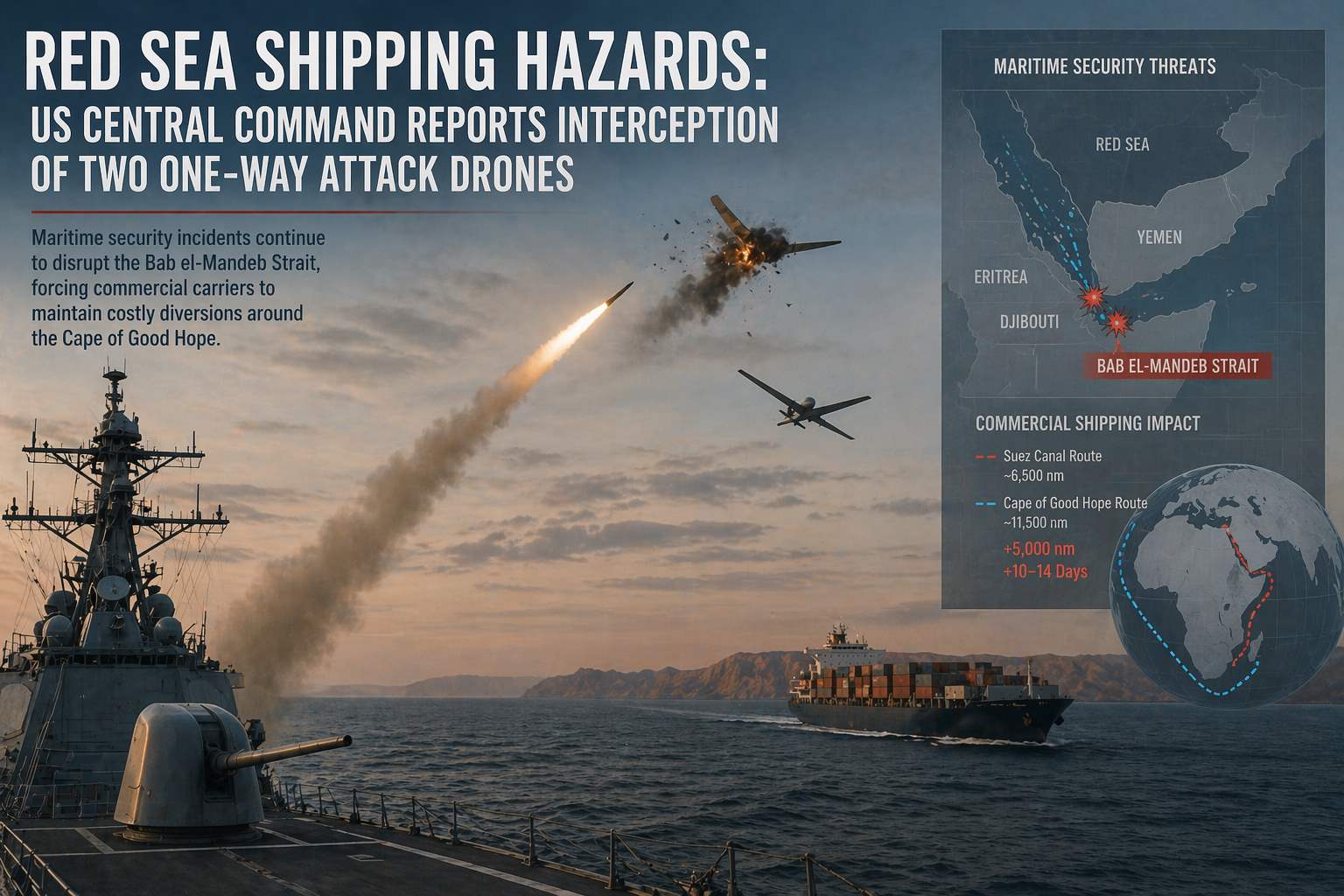
Maritime security incidents continue to disrupt the Bab el-Mandeb Strait, forcing commercial carriers to maintain costly diversions around the Cape of Good Hope.
April 23, 2026
Last Updated: April 23, 2026
By Global War News Editorial
United States Central Command (CENTCOM) confirmed that its naval forces intercepted and destroyed two one-way attack (OWA) unmanned aerial vehicles launched from Houthi-controlled territories in Yemen early Thursday. According to the official statement released via social media and military wire services, the drones were identified as a direct threat to merchant vessels and US Navy ships operating in the Red Sea.
There were no reported injuries or damage to any vessels in the vicinity. This latest engagement follows a month of resurgent activity in the Southern Red Sea, undermining recent hopes that a decrease in regional tensions would lead to a normalization of traffic through the Suez Canal.
While the military impact of these specific interceptions remains limited, the cumulative effect of such hazards continues to reshape global trade routes and the insurance landscape for international shipping.
Tactical Overview and Defense Response
The interception occurred at approximately 04:00 local time. According to reporting from the Associated Press, the drones were neutralized by a destroyer assigned to Operation Prosperity Guardian, the international maritime coalition established to safeguard the waterway.
Analysts from the International Institute for Strategic Studies (IISS) note that the use of one-way attack drones—often referred to as “suicide drones”—represents a low-cost, high-disruption tactic. These systems allow shore-based forces to harass sophisticated naval assets and civilian tankers with minimal logistical footprint. According to CENTCOM, these actions are “reckless” and directly endanger the freedom of navigation in one of the world’s most critical transit corridors.
Economic Consequences: The High Cost of Diversion
The persistence of shipping hazards in the Red Sea is having a measurable impact on the global economy. According to data from the International Monetary Fund (IMF) and the Portwatch tracking system, container traffic through the Suez Canal has remained at roughly 50% of its 2023 levels.
For many shipping giants, the risk of drone or missile strikes outweighs the convenience of the shorter route. Major carriers, according to Reuters, continue to reroute vessels around the Cape of Good Hope at the southern tip of Africa. This diversion adds approximately 10 to 14 days to the journey and increases fuel costs by an estimated $1 million per round trip.
The economic “ripple effect” includes:
- Increased Freight Rates: Spot rates for shipping containers from Asia to Northern Europe have stabilized at a significantly higher baseline than pre-2024 levels.
- Inventory Delays: Manufacturing sectors in Europe, particularly the automotive industry, have reported periodic delays in component arrivals.
- Insurance Premiums: Maritime insurers have maintained “war risk” premiums for any vessel choosing to transit the Bab el-Mandeb, with some premiums rising by up to 1% of the ship’s total value.
Analysis: A New Baseline for Maritime Risk
Military observers suggest that the Red Sea has become a laboratory for asymmetric naval warfare. The ability of a non-state actor to disrupt trillions of dollars in trade using relatively inexpensive drone technology has created a new security reality.
“The issue is no longer just about the success of a single strike,” notes one maritime security consultant. “It is about the ‘perceived risk.’ As long as CENTCOM is required to intercept drones on a weekly basis, the Red Sea cannot be considered a safe commercial environment.”
This raises significant questions for Egypt, which relies heavily on Suez Canal transit fees for its national budget. According to the Suez Canal Authority, revenues have seen a significant year-on-year decline, placing further strain on the Egyptian pound and the country’s broader economic stability.
What to Watch For
In the coming weeks, the focus will be on whether the US and its allies shift from a “defensive” posture to more frequent “pre-emptive” strikes on drone launch sites within Yemen. According to reporting from the BBC, diplomatic channels are currently being used to pressure regional backers of the Houthi movement to de-escalate, yet the frequency of drone launches suggests these efforts have had limited impact on the ground.
Until a permanent maritime security agreement is reached, the global supply chain will likely continue to factor in the “Red Sea Premium,” keeping consumer prices for imported goods higher than they would be under normal transit conditions.
Sources: This article is based on official statements from US Central Command (CENTCOM), and reporting from the Associated Press, Reuters, the BBC, the International Monetary Fund (IMF), and the Suez Canal Authority.
This article is based on publicly available reporting from named international news agencies and attributed official statements. All claims about ongoing events are attributed to their original sources. Analysis sections represent the editorial interpretation of reported facts and do not constitute advocacy for any party to the described conflict. AI tools may be utilized for image generation to assist in explaining complex concepts, as well as for refining grammar, spelling, and other linguistic enhancements. However, all original content is produced, fact-checked, and revised by the editorial team. This publication does not take political positions on active military conflicts.