
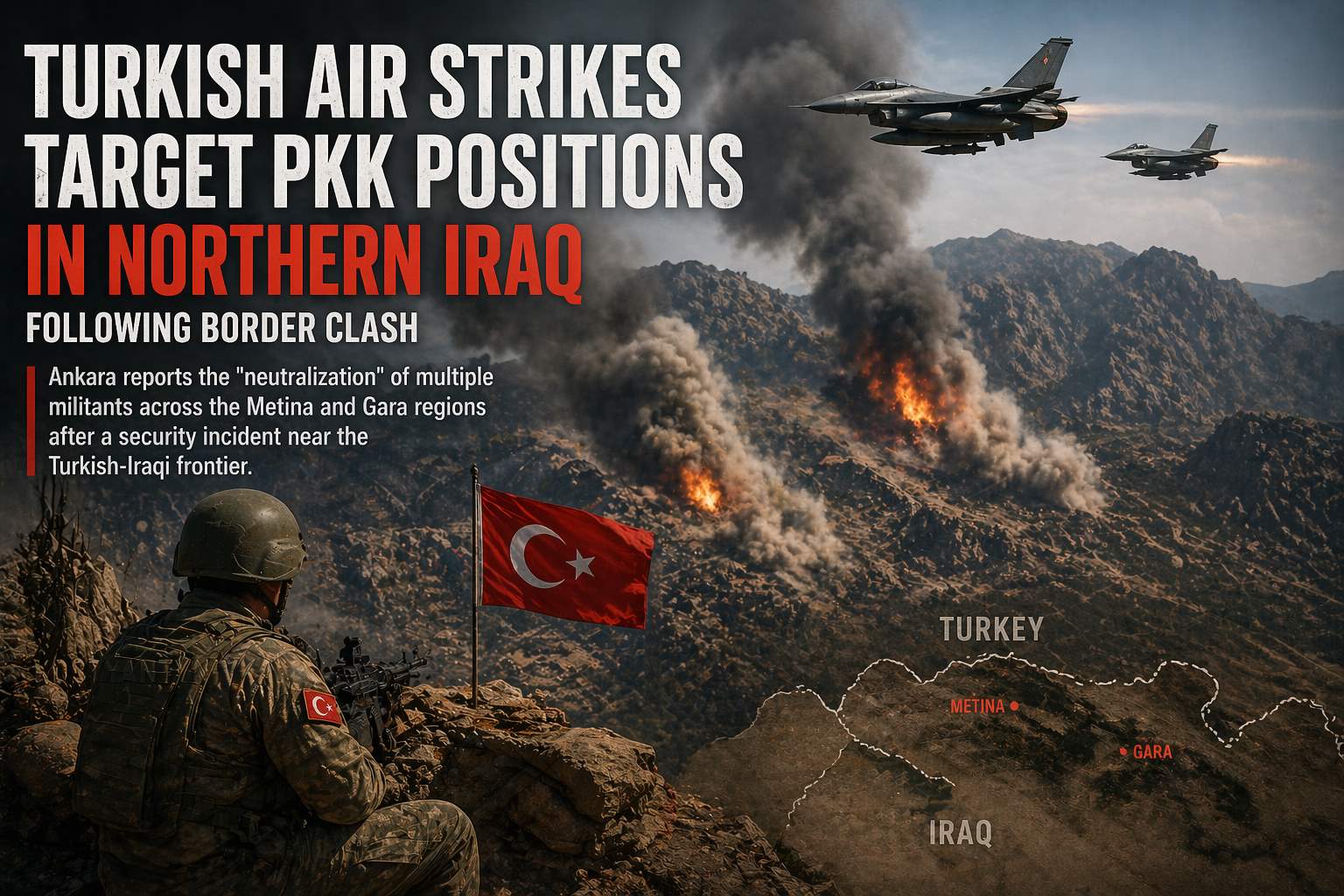
Ankara reports the “neutralization” of multiple militants across the Metina and Gara regions after a security incident near the Turkish-Iraqi frontier.
April 23, 2026
Last Updated: April 23, 2026
By Global War News Editorial
The Turkish Ministry of National Defence confirmed on Wednesday that its air force conducted a series of targeted strikes against Kurdistan Workers’ Party (PKK) assets in northern Iraq. According to an official statement, the operations were launched in retaliation for a “border incident” earlier that morning, which reportedly involved an attempted infiltration by militants into a Turkish forward operating base.
Military officials in Ankara stated that the air strikes successfully “neutralized” several PKK members and destroyed numerous caves, bunkers, and ammunition depots in the Metina, Hakurk, and Gara regions. While the Turkish authorities frequently use the term “neutralized” to imply that targets were killed, captured, or surrendered, independent verification of casualty figures in these remote mountainous areas remains difficult.
The Iraqi federal government has previously described such incursions as a violation of its national sovereignty, though Ankara maintains that the operations are conducted under its right to self-defense as outlined in Article 51 of the UN Charter.
Tactical Scope and Operational Details
The strikes were carried out by F-16 fighter jets and domestically produced unmanned combat aerial vehicles (UCAVs). According to reporting from the Anadolu Agency, the mission focused on what the Turkish military described as “strategic hideouts” used by senior members of the PKK.
The latest sorties represent an extension of Turkey’s long-running “Operation Claw-Lock,” a campaign initiated to dismantle the PKK’s logistical networks in northern Iraq. Military analysts note that Turkey has increasingly relied on high-altitude drone surveillance to monitor the Gara and Qandil mountain ranges, allowing for rapid-response strikes following border skirmishes.
According to local sources in the Erbil governorate, as reported by Al Jazeera, the sound of explosions was heard in several border villages. While there were no immediate reports of civilian casualties, residents in the Bradost area noted that the strikes caused significant damage to local agricultural land and sparked small wildfires in the rugged terrain.
The Regional Security Context
The escalation comes amid a complex regional security landscape. While Turkey has been engaged in a decades-long conflict with the PKK—an organization listed as a terrorist group by Turkey, the US, and the EU—recent months have seen a fragile political environment in Baghdad.
According to a report from the Middle East Institute, the Iraqi government has been under increasing domestic pressure to curb foreign military activity within its borders. However, the Kurdistan Regional Government (KRG) in Erbil often finds itself in a difficult position, balancing its economic ties with Turkey against the presence of PKK militants in its northern territories.
Analysis: Economic and Strategic Implications
The continued military presence in northern Iraq carries substantial costs for both the Turkish and Iraqi economies. For Turkey, the maintenance of a network of over 100 outposts and forward operating bases inside Iraqi territory is a significant budgetary commitment. Analysts suggest that the reliance on expensive precision-guided munitions and constant drone patrols is part of a “denial strategy” designed to push the conflict entirely outside of Turkey’s domestic borders.
From the Iraqi perspective, the instability in the north hampers the development of regional energy infrastructure. According to data from the Iraq Oil Report, several planned pipeline maintenance projects near the Turkish border have been delayed due to the risk of being caught in the crossfire of the ongoing “Claw” operations.
“The border between Turkey and Iraq has effectively become a permanent combat zone,” says a regional security consultant. “This makes any long-term investment in transit corridors or cross-border trade highly speculative, as the security environment can shift within hours of a single skirmish.”
Future Outlook
It remains unclear if the latest strikes signal a broader summer offensive. Historically, Turkey has increased its operational tempo in northern Iraq as the mountain snow melts, allowing for easier ground maneuvers.
Observers will be watching the upcoming security summit between Turkish and Iraqi officials in Baghdad. Reports suggest that Ankara is seeking a formal “security corridor” agreement that would legalize its military presence in a 30-kilometer buffer zone. If such an agreement is reached, it could represent a fundamental shift in the regional sovereignty framework; if not, the cycle of border incidents followed by retaliatory air strikes is likely to persist.
Sources: This article is based on official statements from the Turkish Ministry of National Defence, and reporting from the Anadolu Agency, Reuters, Al Jazeera, the Middle East Institute, and local sources in the Kurdistan Region of Iraq.
This article is based on publicly available reporting from named international news agencies and attributed official statements. All claims about ongoing events are attributed to their original sources. Analysis sections represent the editorial interpretation of reported facts and do not constitute advocacy for any party to the described conflict. AI tools may be utilized for image generation to assist in explaining complex concepts, as well as for refining grammar, spelling, and other linguistic enhancements. However, all original content is produced, fact-checked, and revised by the editorial team. This publication does not take political positions on active military conflicts.