
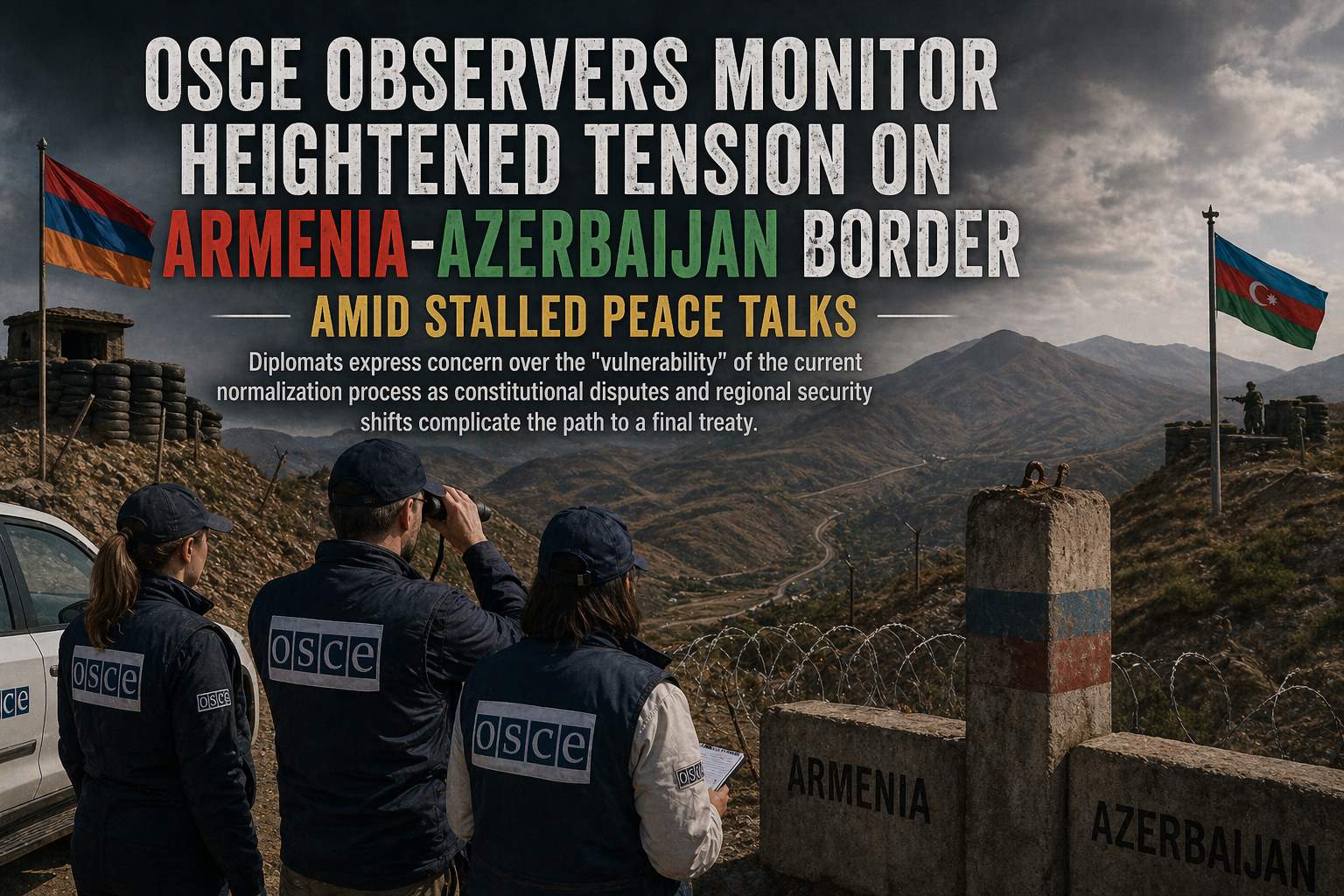
Diplomats express concern over the “vulnerability” of the current normalization process as constitutional disputes and regional security shifts complicate the path to a final treaty.
April 23, 2026
Last Updated: April 23, 2026
By Global War News Editorial
The Organization for Security and Co-operation in Europe (OSCE) has intensified its monitoring efforts along the Armenia-Azerbaijan frontier this week, citing a “crucial moment” in the regional security architecture. During the fifth Antalya Diplomacy Forum held on April 20, OSCE Secretary General Feridun H. Sinirlioğlu underscored the necessity of utilizing cooperative diplomacy to manage rising tensions that threaten to derail nearly two years of relative stability.
While official statements from Baku and Yerevan have recently touted a “de facto peace,” the formal signing of a 17-article peace agreement remains stalled. The current friction centers on Azerbaijan’s demand for changes to the Armenian constitution and the proposed dissolution of the OSCE Minsk Group, a body that has mediated the conflict since 1992 but which Baku now considers obsolete.
The heightened monitoring comes as international mediators, including a new US-led diplomatic initiative, attempt to bridge the gap between “dividends of peace”, such as resumed fuel exports—and the unresolved legal and territorial grievances that continue to simmer along the border.
The Constitutional Deadlock
The primary obstacle to a final treaty, according to official statements from Azerbaijani President Ilham Aliyev, is the preamble of the Armenian Constitution. Baku asserts that the document contains implicit territorial claims against Azerbaijan, specifically referencing a 1989 declaration on the unification of Armenia and Nagorno-Karabakh.
According to reporting from the Armenian news agency Armenpress, Prime Minister Nikol Pashinyan has acknowledged the need for a “new constitution” to reflect the current geopolitical reality, yet the proposal face significant domestic political opposition. Analysts note that Baku has made the constitutional change a non-negotiable precondition for signing the final peace accord, leading to a diplomatic impasse even as secondary trade relations begin to normalize.
Infrastructure and the “TRIPP” Project
A significant focus of the current negotiations is the “Trump Route for International Peace and Prosperity” (TRIPP), a connectivity agreement brokered in late 2025. According to reports from GEOpolitics, this project aims to reconstruct Soviet-era railroads and potentially establish oil and gas pipelines through Armenian territory, connecting mainland Azerbaijan to its exclave, Nakhchivan.
While both sides have expressed enthusiasm for the economic benefits of de-blocking trade routes, the security of these corridors remains a flashpoint. According to reports from Reuters, the Armenian side remains wary of any extraterritorial status for the routes, while Azerbaijan insists on “guaranteed and unhindered” access.
Analysis: A Fragile “De Facto” Peace
Observers characterize the current situation as a “frozen transition.” While the last two years have been described by the Azerbaijani Milli Majlis as the “calmest period” in decades with minimal military incidents, the lack of a legal framework leaves the region vulnerable to external shocks.
“The dividends of peace, such as the recent shipment of 887 tons of diesel fuel from Azerbaijan to Armenia—are real, but they are built on a foundation of sand,” says a regional security consultant. “Without a signed treaty and verified border delimitation, any localized skirmish could escalate into a broader confrontation, especially as regional powers like Russia and Iran monitor the shifting US influence in the Caucasus.”
From an economic perspective, the current “de facto” peace has allowed for a cautious resumption of civil society talks and limited trade. However, major international investment in the South Caucasus transit corridor remains on hold as long as the OSCE and other monitoring bodies report “major uncertainty” regarding the finality of the borders.
The Role of International Monitors
The presence of international observers remains a point of contention. While the European Mission in Armenia (EUMA) continues to monitor the border from the Armenian side, Azerbaijan has called for the removal of all third-party military and civilian presence once a peace agreement is ratified.
According to a recent report from the European Parliament, the road to peace is currently “vulnerable to domestic and external factors,” including the upcoming Armenian parliamentary elections in June 2026. Mediators from the OSCE and the US state department are reportedly pushing for a “final de-blocking” of communications before the end of the year to solidify the progress made during the Washington and Antalya summits.
Sources: This article is based on official statements from the OSCE Secretariat, the Azerbaijani Milli Majlis, and Armenpress, as well as reporting from Reuters, APA News Agency, GEOpolitics, and the European Parliament Research Service.
This article is based on publicly available reporting from named international news agencies and attributed official statements. All claims about ongoing events are attributed to their original sources. Analysis sections represent the editorial interpretation of reported facts and do not constitute advocacy for any party to the described conflict. AI tools may be utilized for image generation to assist in explaining complex concepts, as well as for refining grammar, spelling, and other linguistic enhancements. However, all original content is produced, fact-checked, and revised by the editorial team. This publication does not take political positions on active military conflicts.