
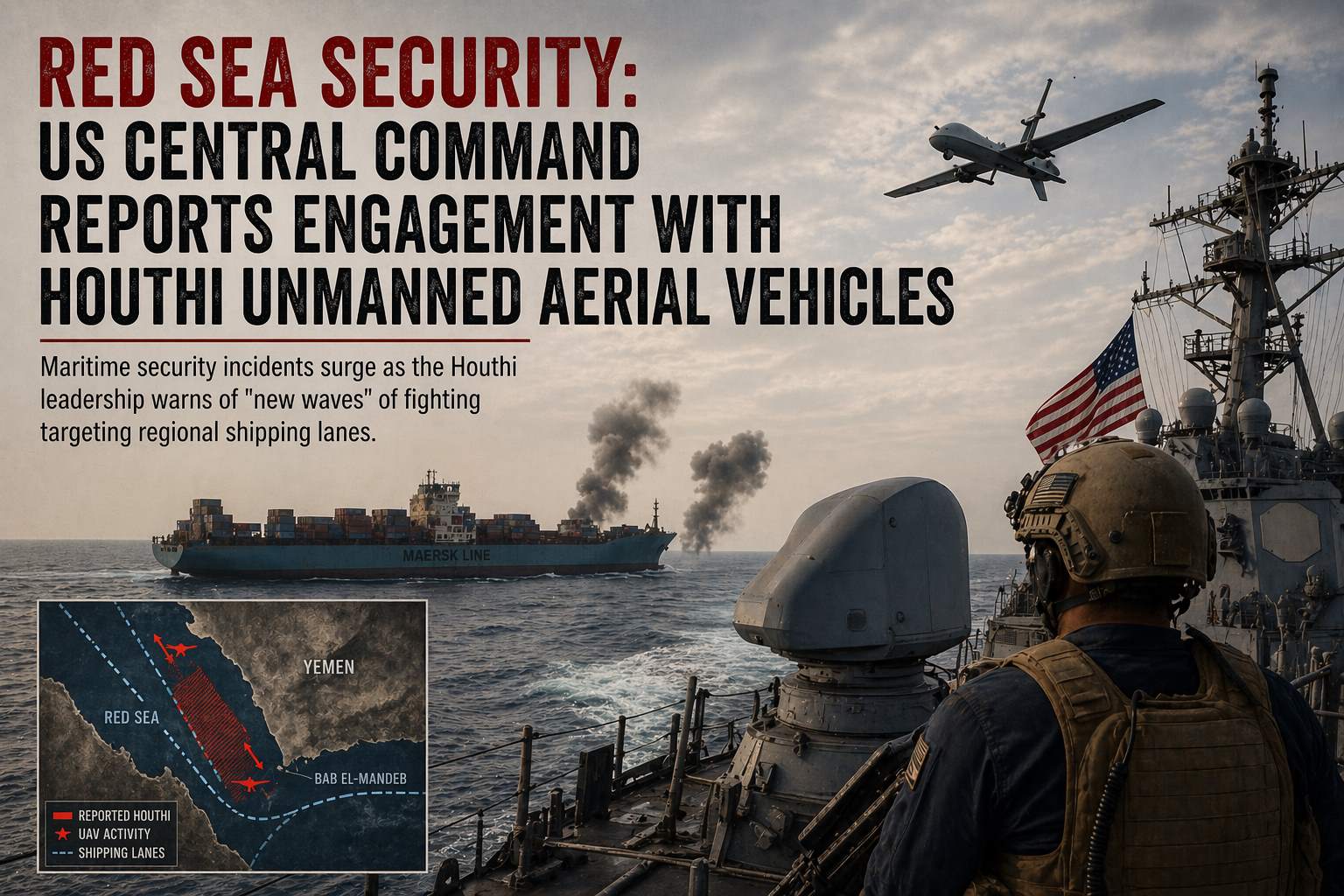
Maritime security incidents surge as the Houthi leadership warns of “new waves” of fighting targeting regional shipping lanes.
April 23, 2026
Last Updated: 16:45 GMT
By Global War News Editorial
Naval forces led by the United States have intercepted multiple unmanned aerial vehicles (UAVs) over the Red Sea in the last 24 hours, according to official military reports. The spike in aerial activity comes amid a broader regional maritime blockade and follows public warnings from Houthi leadership in Yemen regarding a potential escalation in the Bab al-Mandeb Strait.
CENTCOM Operational Breakdown
According to a statement released by US Central Command (CENTCOM) on Thursday, US forces successfully identified and destroyed two Houthi-launched UAVs that were assessed to be on a flight path toward commercial shipping lanes in the Southern Red Sea. CENTCOM stated that these actions were taken to “protect freedom of navigation” and were conducted in international waters.
The command reported that no injuries or damage to US or coalition vessels occurred during the engagement. These intercepts follow a similar incident on April 20, where US forces interdicted a vessel in the region allegedly attempting to evade international maritime sanctions.
Houthi Declarations and “Red Lines”
Houthi-aligned media and officials in Sana’a have characterized these recent maritime activities as a response to the ongoing naval blockade affecting the region. In a televised address on April 21, Houthi leader Abdul Malik al-Houthi stated that “further rounds of fighting are coming,” describing the current state of regional security as a “fragile truce” rather than a lasting peace.
Simultaneously, Houthi Deputy Foreign Minister Hussein al-Ezzi posted a statement on social media suggesting that the group possesses the capability to close the Bab al-Mandeb Strait entirely. According to reports from regional news outlets, the group asserts that its maritime operations will continue as long as policies obstructing regional peace remain in place. These claims of an imminent shutdown have not resulted in a total cessation of traffic, but they have heightened the alert status for commercial liners.
Global Shipping and Insurance Realities
The persistent threat of UAV and maritime drone attacks is having a measurable impact on the global logistics chain. According to the latest maritime risk assessment from MitKat Advisory, the confidence level for safe passage through the Bab al-Mandeb remains moderate to low, with a “medium-high” confidence that asymmetric attacks using UAVs or fast-attack boats will persist over the next 72 hours.
Analysis: The Shift to Asymmetric Attrition
Security analysts note that the Houthi strategy has evolved toward the frequent use of low-cost, sophisticated drones that are difficult for traditional radar systems to consistently track in cluttered coastal environments. By maintaining a constant, albeit low-intensity, threat, the group exerts significant economic pressure without engaging in a large-scale naval confrontation.
Observers suggest that these UAV launches are often used as “probes” to test the reaction times and sensor capabilities of the international naval task forces stationed in the Red Sea. It remains unclear whether the recent intercepts indicate a precursor to a larger coordinated attack or are part of a sustained campaign of harassment aimed at driving up maritime insurance premiums.
Economic Impact: The Cost of Vigilance
The economic consequences of these security incidents are reflected in the operational costs for global shipping. According to data from the IMF and shipping industry bodies, Protection & Indemnity (P&I) insurance premiums for Red Sea transits have remained elevated, with some carriers opting for the longer route around the Cape of Good Hope.
Furthermore, the rerouting of vessels has led to significant delays at entry points for the Suez Canal. For nations in South Asia and East Africa, these disruptions translate directly into increased landed costs for fuel and grain, contributing to localized inflationary pressures.
What to Watch
The international maritime community is closely monitoring the expiration of several regional ceasefire agreements scheduled for late this week. Of particular concern is whether Houthi forces will attempt to implement their stated threats to restrict passage through the Bab al-Mandeb, a move that would likely trigger a more robust military response from the international coalition.
Sources: This report is based on official operational updates from US Central Command (CENTCOM), televised statements from Houthi leader Abdul Malik al-Houthi, and public posts from Houthi officials. Supplemental economic and risk data were sourced from MitKat Advisory, the IMF, and Reuters.
This article is based on publicly available reporting from named international news agencies and attributed official statements. All claims about ongoing events are attributed to their original sources. Analysis sections represent the editorial interpretation of reported facts and do not constitute advocacy for any party to the described conflict. AI tools may be utilized for image generation to assist in explaining complex concepts, as well as for refining grammar, spelling, and other linguistic enhancements. However, all original content is produced, fact-checked, and revised by the editorial team. This publication does not take political positions on active military conflicts.