
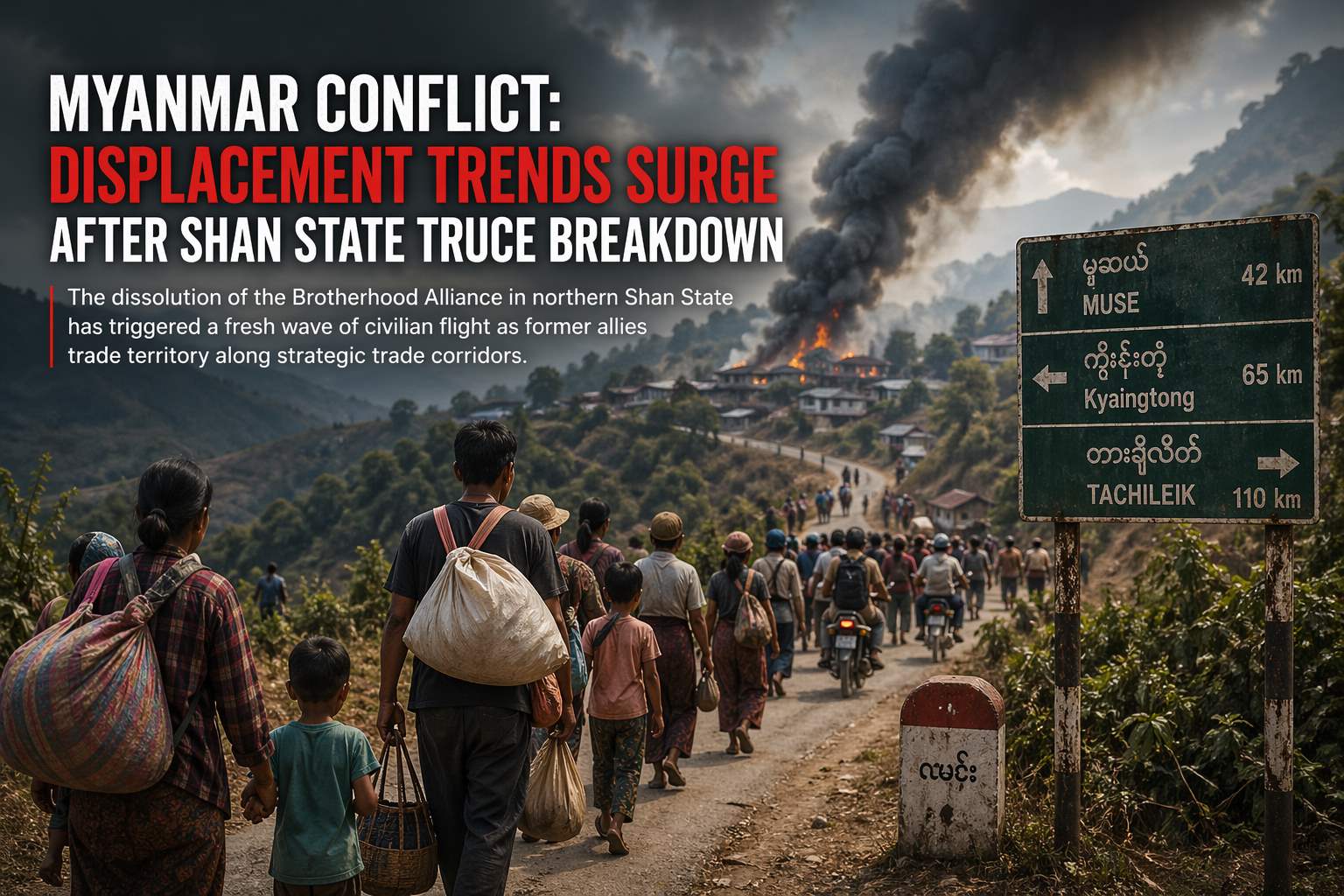
The dissolution of the Brotherhood Alliance in northern Shan State has triggered a fresh wave of civilian flight as former allies trade territory along strategic trade corridors.
April 23, 2026
Last Updated: 17:15 GMT
By Global War News Editorial
Humanitarian conditions in northern Shan State have deteriorated rapidly following the collapse of a localized stability agreement between the Myanmar National Democratic Alliance Army (MNDAA) and the Ta’ang National Liberation Army (TNLA). Over the past six weeks, the breakdown of the “Brotherhood Alliance” has shifted from political friction to active combat, primarily centered on the strategic trade hub of Kutkai. According to humanitarian agencies, this intra-ethnic conflict is creating a “secondary displacement” crisis, forcing thousands who had already fled junta offensives to seek safety for a second or third time.
The Fragmentation of the Alliance
The conflict reached a turning point on March 16, 2026, when the MNDAA reportedly seized complete control of Kutkai from its former ally, the TNLA. According to reporting from The Irrawaddy, the fall of the town followed a month-long standoff triggered by territorial disputes over administration and tax collection rights along the Union Highway.
In a statement issued following the loss of the town, TNLA General Secretary Major General Tar Hpone Kyaw acknowledged that efforts to resolve the rift through mediation had failed, stating that the situation had entered a “stage of armed conflict.” Since the MNDAA’s takeover of Kutkai, fighting has reportedly expanded toward Namkham, where MNDAA forces are allegedly targeting TNLA hilltop positions.
Humanitarian Impact and Displacement Trends
The resumption of hostilities has invalidated the relative stability established during the late-2025 ceasefires. According to the Myanmar Humanitarian Needs and Response Plan 2026, there are currently an estimated 3.6 million internally displaced persons (IDPs) across Myanmar, with northern Shan State representing one of the most volatile sectors.
Local aid workers in Muse reported that hundreds of families began fleeing Kutkai and surrounding villages as MNDAA artillery units moved into position. Unlike earlier waves of displacement, which saw civilians moving toward major urban centers like Lashio, current trends show families fleeing toward “grey zones” or the Chinese border, as Lashio itself was recently returned to junta control under intense pressure from Beijing.
Analysis: China’s Role and the “Stability” Paradox
Analysts suggest that the current escalation is inextricably linked to Chinese diplomatic and economic interests. Observers note that the MNDAA offensive began just one day after a meeting between Chinese Special Envoy Deng Xijun and junta officials in Naypyidaw.
The strategic logic, according to regional analysts, is to consolidate the Myanmar-China trade route under a single, more predictable entity. By encouraging the MNDAA to secure the road from Lashio to the 105-Mile Trade Zone, Beijing may be seeking to bypass the multi-actor “taxation” system that previously slowed border commerce. However, this pursuit of logistical stability has paradoxically created greater humanitarian instability for the local Shan and Ta’ang populations.
Economic and Logistical Disruption
The reopening of the Union Highway under MNDAA control on March 16 has allowed some cross-border trade to resume, but at a significant social cost. According to data from the Shan Herald Agency for News, farmland along major roads in Hsenwi is being sold at unusually high prices to foreign investors, further disenfranchising displaced local farmers who cannot return to their land due to ongoing skirmishes.
What to Watch
The international community is monitoring whether the TNLA’s recent political pivot, which included a controversial statement congratulating junta leader Min Aung Hlaing on his April 3 presidency, will lead to a tactical alignment with the military to regain lost territory from the MNDAA. Such a development would fundamentally redraw the map of the Myanmar civil war and likely escalate the current displacement crisis.
Source Disclosure
This report is based on field reporting from the Shan Herald Agency for News, The Irrawaddy, and official statements from the TNLA leadership. Humanitarian data was sourced from the UN Global Humanitarian Overview 2026 and the Myanmar Humanitarian Needs and Response Plan 2026.
Mandatory Disclaimer
This article is based on publicly available reporting from named international news agencies and attributed official statements. All claims about ongoing events are attributed to their original sources. Analysis sections represent the editorial interpretation of reported facts and do not constitute advocacy for any party to the described conflict. AI tools may be utilized for image generation to assist in explaining complex concepts, as well as for refining grammar, spelling, and other linguistic enhancements. However, all original content is produced, fact-checked, and revised by the editorial team. This publication does not take political positions on active military conflicts.