
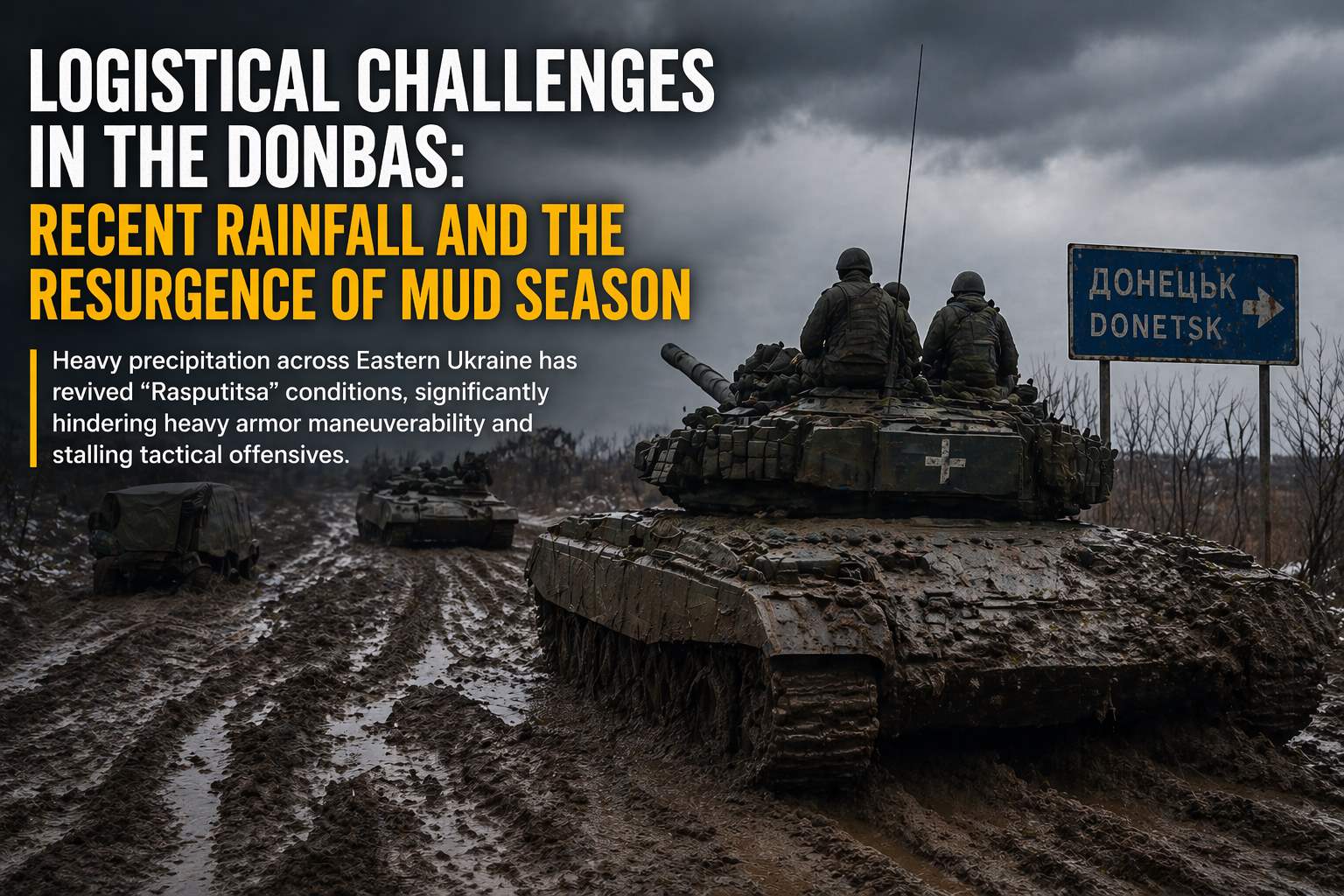
Heavy precipitation across Eastern Ukraine has revived “Rasputitsa” conditions, significantly hindering heavy armor maneuverability and stalling tactical offensives.
April 23, 2026
Last Updated: 17:30 GMT
By Global War News Editorial
The spring-summer offensive cycle in the Donbas has encountered a significant natural obstacle: the return of the Rasputitsa, or “season of bad roads.” Recent regional administration briefings and military blogger reports indicate that localized heavy rainfall has transformed the fertile chernozem (black soil) of the Donetsk and Luhansk regions into deep, viscous mud. This environmental shift has reportedly forced both Russian and Ukrainian forces to limit heavy armor movements to paved road networks, increasing their vulnerability to drone and artillery strikes.
Rainfall and Soil Saturation
According to the Ukrainian Hydrometeorological Center, April 2026 has seen precipitation levels reaching 80-120% of the seasonal norm, with significant clusters of rainfall occurring between April 15 and April 21. Reports from the Donetsk Regional Military Administration suggest that this moisture, combined with the spring thaw, has fully saturated the unpaved supply routes that are critical for frontline logistics.
In several tactical updates provided by Ukrainian military observers, the “swamp-like” conditions in the fields southeast of Slovyansk and near Lyman have effectively halted cross-country tank maneuvers. For tracked vehicles like the T-90 or Leopard 2, the risk of “bottoming out”, where the hull rests on the mud, lifting the tracks off the ground, is currently high.
Tactical Impact: The “Road Bound” Dilemma
Russian military bloggers (milbloggers) have recently criticized the Southern Grouping of Forces’ insistence on maintaining offensive momentum despite these conditions. According to reports from the Rybar Telegram channel and other prominent observers, armored columns are frequently becoming “road bound.” When vehicles are restricted to predictable, paved highways, they become easy targets for “First Person View” (FPV) drones and anti-tank guided missiles (ATGMs).
The logistical bottleneck is not limited to frontline combat. Briefings from the Luhansk Regional Administration indicate that the transport of ammunition and fuel to forward positions now requires three times the usual duration. High-mobility multipurpose wheeled vehicles (HMMWVs) and standard supply trucks are reportedly struggling to navigate even established dirt paths, leading to a surge in the use of specialized recovery vehicles.
Analysis: Defensive Advantage in the Mud
Historically, the Rasputitsa has favored the defending force. Analysts from the Institute for the Study of War (ISW) note that while mud hampers the mobility of both sides, it disproportionately affects the attacker, who must maintain speed and coordination to achieve breakthroughs. In the current context, the mud provides a tactical “breathing room” for Ukrainian defensive lines, as it prevents the rapid exploitation of any localized breaches by Russian armored reserves.
However, observers also point out that this environmental pause is temporary. As temperatures are forecast to stabilize between 12°C and 18°C toward the end of April, the evaporation rate will increase. Military planners on both sides are likely using this forced lull to stockpile supplies and repair equipment in anticipation of the ground hardening by mid-May.
Economic Impact on Regional Logistics
Beyond the battlefield, the mud season has crippled local agricultural logistics. According to a recent bulletin from the World Food Programme (WFP), the inability to move heavy machinery across saturated fields in the Donbas has delayed the spring planting season for several key grain-producing areas. The destruction of rural road infrastructure by heavy military traffic during the wet season is expected to increase the cost of post-conflict reconstruction by an estimated 15% in the affected districts.
What to Watch
Observers are monitoring whether Russian forces will attempt more frequent “infiltration missions” using small infantry groups on foot or light motorcycles to bypass the mud-clogged main roads. Additionally, the arrival of drier weather in early May will likely signal a renewed attempt at high-intensity armored assaults in the Pokrovsk and Chasiv Yar directions.
Sources: This article is based on weather data from the Ukrainian Hydrometeorological Center and AccuWeather, official briefings from the Donetsk and Luhansk Regional Military Administrations, and tactical assessments from the Institute for the Study of War (ISW). Additional reporting on ground conditions was synthesized from pro-Russian milblogger channels and Ukrainian military observer Kostyantyn Mashovets.
This article is based on publicly available reporting from named international news agencies and attributed official statements. All claims about ongoing events are attributed to their original sources. Analysis sections represent the editorial interpretation of reported facts and do not constitute advocacy for any party to the described conflict. AI tools may be utilized for image generation to assist in explaining complex concepts, as well as for refining grammar, spelling, and other linguistic enhancements. However, all original content is produced, fact-checked, and revised by the editorial team. This publication does not take political positions on active military conflicts.