
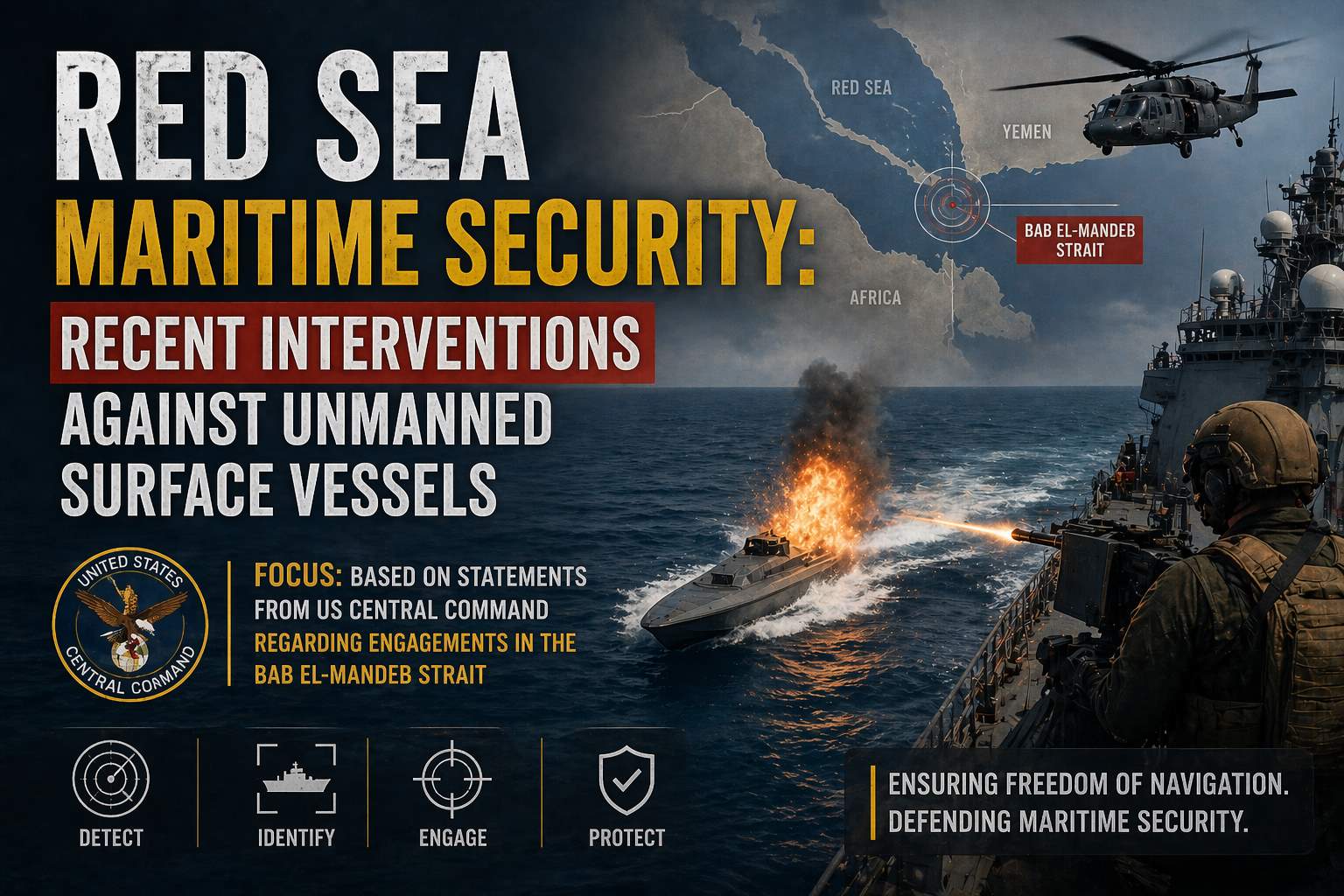
Naval task forces adapt to asymmetric threats in the Bab el-Mandeb as blockade conditions shift regional trade dynamics
April 24, 2026
Last Updated: 17:15 UTC
By Staff Writer, Global War News
The maritime security environment in the southern Red Sea has escalated significantly following a series of kinetic engagements between Western naval forces and unmanned systems. According to recent statements from U.S. Central Command (CENTCOM), coalition warships have intercepted and destroyed multiple Unmanned Surface Vessels (USVs) in the Bab el-Mandeb Strait over the last 72 hours. These interventions occur against a backdrop of a newly implemented U.S.-led maritime blockade of Iranian ports, a move that has drastically altered the risk profile for commercial shipping in the region.
While large-scale missile volleys have seen a relative decrease in frequency compared to 2025, the deployment of low-cost, explosive-laden USVs represents an evolving asymmetric threat. CENTCOM reported that the intercepted vessels were “operating in a manner that posed an imminent threat to merchant mariners and U.S. Navy ships in the international waters of the Red Sea.”
Tactical Evolution: The Rise of Unmanned Threats
Military analysts note that the shift toward USVs—essentially remotely piloted or autonomous explosive boats—marks a tactical pivot by regional actors. Unlike ballistic missiles, which are easily detected by advanced radar systems, USVs operate at the water’s surface, making them more difficult to track in heavy seas or congested shipping lanes.
According to a CENTCOM public release dated April 19, 2026, U.S. forces successfully “disabled” a vessel attempting to violate the current blockade. This followed an earlier mission on April 11 focused on mine clearance in the adjacent Strait of Hormuz. Observers suggest that the combination of drifting sea mines and USV swarms is intended to create a “virtual blockade” by driving up insurance costs and deterring commercial traffic without the need for a standing navy.
Economic Consequences of Persistent Maritime Friction
The ongoing interventions have direct implications for global trade and regional economic stability. Despite a brief period of stabilization earlier in 2026, the recent surge in USV activity has reversed the trend of shipping lines returning to the Suez Canal corridor.
- Insurance and Risk Premiums: According to reports from the Joint Maritime Information Center (JMIC), insurance premiums for transiting the Bab el-Mandeb remain at “exceptional” levels. Some carriers have reportedly reinstated the Cape of Good Hope rerouting, adding approximately 10 to 14 days to transit times between Asia and Europe.
- Impact of the Iranian Port Blockade: On April 14, 2026, CENTCOM commanders stated that a blockade of Iranian ports had been “fully implemented,” affecting an estimated 90% of Iran’s sea-based trade. This has led to retaliatory rhetoric from Houthi officials in Yemen, who indicated that the Bab el-Mandeb remains a “pressure valve” that can be closed in response to escalations.
- Supply Chain Stress: World Bank data from late 2025 indicated that traffic through the Red Sea had already plummeted by three-fourths. The current April 2026 tensions threaten to solidify these disruptions as a permanent feature of the global supply chain.
Analysis: Deterrence vs. Escalation
The current strategy of “active interception” poses a fundamental question: can naval presence deter asymmetric attacks indefinitely? Analysts have suggested that the cost-to-kill ratio heavily favors the attackers. A single defensive missile used by a destroyer can cost upwards of $2 million, while the USVs they intercept may cost as little as $10,000 to produce.
Furthermore, the linkage between the Red Sea and the Strait of Hormuz has become more pronounced. Observers note that military activity in one chokepoint now almost immediately triggers a response in the other. It remains unclear whether the current blockade will force a de-escalation or if it will prompt more sophisticated “swarm” attacks designed to saturate the defenses of coalition task forces.
Closing Summary
The Bab el-Mandeb remains the most critical and fragile chokepoint in the international maritime order. While U.S. and coalition forces have maintained technical superiority in intercepting recent USV threats, the structural insecurity of the region persists. As the U.S. maintains its blockade of Iranian ports through late April, the potential for a larger-scale maritime confrontation remains a central concern for global energy and commodity markets.
Sources: This article is based on official press releases from U.S. Central Command (CENTCOM), reports from the International Crisis Group, and maritime advisories from the U.S. Department of Transportation’s Maritime Administration (MARAD). Economic data was sourced from the World Bank and the St. Petersburg International Mercantile Exchange.
This article is based on publicly available reporting from named international news agencies and attributed official statements. All claims about ongoing events are attributed to their original sources. Analysis sections represent the editorial interpretation of reported facts and do not constitute advocacy for any party to the described conflict. AI tools may be utilized for image generation to assist in explaining complex concepts, as well as for refining grammar, spelling, and other linguistic enhancements. However, all original content is produced, fact-checked, and revised by the editorial team. This publication does not take political positions on active military conflicts.