
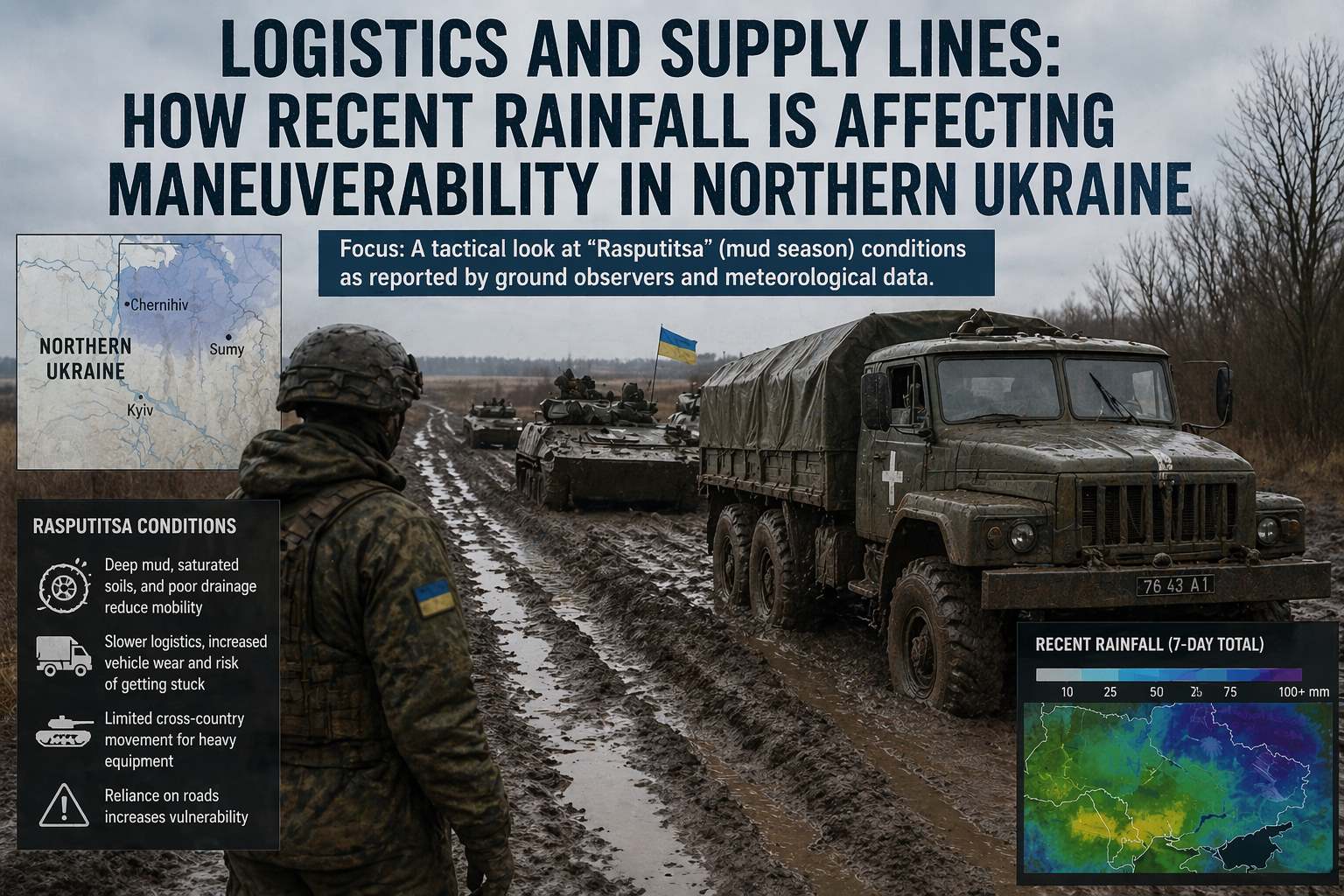
The return of “Rasputitsa” creates a tactical stalemate as heavy armor faces the seasonal transition to deep mud
April 24, 2026
Last Updated: 16:20 UTC
By Global War News Editorial
The arrival of the spring thaw, combined with above-average rainfall across Northern Ukraine in late April, has once again activated the seasonal phenomenon known as Rasputitsa. Translated literally as “the time without roads,” this period of intense mud has historically dictated the tempo of military operations in the region. According to ground observers and meteorological data from the Ukrainian Hydrometeorological Center, the transition from frozen winter ground to soft, saturated clay has significantly restricted the maneuverability of both tracked and wheeled vehicles.
As of April 24, 2026, reports from the Sumy and Chernihiv oblasts indicate that off-road movement has become nearly impossible for heavy armored columns. This environmental shift is forcing military logistics back onto established paved roads, which are increasingly vulnerable to long-range drone interdiction and artillery fire.
The Mechanics of Maneuverability
The primary challenge of the current season is the composition of the soil. Northern Ukraine is characterized by loamy and clay-heavy soils that, when saturated by the 40–50 mm of rainfall typical for April, lose their structural integrity.
Military analysts differentiate between the impact on different classes of equipment:
- Tracked Vehicles (Tanks and IFVs): While tanks like the Leopard 2 or T-80 exert lower ground pressure per square inch than wheeled vehicles, they are not immune. Ground reports suggest that even tracked platforms are “bottoming out” in fields where the mud depth exceeds 0.5 meters, leading to mechanical strain and immobilization.
- Wheeled Logistics (Trucks and APCs): According to technical assessments, wheeled supply trucks are currently restricted almost entirely to “hard-top” roads. Any attempt to bypass destroyed bridges or roadblocks via fields is resulting in immediate vehicle miring.
Tactical Implications: The “Chokepoint” Effect
According to the Institute for the Study of War (ISW), the Rasputitsa has created a predictable “chokepoint” effect. Because heavy equipment cannot maneuver cross-country, both Russian and Ukrainian forces are forced to utilize the same limited network of secondary and primary highways.
Recent reports from the Bohodukhiv and Sumy sectors highlight that Russian forces have intensified their “Battlefield Air Interdiction” (BAI) campaign. By using Starlink-equipped tactical drones to monitor these mandatory road corridors, they have targeted Ukrainian supply convoys that are unable to disperse into the surrounding treelines due to the mud. Conversely, Ukrainian defenders have utilized the mud to funnel advancing units into “kill zones” where the restricted mobility of the attacker makes them a stationary target for artillery.
Logistics in 2026: The Rise of the UGV
To counter the seasonal paralysis of traditional logistics, the Ukrainian Ministry of Defense has accelerated the deployment of Unmanned Ground Vehicles (UGVs). According to a statement by the Ministry, over 9,000 missions were carried out by UGVs in March alone, with a goal to have 25,000 robotic systems operational by mid-2026.
These smaller, lighter systems—often equipped with wide, low-pressure tires or specialized tracks—can navigate terrain that would swallow a 40-ton truck. Analysts note that these robots are now carrying out 100% of the “last-mile” logistics in high-risk sectors of the northern front, delivering ammunition and medical supplies to isolated positions that are currently inaccessible by standard transport.
Analysis: The Seasonal Stalemate
Observers note that the 2026 spring mud season has arrived with “climatic normalcy,” meaning there have been no abnormal droughts to provide early relief. This suggests that large-scale mechanized offensives in the north are likely to remain paused until at least late May or early June, when the soil moisture levels typically drop enough to support off-road maneuver.
This raises questions about the strategic use of this time. While the mud prevents the movement of tanks, it provides a window for both sides to fortify existing lines and stockpile supplies using rail and drone networks. It remains unclear whether the current “mud stalemate” will lead to a broader de-escalation or if it is merely the quiet before a more intense summer campaign once the ground hardens.
Closing Summary
The northern front has entered a period of environmental containment. As the Rasputitsa restricts heavy armor to predictable road networks, the conflict has shifted into a high-stakes game of drone-led interdiction. For the soldiers on the ground, the mud is as much an enemy as the opposing force, dictating where they can move, how they are supplied, and the ultimate tempo of the war in the spring of 2026.
Sources: This article is based on meteorological data from the Ukrainian Hydrometeorological Center, military assessments from the Institute for the Study of War (ISW), and official statements regarding UGV procurement from the Ukrainian Ministry of Defense. Ground-level tactical observations were cross-referenced with reporting from Reuters and independent military analysts specializing in Eastern European terrain.
This article is based on publicly available reporting from named international news agencies and attributed official statements. All claims about ongoing events are attributed to their original sources. Analysis sections represent the editorial interpretation of reported facts and do not constitute advocacy for any party to the described conflict. AI tools may be utilized for image generation to assist in explaining complex concepts, as well as for refining grammar, spelling, and other linguistic enhancements. However, all original content is produced, fact-checked, and revised by the editorial team. This publication does not take political positions on active military conflicts.