
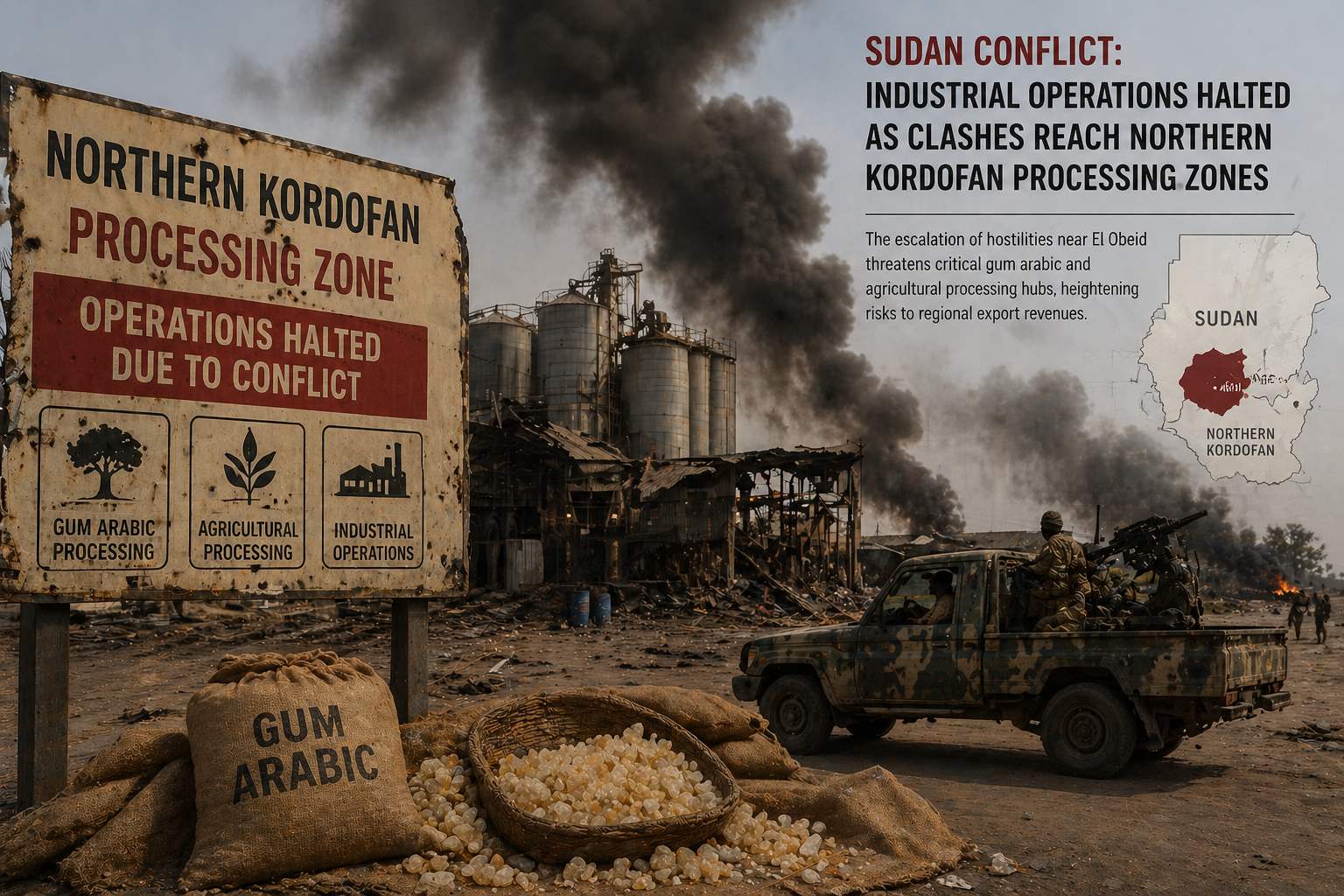
The escalation of hostilities near El Obeid threatens critical gum arabic and agricultural processing hubs, heightening risks to regional export revenues.
April 27, 2026
Last updated: April 27, 2026
By Global War News Editorial
Intense fighting between the Sudanese Armed Forces (SAF) and the Rapid Support Forces (RSF) has reportedly spread to industrial and commercial zones on the outskirts of El Obeid, the capital of North Kordofan. This shift in the conflict marks a significant threat to one of Sudan’s few remaining functional economic corridors, as the city serves as a primary collection point for gum arabic and livestock destined for international markets.
According to reports from Sudan Tribune on April 25, drone strikes and artillery fire have targeted multiple locations within El Obeid, which the military has increasingly utilized as a logistical hub for operations across the Kordofan and Darfur regions. Local sources indicate that recent clashes have encroached upon northern and western industrial sectors, where several manufacturing and processing facilities have been forced to suspend operations due to security concerns and infrastructure damage.
Background: The Strategic Value of North Kordofan
North Kordofan occupies a pivotal position in Sudan’s internal trade network. The state is central to the “Gum Arabic Belt,” producing a significant portion of the world’s supply of the stabilizer used globally in the food and pharmaceutical industries. El Obeid itself is home to the country’s largest inland port and major refineries for oilseeds.
Since the escalation of the national conflict in April 2023, El Obeid has remained under SAF control but has faced repeated sieges and intermittent shelling by the RSF. Analysts note that the current push toward industrial zones represents a calculated attempt to disrupt the SAF’s supply lines and the state’s remaining revenue-generating capacities.
Economic Impact: Industrial Paralysis and Market Instability
The movement of the front lines into industrial areas has had an immediate chilling effect on local commerce. Reports from the Sudan Doctors Network confirmed that suicide drones struck residential and commercial neighborhoods over the weekend, resulting in at least seven civilian fatalities. The proximity of these strikes to processing plants has led to a mass exodus of skilled labor.
The IMF and World Bank have previously warned that the destruction of productive assets in Kordofan would exacerbate Sudan’s already historic economic contraction. Beyond the physical damage to machinery, the insecurity has severed the Bara–Um Durman road, a vital commercial link to Khartoum. According to ACAPS reporting from February 2026, the contest for this route has already restricted the movement of essential commodities, leading to localized hyperinflation of food and fuel prices.
Analysis: Fragmentation of the Export Economy
The targeting of industrial zones suggests a transition from purely territorial warfare to a strategy of economic attrition. By compromising the facilities in El Obeid, the RSF potentially limits the SAF-aligned government’s ability to process and export agricultural wealth, which is often used to fund military procurement.
However, observers suggest this strategy carries a double-edged risk. The total collapse of the Kordofan industrial base would leave both sides presiding over a “hollowed-out” territory. Furthermore, the UN Development Programme (UNDP) recently highlighted in its April 2026 report that Sudan has already lost over $6 billion in GDP since the war’s inception. The loss of North Kordofan’s processing capacity would likely push millions more into extreme poverty, as the state currently hosts over 240,000 internally displaced persons (IDPs) who rely on the functionality of local markets.
Outlook: A Fragile Supply Chain
As of late Sunday, the security situation around El Obeid remains highly volatile. While the SAF claims to have conducted clearing operations to secure the city’s periphery, RSF accounts describe a continued advance toward the “final strongholds” of the regional capital.
For the global market, the instability in North Kordofan signals a likely shortage of Sudanese exports. For the local population, the immediate concern is whether the industrial zones will become permanent battlefields, rendering the state’s economic recovery impossible even in the event of a future ceasefire.
Sources:
- Sudan Tribune (Reports dated April 18 and April 25, 2026).
- ACAPS Briefing Note: Conflict-induced displacement in Kordofan (February 2026).
- ReliefWeb/Security Council Report Monthly Forecast (February–April 2026).
- UNDP Special Report on Sudan’s Economic Transition (April 2026).
- Official statements attributed to the Sudanese Armed Forces and the Rapid Support Forces.
This article is based on publicly available reporting from named international news agencies and attributed official statements. All claims about ongoing events are attributed to their original sources. Analysis sections represent the editorial interpretation of reported facts and do not constitute advocacy for any party to the described conflict. AI tools may be utilized for image generation to assist in explaining complex concepts, as well as for refining grammar, spelling, and other linguistic enhancements. However, all original content is produced, fact-checked, and revised by the editorial team. This publication does not take political positions on active military conflicts.