
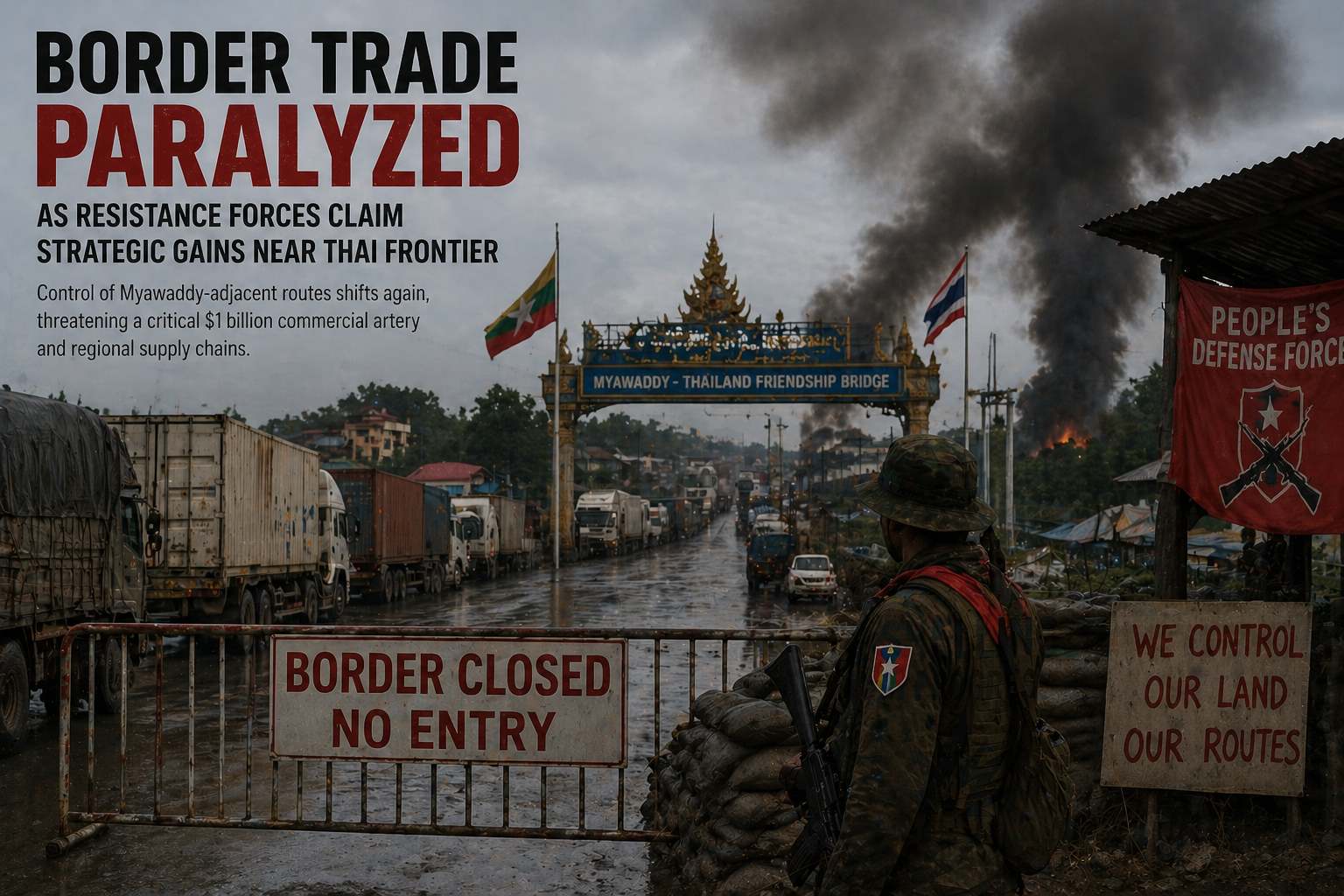
Control of Myawaddy-adjacent routes shifts again, threatening a critical $1 billion commercial artery and regional supply chains.
April 27, 2026
Last updated: April 27, 2026
By Global War News Editorial
Resistance forces in Myanmar, led by the Karen National Liberation Army (KNLA) and allied People’s Defence Forces (PDF), have reportedly asserted control over strategic positions surrounding the Myawaddy trade hub. This development follows weeks of intensified fighting along the Asian Highway 1, the primary land link for cross-border commerce with Thailand. The disruption has effectively halted the movement of cargo trucks, leaving millions of dollars in goods stranded at the border.
According to reports from The Irrawaddy and local monitoring groups, resistance fighters have established checkpoints on the periphery of Myawaddy, challenging the military junta’s recent attempts to secure the zone. While the town center remains under a fragile and contested administrative arrangement involving various Karen armed factions, the main transit corridors are currently reported as impassable for commercial traffic.
Background: The Siege of a Trade Giant
Myawaddy is the most significant of the six official Thai-Myanmar border crossings, accounting for over $1 billion in annual bilateral trade in recent fiscal years. Its strategic importance has made it a focal point of the civil war since the 2021 coup.
In April 2024, resistance forces briefly seized the town before a military counteroffensive and complex negotiations involving the Border Guard Force (BGF) saw the junta’s flag raised again. However, throughout late 2025 and early 2026, the military’s “Operation Aung Zeya”, intended to permanently secure the road to the border, has faced persistent ambushes, preventing a full return to commercial normalcy.
Economic Impact: Supply Chain Fragility
The immediate consequence of the renewed claims of control is the total suspension of legal trade through the No. 2 Thai-Myanmar Friendship Bridge. Logistics business owners in the region report that hundreds of trucks remain in warehouses on both sides of the Moei River.
The economic fallout includes:
- Rising Logistics Costs: Importers have been forced to use unpaved mountain passes, which reportedly cost up to 4.5 million kyats (approximately $2,100) per 12-wheeler truck in unofficial tolls and transit fees.
- Commodity Volatility: The disruption has caused sharp price increases for fuel, cooking oil, and pharmaceuticals in Myanmar’s heartland, which rely heavily on Thai imports.
- Export Stagnation: Major exports such as corn and agricultural products are unable to reach Thai markets during peak seasonal windows, threatening the livelihoods of thousands of small-scale farmers.
Analysis: A Strategy of Economic Attrition
The resistance’s focus on Myawaddy appears to be a shift toward economic attrition. By denying the junta access to customs revenues and stable trade routes, the anti-coup alliance is targeting the regime’s remaining hard currency reserves. Analysts note that while the military may hold the town’s administrative offices, their inability to secure the 132-km stretch of highway from Hpa-an to Myawaddy renders the “control” largely symbolic.
Conversely, the junta’s recent move to appoint Senior General Min Aung Hlaing as president in a contested legislative session has coincided with increased airstrikes in the region. Observers suggest the military is willing to risk the total destruction of trade infrastructure to prevent resistance forces from establishing a functional customs administration of their own.
Current Status and Outlook
As of Monday, Thai security forces have increased their presence in the neighboring district of Mae Sot to manage the potential spillover of the conflict. The Thai Foreign Ministry has expressed hopes for a resumption of trade, yet security experts suggest this is unlikely without a significant de-escalation that currently seems improbable.
The primary indicator for the month of May will be whether the Karen National Union (KNU) maintains its blockade of the Asian Highway or if a tactical withdrawal occurs. For now, the “East-West Economic Corridor” remains a battlefield, and the cost of the conflict continues to be felt in the rising prices of daily essentials across both Myanmar and regional border towns.
Sources:
- Reporting from The Irrawaddy and Myanmar Now (April 1–24, 2026).
- Data from the Myanmar Ministry of Commerce (Fiscal Year 2024-2025).
- Reports from Al Jazeera and Reuters regarding the Myawaddy siege and its aftermath.
- Statements from the Karen National Union (KNU) and the State Administration Council (SAC).
This article is based on publicly available reporting from named international news agencies and attributed official statements. All claims about ongoing events are attributed to their original sources. Analysis sections represent the editorial interpretation of reported facts and do not constitute advocacy for any party to the described conflict. AI tools may be utilized for image generation to assist in explaining complex concepts, as well as for refining grammar, spelling, and other linguistic enhancements. However, all original content is produced, fact-checked, and revised by the editorial team. This publication does not take political positions on active military conflicts.