
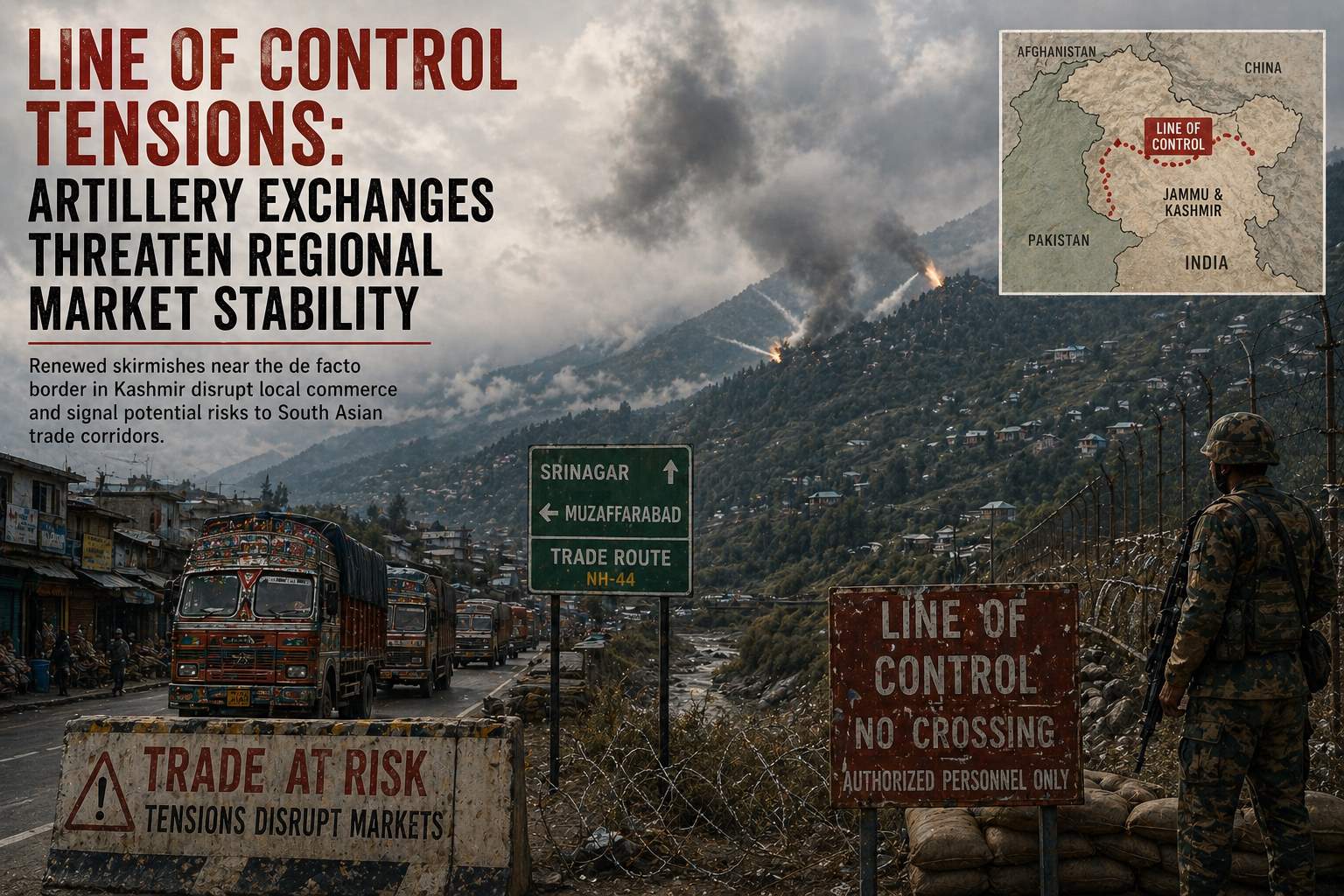
Renewed skirmishes near the de facto border in Kashmir disrupt local commerce and signal potential risks to South Asian trade corridors.
April 27, 2026
Last updated: April 27, 2026
By Global War News Editorial
Recent reports indicate a series of artillery exchanges and small-arms fire along several sectors of the Line of Control (LoC), the de facto border separating Indian and Pakistani-administered Jammu and Kashmir. These skirmishes, primarily centered in the Poonch and Rajouri districts, represent the most significant breach of the prevailing ceasefire arrangement in recent months. The escalation has prompted local authorities to restrict movement near the frontier, effectively halting cross-border logistics and agricultural activity in the immediate vicinity.
According to statements from regional military spokespersons and reporting from the Associated Press, the exchanges began late Sunday following allegations of infiltration attempts. While both sides have traded accusations of “unprovoked” firing, the immediate result has been the displacement of several hundred civilians from border villages and the suspension of local market operations.
Background: A History of Fragile Truces
The current friction follows a period of relative calm established after the major military escalation of May 2025. During that crisis, which involved significant missile and aerial engagements, both nations eventually agreed to a ceasefire following high-level hotline communications between their Directors General of Military Operations (DGMOs).
However, the underlying drivers of the conflict, disputed territorial claims and allegations of cross-border militancy—remain unresolved. Analysts note that seasonal changes in April often coincide with a spike in border activity as mountain passes become more accessible, frequently leading to tactical maneuvering that can inadvertently spark broader artillery duels.
Economic Impact: Local Trade and Agricultural Stagnation
The economic consequences of LoC volatility are felt most acutely by the border-adjacent populations whose livelihoods depend on stability. The recent shelling has led to:
- Agricultural Disruption: April is a critical month for the sowing of seasonal crops. Reporting from Dawn suggests that farmers in the Neelum Valley and Rajouri sectors have been unable to tend to their fields due to persistent mortar risks.
- Supply Chain Bottlenecks: While formal “cross-LoC trade” remains largely suspended due to political tensions, local commerce that services border garrisons and civilian outposts has been paralyzed. Logistics providers have reported a 15% increase in transport costs as vehicles are forced to take longer, more secure mountain routes.
- Infrastructure Damage: Initial reports from local administrative bodies indicate damage to several residential structures and at least one primary school near the Poonch sector. The cost of repairing such infrastructure in remote, high-altitude zones is often prohibitive for local governments already facing budgetary constraints.
Analysis: Tactical Friction or Strategic Shift?
The timing of these skirmishes raises questions about whether they are isolated tactical incidents or part of a broader strategic signaling. Observers note that India and Pakistan have both been navigating complex domestic economic recoveries throughout early 2026. For India, maintaining a stable northern frontier is vital for its broader “local-for-local” supply chain restructuring goals. For Pakistan, avoidence of an expensive escalation is a fiscal necessity as it manages ongoing debt obligations.
Analysts suggest that while neither side currently appears to seek a return to the full-scale conflict seen in 2025, the “normalization” of low-level artillery exchanges acts as a significant deterrent to foreign investment in the region. This persistent insecurity maintains a “risk premium” on South Asian infrastructure projects, complicating the World Bank’s recent efforts to promote regional connectivity.
Current Status and Outlook
As of Monday evening, local reports indicate that the intensity of the firing has subsided, though a “tense silence” prevails across the Lipa and Battal sectors. There have been no official calls for a new DGMO-level meeting, and both militaries remain in a state of high alert.
The outlook for the coming week depends on whether the current friction can be contained to the border’s periphery. If the shelling expands to include civilian administrative hubs, the risk of a wider escalation—and the subsequent closure of regional airspace—could mirror the economic shocks of the previous year. For now, traders and residents are monitoring the situation with caution, waiting to see if the 2025 ceasefire agreement will hold under this latest pressure.
Sources:
- Official statements from the Indian and Pakistani Ministries of Defense (April 26–27, 2026).
- Reporting from Reuters, Associated Press, and Sudan Tribune (regional conflict monitoring).
- Economic impact assessments on South Asian trade from the World Economic Forum (January 2026).
- Historical timeline of the 2025 India-Pakistan Conflict (Source: Arms Control Association).
This article is based on publicly available reporting from named international news agencies and attributed official statements. All claims about ongoing events are attributed to their original sources. Analysis sections represent the editorial interpretation of reported facts and do not constitute advocacy for any party to the described conflict. AI tools may be utilized for image generation to assist in explaining complex concepts, as well as for refining grammar, spelling, and other linguistic enhancements. However, all original content is produced, fact-checked, and revised by the editorial team. This publication does not take political positions on active military conflicts.