
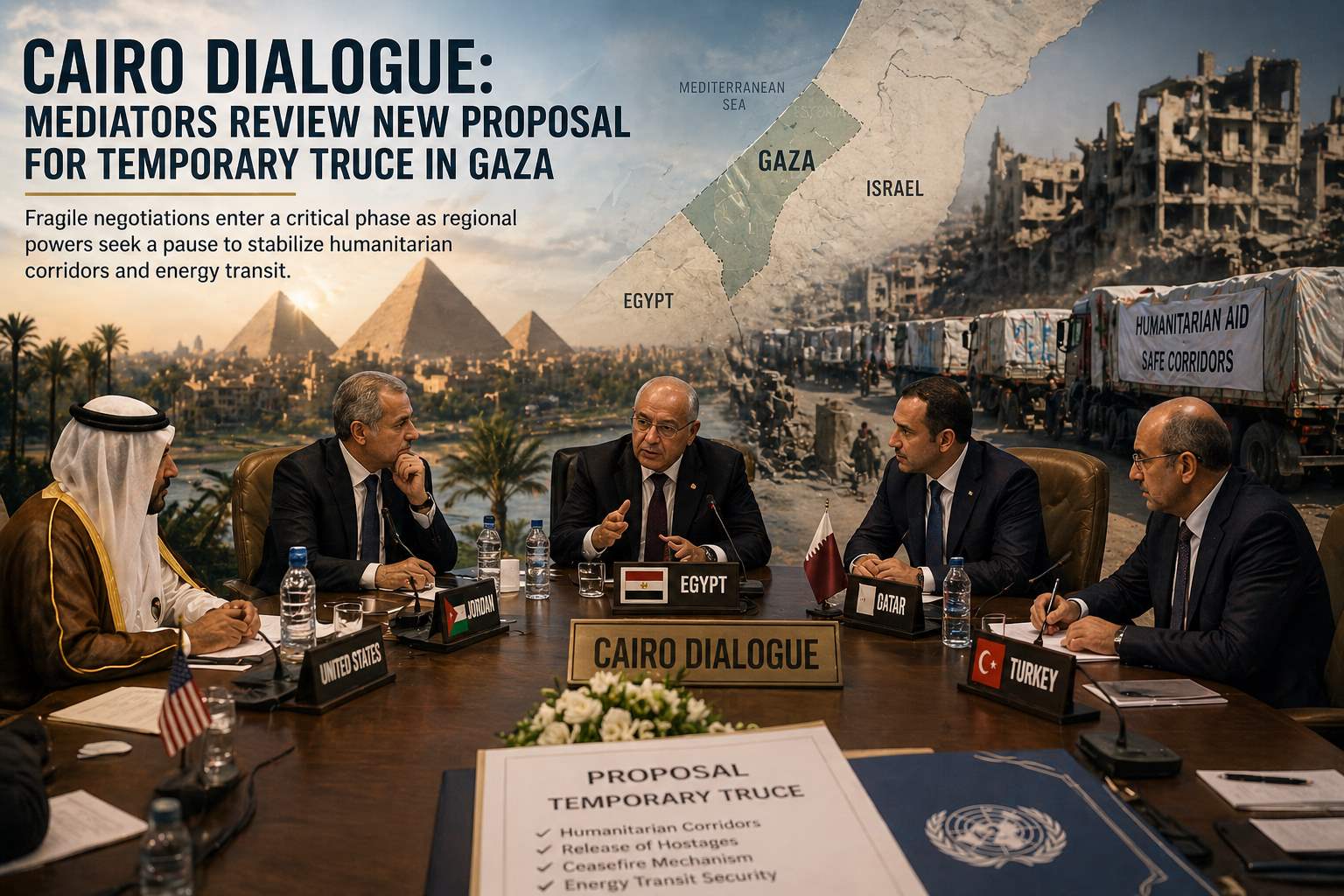
Fragile negotiations enter a critical phase as regional powers seek a pause to stabilize humanitarian corridors and energy transit.
April 27, 2026
Last updated: April 27, 2026
By Global War News Editorial
Diplomatic representatives from Egypt, Qatar, and the United States have convened in Cairo to review a refined proposal for a temporary truce in the Gaza Strip. The latest framework, reportedly presented to both Israeli and Hamas delegations, aims to establish a phased cessation of hostilities to allow for the massive influx of humanitarian aid and the potential exchange of detainees. While previous rounds of talks have struggled to reach a definitive conclusion, mediators have suggested that the current draft includes more specific guarantees regarding the duration of the pause and the security of delivery routes.
According to reporting from Al Jazeera and Reuters, the “Cairo Dialogue” is operating under increased pressure from the international community to prevent a further spillover into neighboring maritime corridors. Although the core of the negotiations remains humanitarian, the broader economic implications for Middle Eastern stability have dominated the sidelines of the summit.
Background: A Cycle of Protracted Negotiations
Since the escalation of the conflict, multiple truce proposals have been tabled, often faltering over the definition of a “permanent” versus “temporary” cessation of fire. By early 2026, the humanitarian situation in Gaza has reached what the UN describes as a catastrophic threshold, with infrastructure damage estimated by the World Bank to exceed $20 billion.
The Cairo Dialogue represents a shift toward a more modular approach, breaking the truce into distinct stages to build trust between the parties. Mediators are focusing on an initial six-week window, which they hope will serve as a proof-of-concept for longer-term regional de-escalation.
Economic Impact: Regional Stability and Trade Confidence
The absence of a truce has exerted a persistent “conflict premium” on the regional economy. The Cairo talks are being closely watched by market analysts for their potential to alleviate several economic pressures:
- Regional Investment Climate: The IMF has previously noted that prolonged instability in the Levant has dampened foreign direct investment across Jordan, Egypt, and Lebanon. A successful truce in Cairo is seen as a necessary precursor to restoring investor confidence in the Eastern Mediterranean.
- Suez Canal Revenue: Egypt’s economy remains sensitive to the security of the Red Sea and the Suez Canal. While the Gaza conflict is distinct from the maritime threats in the south, Egyptian officials have stated that a pause in Gaza would significantly de-escalate the regional “temperature,” potentially encouraging shipping firms to return to the canal.
- Reconstruction Planning: Donor nations and international financial institutions have reportedly linked the release of large-scale reconstruction funds to a verified and stable truce. Without the Cairo framework, the logistics of rebuilding Gaza’s power and water infrastructure remain unfunded and uninsurable.
Analysis: The “Pause” as a Strategic Buffer
The current proposal is being analyzed not as a final peace treaty, but as a strategic buffer. By focusing on a “temporary” arrangement, mediators are attempting to bypass the seemingly irreconcilable political demands of both parties in favor of immediate humanitarian relief.
Observers note that for Egypt, the Cairo Dialogue is also a matter of national security. The potential for a mass displacement event toward the Sinai Peninsula remains a primary concern for Cairo’s leadership. A successful truce would stabilize the border and allow for a more controlled, institutionalized delivery of aid through the Rafah and Kerem Shalom crossings. However, the risk remains that any violation of the truce during the first phase could lead to an even more intense resumption of hostilities, effectively resetting months of diplomatic labor.
Current Status and Outlook
As of late Monday, sources close to the talks indicate that the delegations are reviewing the technicalities of the “Phase One” withdrawal of forces from high-density civilian areas. No official signing ceremony has been scheduled, and spokespersons for the involved parties have warned that “significant gaps” remain regarding the ratio of detainee exchanges.
The outlook for the coming week depends on the internal deliberations of the respective leaderships. If a truce is reached, the primary indicator of success will be the volume of aid trucks successfully entering northern Gaza and the maintenance of the ceasefire during the initial 72-hour window. For the global economy, a “Cairo Success” would likely lead to a cooling of regional oil price volatility and a cautious uptick in Middle Eastern market indices.
Sources:
- Official statements from the Egyptian Ministry of Foreign Affairs and the Qatari Ministry of Foreign Affairs (April 26–27, 2026).
- Reporting from Al Jazeera, Reuters, and BBC News regarding the Cairo summit.
- UN OCHA and World Bank reports on Gaza infrastructure damage (Q1 2026).
- IMF Regional Economic Outlook for the Middle East and Central Asia.
This article is based on publicly available reporting from named international news agencies and attributed official statements. All claims about ongoing events are attributed to their original sources. Analysis sections represent the editorial interpretation of reported facts and do not constitute advocacy for any party to the described conflict. AI tools may be utilized for image generation to assist in explaining complex concepts, as well as for refining grammar, spelling, and other linguistic enhancements. However, all original content is produced, fact-checked, and revised by the editorial team. This publication does not take political positions on active military conflicts.