
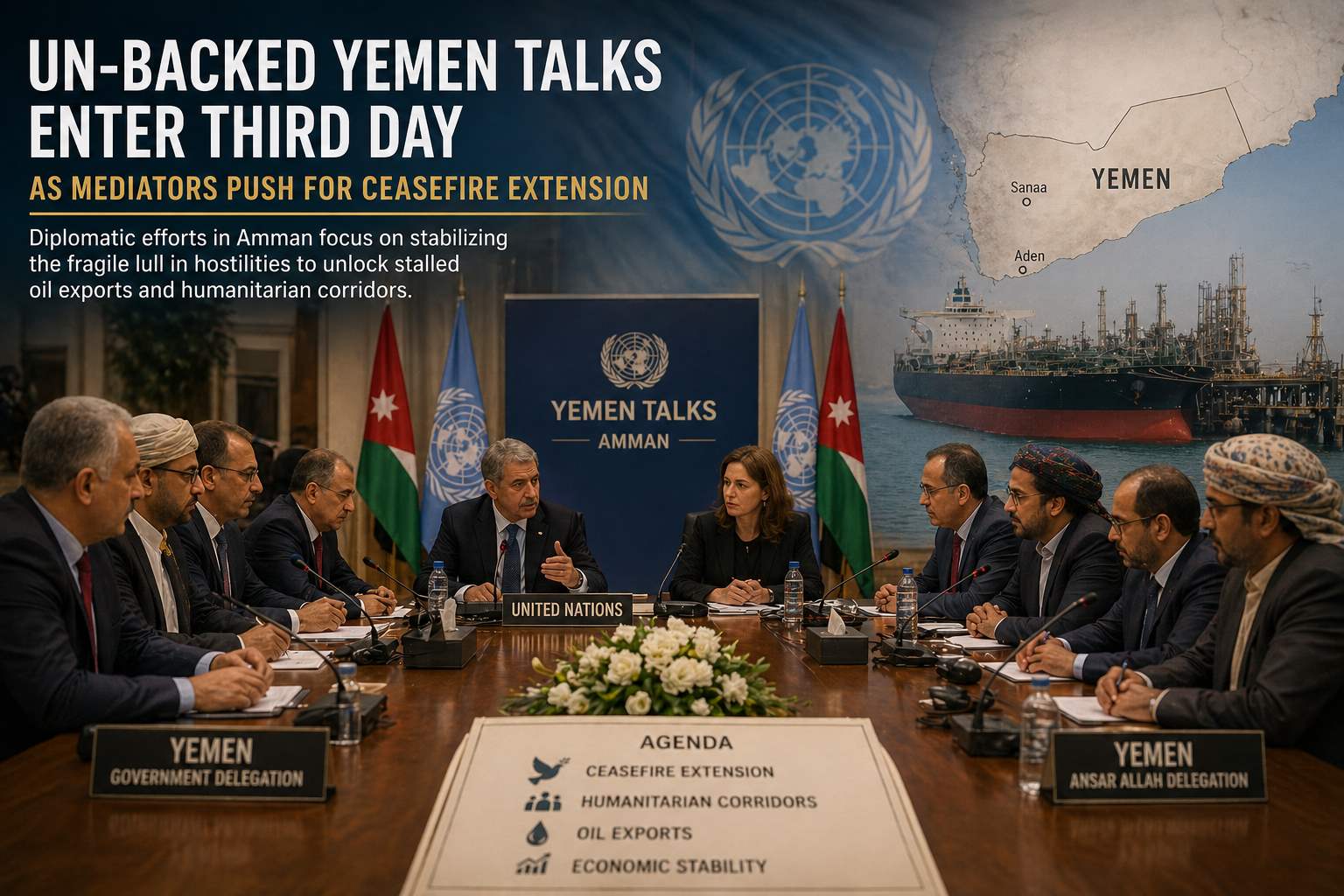
Diplomatic efforts in Amman focus on stabilizing the fragile lull in hostilities to unlock stalled oil exports and humanitarian corridors.
April 27, 2026
Last updated: April 27, 2026
By Global War News Editorial
UN-facilitated negotiations for an extension of the nationwide ceasefire in Yemen have entered their third consecutive day in Amman, Jordan. The talks, convened under the framework of the Military Coordination Committee (MCC), bring together representatives from the internationally recognized government, the Saudi-led coalition, and the Houthi movement. According to a statement from the Office of the UN Special Envoy for Yemen, Hans Grundberg, the current discussions are centered on “technical de-escalation measures” intended to preserve the relative calm that has largely held since 2022.
While the formal truce expired in late 2022, its core elements, including the opening of Sana’a airport and the easing of restrictions on the port of Hodeidah, have remained a vital lifeline for the country. The current push for a formal extension comes at a time of heightened regional volatility, as mediators seek to insulate Yemen from broader Middle Eastern tensions that have periodically threatened to reignite the conflict.
Background: A Precarious Lull
The conflict in Yemen, which escalated in 2015, has long been described by the United Nations as one of the world’s most severe humanitarian crises. The 2022 truce provided the first significant reprieve for civilians, yet a permanent political settlement has remained elusive. Throughout early 2026, the UN Special Envoy has conducted a series of regional visits to Muscat and Riyadh, emphasizing that “no single actor has the right to unilaterally drag the country back into a wider conflict.”
The Amman talks follow a crucial shift in 2025, during which military frontlines remained relatively static, allowing for a modest transition toward economic stabilization. However, persistent issues, including the detention of UN personnel and sporadic clashes in southern governorates, continue to underscore the fragility of the peace process.
Economic Impact: The Stalled Oil Recovery
The outcome of the Cairo and Amman dialogues is directly linked to Yemen’s macroeconomic survival. The IMF reported in early April 2026 that the Yemeni economy is only beginning to emerge from a deep recession caused by the 2022 suspension of oil exports.
Key economic factors hinging on a successful ceasefire extension include:
- Hydrocarbon Exports: Yemen’s fiscal deficit remains critical due to the halt in oil and Liquefied Petroleum Gas (LPG) exports following 2022 drone strikes on export terminals. A formal truce extension is seen as a prerequisite for international firms to resume production and export operations.
- Currency Stability: According to the IMF, Yemen’s reserves barely cover one month of essential imports. Any return to full-scale warfare would likely lead to a rapid depreciation of the rial, further inflating the cost of food and medicine for a population where 18.3 million are already acutely food insecure.
- Humanitarian Funding Gap: The 2026 Yemen Humanitarian Needs and Response Plan (HNRP) requires $2.16 billion to assist 22 million people. UN officials note that donor fatigue is exacerbated by security risks; a formal ceasefire would provide the “stability premium” necessary to secure international aid commitments.
Analysis: De-escalation Amidst Regional Spillovers
The “Cairo and Amman tracks” are being viewed by observers as a strategic attempt to “de-link” Yemen from the intensifying maritime and aerial conflicts in the Red Sea and the Strait of Hormuz. By focusing on face-to-face military coordination, the UN hopes to build sufficient confidence to transition from a “lull” to a “sustainable peace.”
However, analysts note that the Houthis’ continued detention of 73 UN and NGO personnel remains a significant hurdle to full diplomatic normalization. The UN’s strategy appears to be a dual-track approach: managing immediate military friction in Amman while utilizing regional partners like Oman to facilitate broader political concessions. If the talks fail to secure a formal extension by the end of the week, the risk of a “reciprocal escalation”, where infrastructure in Houthi-held areas and government-controlled oil ports are targeted—could return Yemen to the catastrophic levels of violence seen in 2018.
Current Status and Outlook
As of Monday, the parties remain engaged in closed-door consultations. Reports from the UN Envoy’s office suggest that while “incremental progress” has been made on finalizing names for a new detainee release operation, the broader agreement on a permanent ceasefire remains stalled by disagreements over the payment of public sector salaries from oil revenues.
The outlook for the remainder of April depends on whether the military representatives can agree on a shared monitoring mechanism for the frontlines. For the global community, a stable Yemen is essential for the security of the Bab el-Mandeb Strait. For the Yemeni people, the stakes are existential; the difference between a successful extension and a return to war is the difference between a fragile economic recovery and a renewed descent into famine.
Sources:
- Official statements from the Office of the UN Special Envoy for Yemen, Hans Grundberg (April 22–27, 2026).
- IMF Executive Board Article IV Consultation report for the Republic of Yemen (April 2, 2026).
- UN Security Council Report: Yemen Monthly Forecast (April 2026).
- Reporting from Middle East Online and Anadolu Agency regarding the Amman military coordination talks.
- UN OCHA 2026 Humanitarian Needs and Response Plan (HNRP).
This article is based on publicly available reporting from named international news agencies and attributed official statements. All claims about ongoing events are attributed to their original sources. Analysis sections represent the editorial interpretation of reported facts and do not constitute advocacy for any party to the described conflict. AI tools may be utilized for image generation to assist in explaining complex concepts, as well as for refining grammar, spelling, and other linguistic enhancements. However, all original content is produced, fact-checked, and revised by the editorial team. This publication does not take political positions on active military conflicts.