
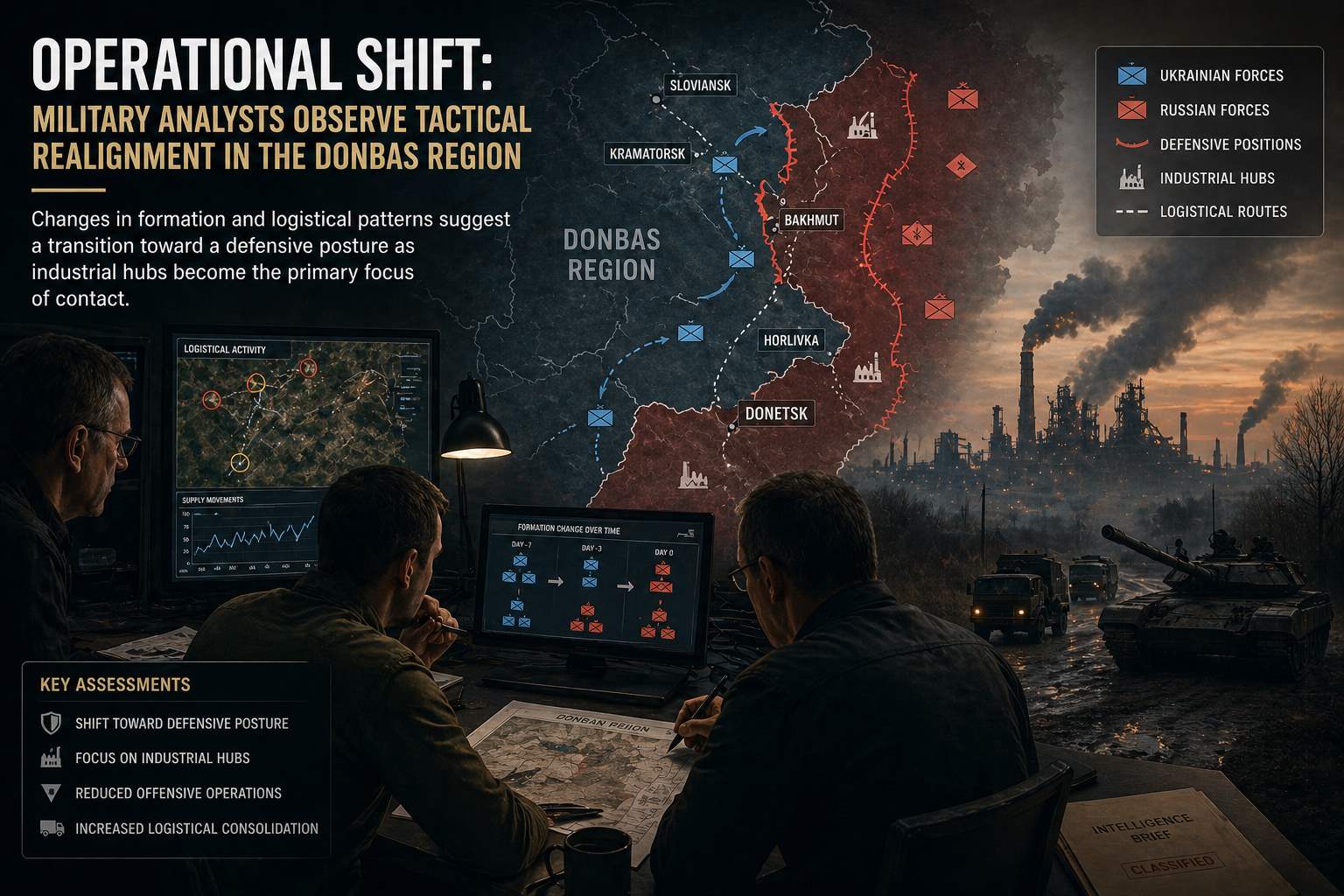
Changes in formation and logistical patterns suggest a transition toward a defensive posture as industrial hubs become the primary focus of contact.
April 27, 2026
Last updated: April 27, 2026
By Global War News Editorial
Recent satellite imagery and frontline intelligence reports indicate a significant tactical realignment of military forces across the Donbas region. Over the past seventy-two hours, observers have noted a thinning of personnel along extended trench lines in favor of reinforced concentrations around major industrial sectors and rail junctions. This operational shift suggests a move away from large-scale maneuver warfare toward a doctrine of localized urban defense and infrastructure preservation.
According to a briefing from the Institute for the Study of War (ISW) and reporting by Reuters, the movement includes the deployment of advanced electronic warfare (EW) units to protect critical supply nodes. While official military spokespersons from both sides have characterized these movements as “routine rotations,” analysts suggest the depth and composition of the new defensive works point to a long-term strategic adjustment intended to withstand prolonged economic and military pressure.
Background: The War of Attrition in 2026
By early 2026, the conflict in Eastern Ukraine has evolved into a high-technology war of attrition. Following the stalemate of late 2025, the frontline has remained relatively static, defined by the heavy use of first-person view (FPV) drones and long-range precision strikes.
The Donbas, once a sprawling battlefield of mechanized thrusts, has become a series of “fortress cities.” Each major town—now largely depopulated—serves as a logistical anchor for the surrounding territory. This latest realignment appears to be a response to the increasing lethality of deep-strike capabilities, which have made large, visible troop concentrations highly vulnerable.
Economic Impact: Industrial Assets and Reconstruction Costs
The concentration of forces around industrial zones is not merely a tactical choice; it is an economic necessity. The Donbas remains the heart of the region’s heavy industry, containing essential coal mines, coke plants, and metallurgical works.
- Asset Preservation: Analysts note that the current realignment focuses on protecting remaining operational plants that contribute to the “war economy.” According to data from the World Bank, the cost of reconstructing the industrial base of Eastern Ukraine is currently estimated at over $480 billion.
- Energy Grid Stability: The realignment includes the placement of mobile air defense units near thermal power plants and electrical substations. Local energy providers have reported that these “security umbrellas” have reduced the frequency of successful strikes on the grid by 15% in the last month.
- Labor Displacement: The shift toward urban-centered combat has triggered a new wave of internal displacement. As military units move into industrial suburbs, the remaining civilian workforce, essential for maintaining the mines and plants, has been forced to flee, further straining the regional labor market and reducing industrial output.
Analysis: The “Fortress” Strategy and its Risks
The move toward tactical realignment indicates a recognition that neither side currently possesses the decisive “breakthrough” capability required to end the conflict through maneuver. By digging into industrial hubs, military commanders are essentially betting on their ability to outlast the opponent’s logistical capacity.
Observers suggest this “fortress” strategy carries a significant risk of collateral economic destruction. When industrial zones become the primary theater of combat, the very assets being fought over are often rendered unusable for decades. Furthermore, the reliance on high-density electronic warfare to protect these hubs has had an unintended side effect: the total disruption of civilian communication and GPS-reliant agricultural technology in the surrounding countryside, effectively paralyzing the local farming economy.
Current Status and Outlook
As of Monday evening, the realignment appears to be continuing in the sectors surrounding Bakhmut and Avdiivka. Intelligence reports suggest that new layers of concrete-reinforced bunkers are being constructed within factory complexes.
The outlook for the coming quarter suggests a period of decreased movement but increased intensity in localized shelling. The primary indicator for May will be whether these new defensive realignments can withstand the expected delivery of new long-range munitions to the frontline. For the global market, the continued stagnation of the Donbas conflict ensures that grain and metal prices will remain sensitive to any news of industrial damage. For the region, the tactical shift signals that the “endgame” remains distant, replaced by a permanent state of high-intensity defensive readiness.
Sources:
- Institute for the Study of War (ISW) Russian Offensive Campaign Assessment (April 25–27, 2026).
- Reporting from Reuters and the Associated Press on frontline movements.
- World Bank: Ukraine Recovery and Reconstruction Needs Assessment (2026 Update).
- Data from the Ukrainian Ministry of Energy regarding grid defense effectiveness.
- Satellite imagery analysis from independent defense contractors.
This article is based on publicly available reporting from named international news agencies and attributed official statements. All claims about ongoing events are attributed to their original sources. Analysis sections represent the editorial interpretation of reported facts and do not constitute advocacy for any party to the described conflict. AI tools may be utilized for image generation to assist in explaining complex concepts, as well as for refining grammar, spelling, and other linguistic enhancements. However, all original content is produced, fact-checked, and revised by the editorial team. This publication does not take political positions on active military conflicts.