
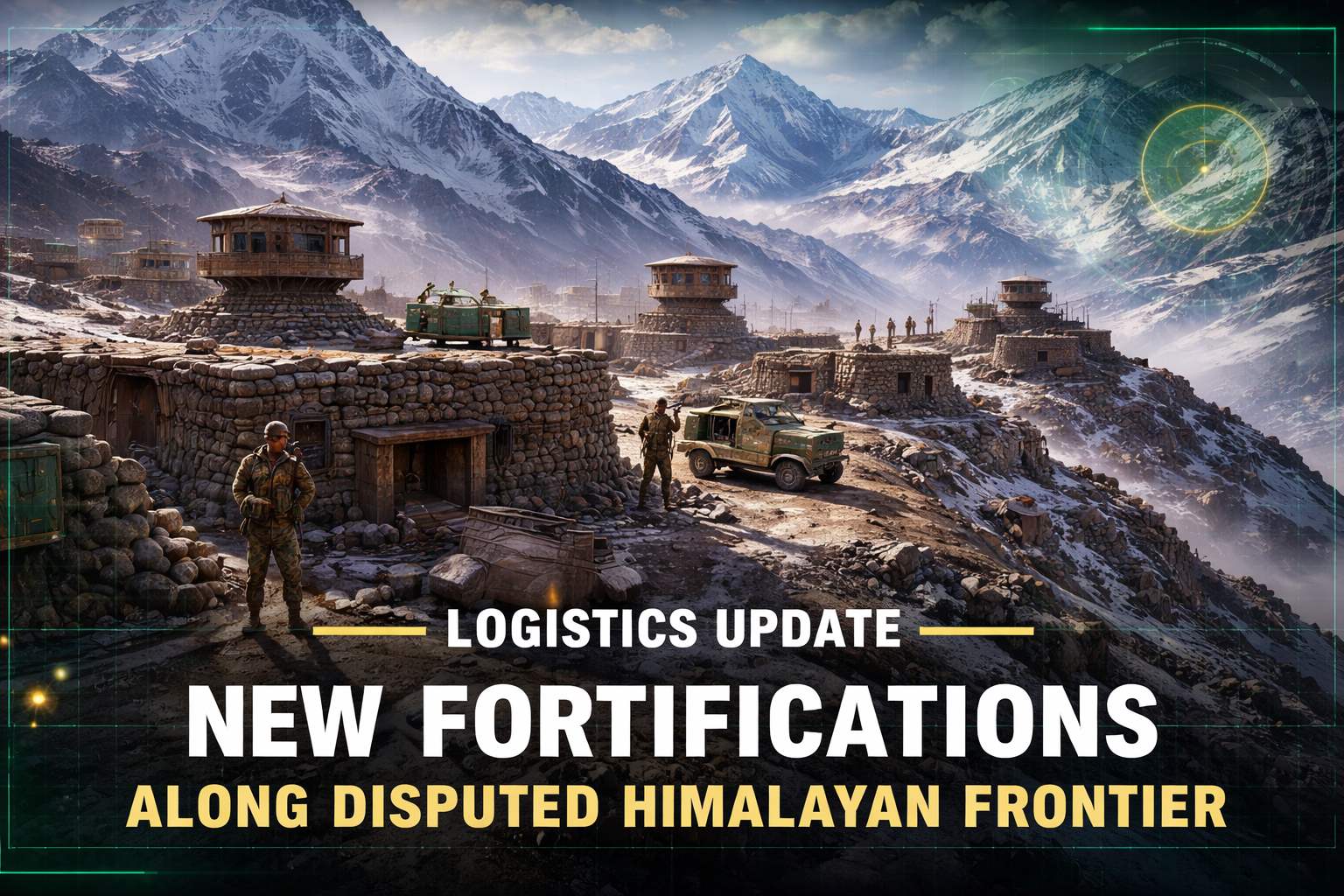
Satellite imagery reveals a surge in high-altitude construction, signaling a transition toward permanent militarization of the “Roof of the World.”
April 27, 2026
Last updated: April 27, 2026
By Global War News Editorial
Recent satellite imagery and intelligence briefings suggest a significant expansion of military infrastructure along the disputed Himalayan frontier between India and China. Over the past month, new permanent fortifications, including reinforced fuel depots, cold-weather barracks, and expanded airstrips, have been observed in several high-altitude sectors. These developments indicate that the temporary standoffs of previous years are being replaced by a permanent, year-round military presence in one of the world’s most inhospitable environments.
According to reporting from Reuters and analysis by the Center for Strategic and International Studies (CSIS), the construction is focused on “dual-use” infrastructure—roads and bridges that serve both remote civilian settlements and rapid military mobilization. While official statements from both New Delhi and Beijing continue to emphasize the importance of diplomatic disengagement, the on-the-ground reality suggests a hardening of positions that could redefine regional logistics for decades.
Background: The High-Altitude Stalemate
The frontier, characterized by the Line of Actual Control (LAC), has been a point of friction since the 2020 Galwan Valley clash. Since then, the region has seen a massive “logistics race.” By early 2026, the strategy has shifted from seasonal patrolling to “permanent occupancy.”
Advances in tunnel-boring technology and high-altitude engineering have allowed for the creation of all-weather routes through passes that were previously closed for six months of the year. This infrastructure allows both nations to bypass the traditional limitations of Himalayan winters, maintaining high-readiness levels regardless of weather conditions.
Economic Impact: The “Border Tax” on Regional Development
The militarization of the Himalayas carries a steep economic price, diverting resources from civilian development and altering the trade dynamics of South and Central Asia.
- Defense Budget Strain: Both nations have seen a significant “border tax” on their national treasuries. According to data from SIPRI, the cost of maintaining a single soldier at altitudes above 4,500 meters is approximately four to five times higher than at sea level.
- Infrastructure Divergence: The World Bank notes that while “dual-use” roads provide connectivity to remote villages, they are often designed for heavy hardware rather than commercial transit. This “fortress-style” development prioritizes security over the potential for trans-Himalayan trade corridors.
- Mineral and Water Security: The disputed regions sit atop vital glacial water sources and potential rare-earth mineral deposits. Analysts note that permanent fortifications around these sites represent a strategic move to secure “natural capital” as climate change makes these resources increasingly scarce.
Analysis: Logistics as a Form of Deterrence
In the context of the Himalayan frontier, logistics is not merely a support function; it is a primary form of deterrence. By building permanent barracks and paved airstrips, a nation signals its intent and capability to hold territory indefinitely. This “fait accompli” strategy aims to discourage the opponent from attempting to alter the status quo through tactical incursions.
Observers suggest that this “concrete-and-steel” approach to border management lowers the threshold for a localized skirmish to escalate into a broader conflict. With troops stationed closer to the line and supported by rapid-reaction infrastructure, the “buffer zones” that previously allowed for diplomatic cooling-off periods are effectively shrinking. Furthermore, the reliance on high-tech surveillance and 24/7 monitoring means that even minor construction projects by one side are viewed as strategic provocations by the other.
Current Status and Outlook
As of Monday, construction crews remain active in the eastern and western sectors of the frontier. The Indian Ministry of External Affairs recently stated that “peace and tranquility” on the border are essential for a normal bilateral relationship, while the Chinese Ministry of National Defense has defended its construction as “legitimate activity on its own territory.”
The outlook for the remainder of 2026 suggests a continuation of this “infrastructure war.” The primary indicator of escalation will be the deployment of offensive assets—such as long-range artillery or missile batteries—to these new fortifications. For the global economy, a stable Himalayan frontier is essential for the steady flow of trade through the broader Indo-Pacific. For the region, the rising wall of concrete at the “Roof of the World” signals that the era of the open, fluid frontier has come to a definitive end.
Sources:
- Satellite imagery analysis provided by Maxar Technologies and CSIS (April 2026).
- Reporting from Reuters, The Associated Press, and The Times of India.
- SIPRI Year Book 2025-2026: Military Expenditure Trends.
- Official statements from the Indian Ministry of External Affairs and the Chinese Ministry of National Defense.
This article is based on publicly available reporting from named international news agencies and attributed official statements. All claims about ongoing events are attributed to their original sources. Analysis sections represent the editorial interpretation of reported facts and do not constitute advocacy for any party to the described conflict. AI tools may be utilized for image generation to assist in explaining complex concepts, as well as for refining grammar, spelling, and other linguistic enhancements. However, all original content is produced, fact-checked, and revised by the editorial team. This publication does not take political positions on active military conflicts.