
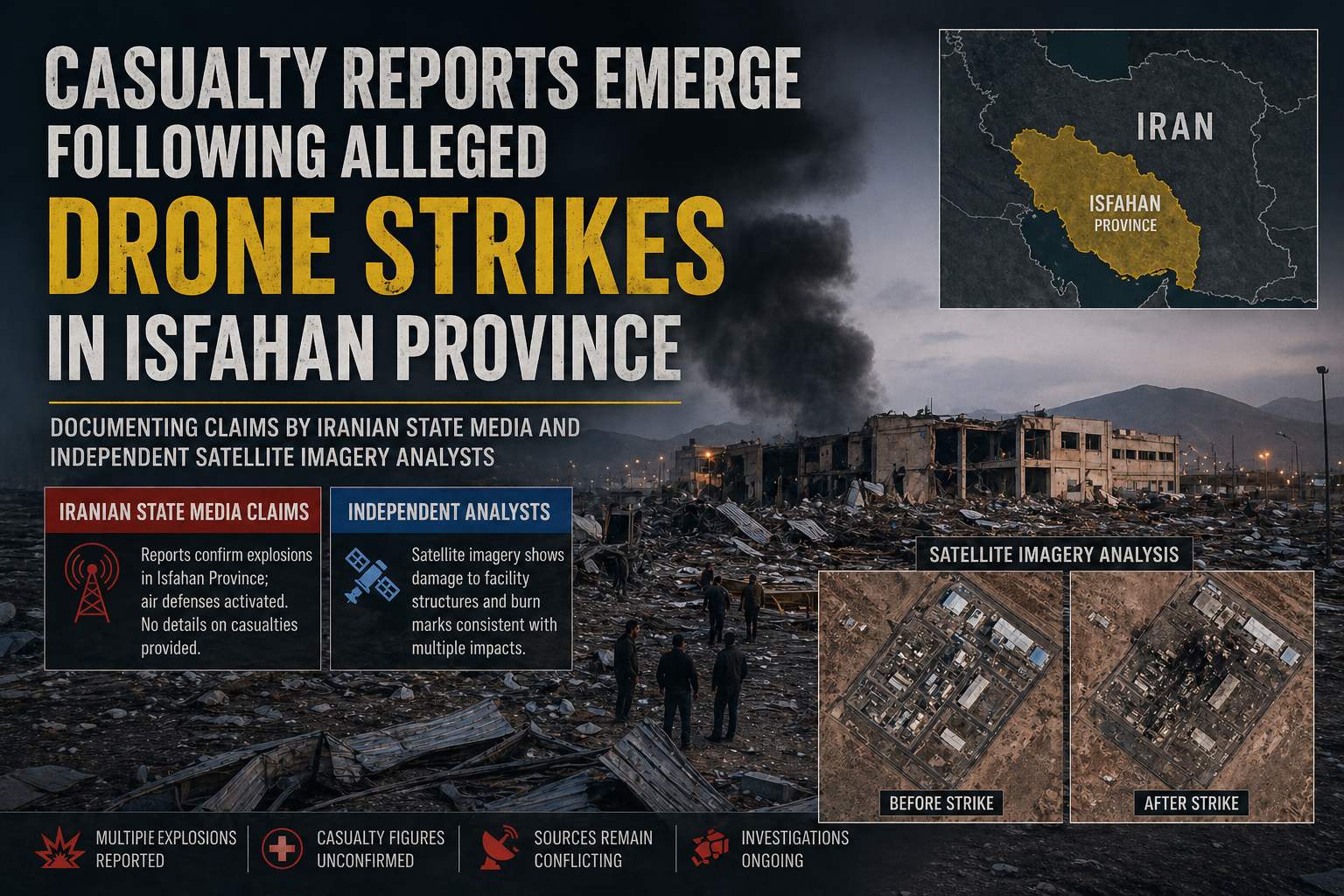
Documentation from Iranian state media and independent satellite analysts indicates renewed activity at central military hubs despite ongoing regional truce efforts.
April 28, 2026
Last Updated: April 28, 2026
By Global War News Editorial
Recent reports from central Iran indicate a series of explosions in Isfahan Province, a region critical to the country’s defense industrial complex and nuclear research. Iranian state media outlets, including the Mehr News Agency, confirmed that air defense systems were activated on Wednesday evening following the detection of “suspicious objects.” While official government statements initially downplayed the severity of the incident, local casualty reports have begun to emerge, suggesting a more significant impact than previously acknowledged.
The incident occurs against a backdrop of a fragile, multi-party ceasefire initiated in early April 2026. However, independent monitors note that “gray zone” activities, unattributed drone and missile strikes, have continued to target high-value military infrastructure. Isfahan, home to the Hesa aircraft plant and several missile production facilities, remains a primary focal point for such engagements.
State Media Accounts and Official Denials
According to Iranian state-affiliated broadcasters, the sounds of explosions heard near the city of Isfahan were the result of “successful interceptions” by ground-based defense batteries. Initial reports from the Islamic Republic of Iran Broadcasting (IRIB) claimed that no significant damage was recorded at any sensitive sites and that the situation in the province remains “normal.”
However, local eyewitness accounts shared through semi-official channels tell a different story. Reports have emerged of ambulances being dispatched to the vicinity of a military workshop in northern Isfahan. While the Iranian Ministry of Defense has not officially released a casualty count, regional monitors suggest that at least four personnel were treated for injuries following a localized fire at a facility allegedly linked to drone manufacturing.
Satellite Imagery Analysis and Physical Evidence
Independent satellite imagery analysts have provided a more detailed view of the aftermath. Reports from OSINT (Open-Source Intelligence) accounts, corroborated by the Institute for the Study of War (ISW), indicate visible scorch marks and structural damage to the roof of a suspected munitions depot in the Isfahan industrial belt.
- Geolocated Footage: Analysis of social media video shows at least one “kamikaze” drone—likely a small-diameter quadcopter—impacting a building near the Shahid Babayi Air Base.
- Infrastructure Impact: Satellite passes from April 27 show a slight increase in thermal signatures at the site, consistent with a localized explosion and subsequent firefighting efforts.
- Supply Lines: Previous reports from ISW on April 7 had already noted the severing of key rail bridges in Kashan, Esfahan Province, aimed at disrupting the transport of missile launchers. This latest incident suggests a continuing effort to degrade the province’s logistical role.
Analysis: The Strategic Importance of Isfahan
Analysts suggest that the recurring focus on Isfahan is due to its density of high-value targets. The province serves as the heart of Iran’s ballistic missile program and its domestic drone industry. By targeting these sites, opposing forces can degrade Iran’s retaliatory capacity without necessarily launching a full-scale conventional invasion.
Observers note that these strikes appear to be “precision-focused,” designed to destroy specific laboratory equipment or assembly lines rather than entire complexes. This “salami-slicing” tactic allows for the continued degradation of military assets while remaining just below the threshold that would force a total collapse of the April ceasefire. It remains unclear whether these latest strikes will prompt a direct retaliatory response from Tehran or if the regime will maintain its current posture of strategic patience.
Closing Summary
As of late Tuesday, the situation in Isfahan appears to have stabilized, though a heavy security presence remains around industrial zones. International news agencies continue to seek clarification on the exact number of casualties. We will update this report as further verified data becomes available from regional health authorities or international monitoring bodies.
Sources: This report is based on reporting from Mehr News Agency, IRIB, and the Anadolu Agency. Tactical analysis incorporates satellite imagery assessments from the Institute for the Study of War (ISW) and geolocated footage verified by independent OSINT analysts.
This article is based on publicly available reporting from named international news agencies and attributed official statements. All claims about ongoing events are attributed to their original sources. Analysis sections represent the editorial interpretation of reported facts and do not constitute advocacy for any party to the described conflict. AI tools may be utilized for image generation to assist in explaining complex concepts, as well as for refining grammar, spelling, and other linguistic enhancements. However, all original content is produced, fact-checked, and revised by the editorial team. This publication does not take political positions on active military conflicts.