
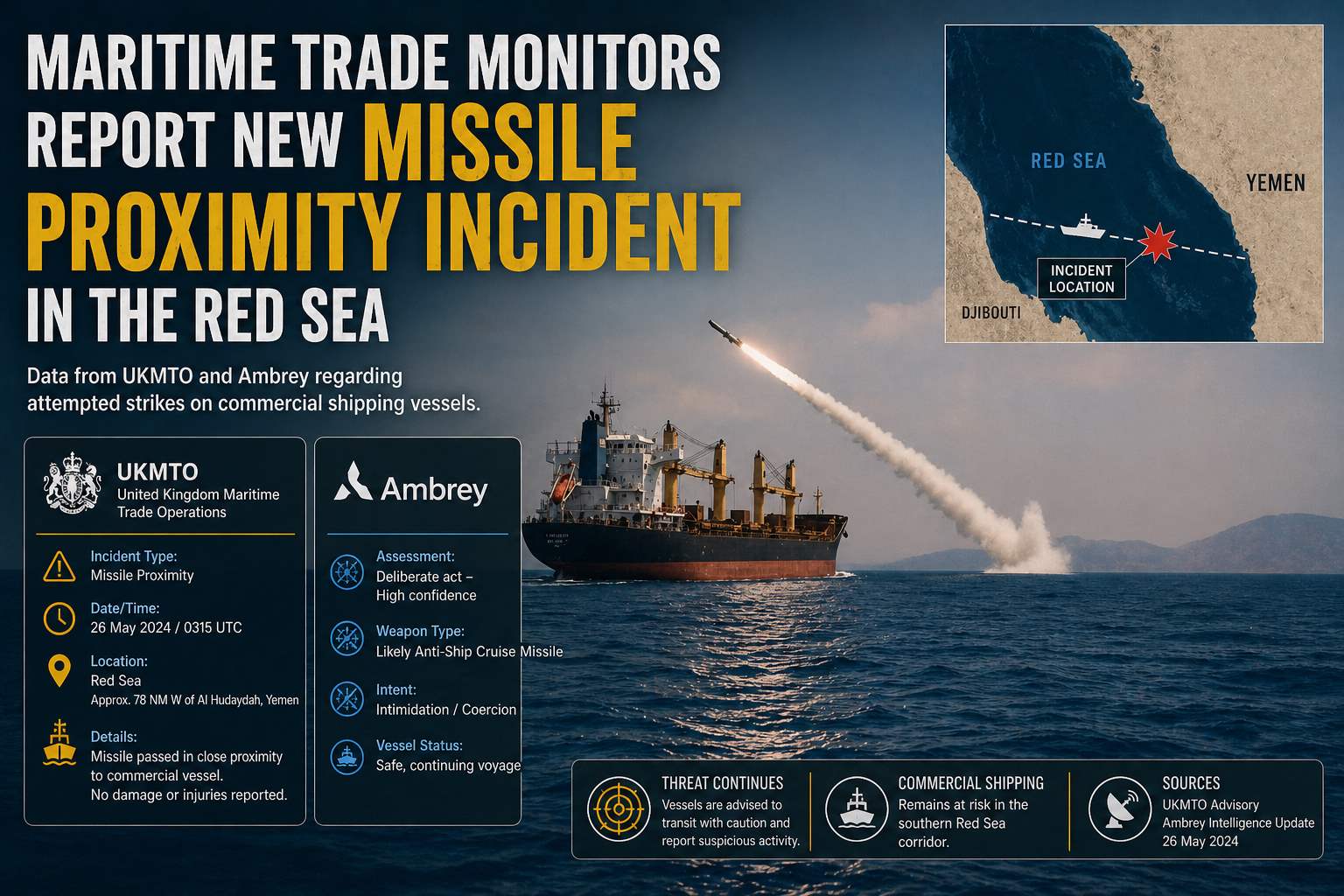
UKMTO and Ambrey confirm a targeted strike attempt near the Bab el-Mandeb Strait, further disrupting global logistics and insurance premiums.
April 28, 2026
Last Updated: April 28, 2026
By Global War News Editorial
International maritime monitors have reported a significant security incident in the southern Red Sea, where a commercial bulk carrier was targeted by a missile in close proximity. According to the United Kingdom Maritime Trade Operations (UKMTO) and the private security firm Ambrey, the incident occurred approximately 60 nautical miles southwest of Aden. While the vessel and its crew are reported safe, the event marks a renewed escalation in a region that serves as a critical artery for global trade.
The attack comes at a time when shipping lanes through the Suez Canal are already experiencing a 40% reduction in traffic compared to 2024 levels. As major shipping conglomerates continue to divert vessels around the Cape of Good Hope, this latest incident reinforces the persistent risk to the 12% of global trade that traditionally transits the Red Sea.
Technical Details of the Engagement
According to an advisory issued by UKMTO on Tuesday morning, the Master of the vessel reported an explosion in the water at a distance of approximately 0.5 nautical miles from the ship. The report stated that “the vessel and all crew are safe and proceeding to the next port of call.” No immediate distress signal was sent, and the ship reportedly maintained its course and speed.
Ambrey’s intelligence brief provided further context, identifying the vessel as a Marshall Islands-flagged carrier. Ambrey analysts noted that the missile’s trajectory suggested it was launched from a coastal region in western Yemen. The firm has advised all commercial vessels in the vicinity to exercise extreme caution and to follow established “Best Management Practices” for transit through High-Risk Areas (HRA).
Economic Consequences: Insurance and Freight Costs
The economic impact of these proximity incidents extends far beyond the physical damage to individual ships. Analysts at Global War News note that every reported missile launch triggers an immediate reassessment of risk by maritime insurers.
- War Risk Premiums: Following the latest reports, industry observers suggest that war risk premiums for Red Sea transits may rise by an additional 10% to 15%.
- Logistics Delays: Diverting a standard container ship around Africa adds approximately 10 to 14 days to a journey from Asia to Northern Europe, significantly increasing fuel consumption and operational costs.
- Supply Chain Inflation: The International Monetary Fund (IMF) has previously cautioned that sustained disruptions in the Red Sea could contribute to a 0.5% increase in global core inflation as transport costs are passed on to consumers.
For emerging economies in South Asia and East Africa, these disruptions are particularly acute, as they rely heavily on the Suez route for the export of agricultural goods and the import of industrial machinery.
Analysis: The Persistence of Maritime Insecurity
Military and trade analysts suggest that despite international naval task force presence, the threat from land-based missile systems remains difficult to neutralize. The “proximity” nature of these strikes, where missiles land near but do not necessarily hit the target, still achieves the strategic objective of the attackers: to create an environment of “prohibitive risk.”
Observers note that as long as the cost of insurance and the fear of crew casualties remain high, the Red Sea will remain a “no-go zone” for a significant portion of the global merchant fleet. This raises questions about the long-term viability of the Suez Canal as a reliable trade route if localized conflicts in the Middle East continue to manifest as maritime threats.
Closing Summary
As of Tuesday afternoon, the targeted vessel has exited the immediate danger zone and is under the monitoring of regional naval forces. UKMTO continues to advise vessels to report any suspicious activity immediately. We will continue to track the impact of these security developments on global freight rates and energy prices.
Sources: This report is based on official advisories from the United Kingdom Maritime Trade Operations (UKMTO), security briefs from Ambrey, and trade data from the IMF and the Suez Canal Authority.
This article is based on publicly available reporting from named international news agencies and attributed official statements. All claims about ongoing events are attributed to their original sources. Analysis sections represent the editorial interpretation of reported facts and do not constitute advocacy for any party to the described conflict. AI tools may be utilized for image generation to assist in explaining complex concepts, as well as for refining grammar, spelling, and other linguistic enhancements. However, all original content is produced, fact-checked, and revised by the editorial team. This publication does not take political positions on active military conflicts.