
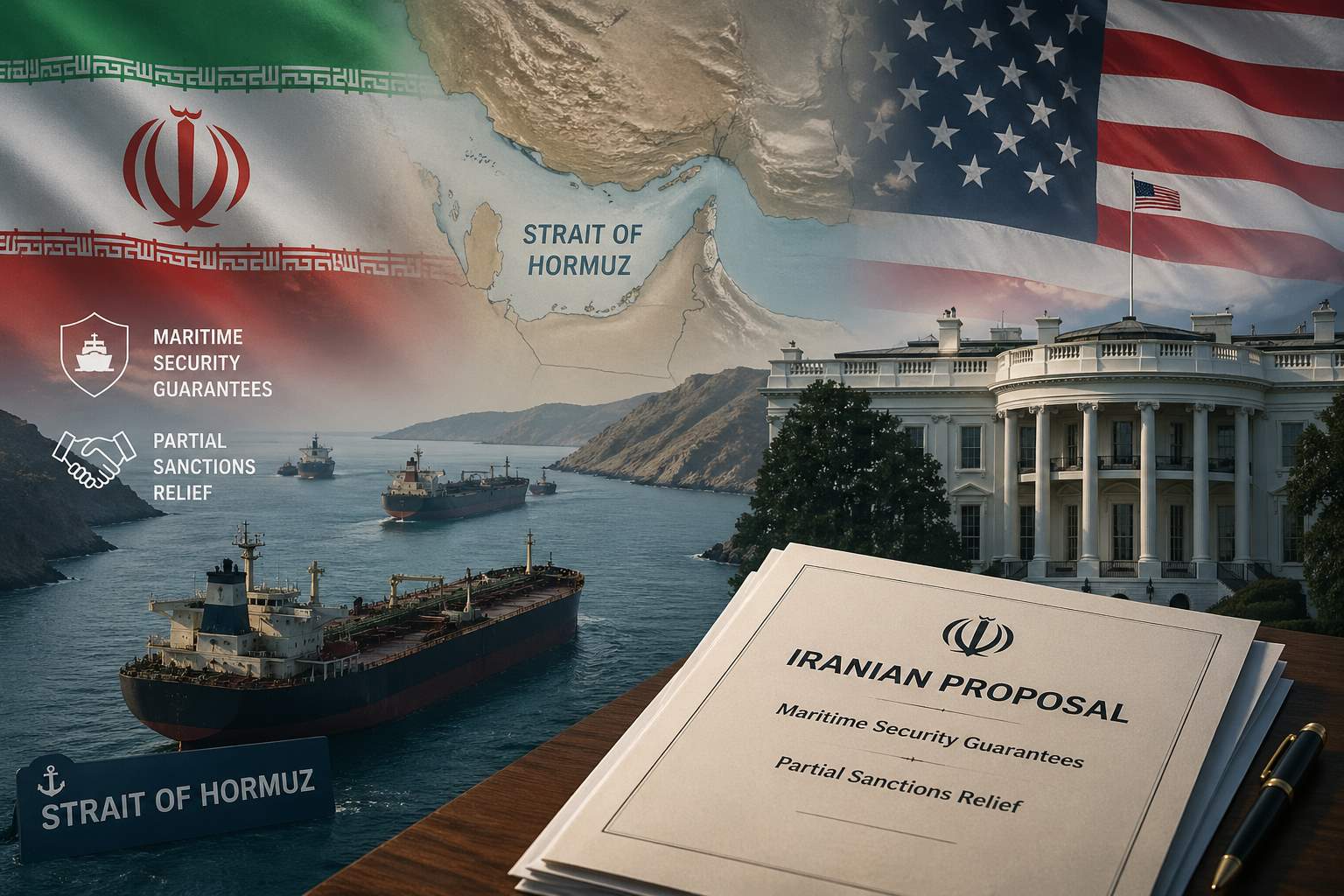
Efforts to reopen the world’s most critical oil chokepoint focus on maritime security guarantees and partial sanctions relief.
April 29, 2026
By Global War News Editorial
The United States administration has confirmed it is reviewing a formal proposal from Tehran aimed at ending the ongoing naval blockade of the Strait of Hormuz. The proposal, which reportedly reached Washington through Omani mediators late Tuesday, suggests a phased de-escalation of maritime hostilities in exchange for the targeted lifting of insurance and shipping sanctions that have stifled Iranian exports.
This development comes after a twenty-day standoff that has seen global crude prices fluctuate significantly, causing particular strain on energy-importing economies across Europe and Asia. White House National Security Council spokesperson Adrienne Watson stated publicly that the administration is “evaluating the credibility” of the terms alongside international partners but emphasized that no agreement has yet been reached.
The Proposed Framework
According to reports from the Associated Press and regional media in Muscat, the Iranian framework focuses on two primary pillars. First, it proposes a “maritime safety corridor” managed by neutral monitors to ensure the unhindered passage of commercial tankers. Second, it calls for a temporary waiver of international sanctions on Iranian port authorities.
Tehran has consistently maintained that its naval presence in the Strait is a response to external threats. However, Western analysts, including those from the International Institute for Strategic Studies (IISS), have described the blockade as a strategic lever used to pressure global markets. While the Iranian Ministry of Foreign Affairs stated that the proposal represents a “good-faith effort to restore regional stability,” US officials have remained cautious, noting that similar previous offers failed to address the presence of naval mines in the channel.
Economic Impact on Global Energy
The closure of the Strait of Hormuz, through which approximately 20% of the world’s total oil consumption passes, has led to a sharp increase in logistics costs. Data from the International Energy Agency (IEA) indicates that shipping insurance premiums for vessels operating in the Persian Gulf have risen by nearly 400% since the start of the blockade.
For major Asian economies, the impact is direct. Analysts note that South Korea and Japan, which rely heavily on Middle Eastern crude, have begun tapping into strategic petroleum reserves to stabilize domestic prices. If the blockade is lifted, economists at the World Bank suggest that global oil prices could stabilize within 48 to 72 hours, though the “war risk” premium on shipping may take months to fully dissipate.
Analysis: A Fragile Path Forward
The arrival of this proposal suggests that the economic pressure of counter-sanctions may be influencing Tehran’s strategic calculus. However, observers note that significant hurdles remain. The US and its allies are likely to demand the complete removal of Iranian fast-attack craft from shipping lanes before any sanctions relief is granted.
There is also the question of verification. Analysts have suggested that without a robust, third-party monitoring mechanism, perhaps involving UN maritime observers—any “safety corridor” may be seen as too high a risk for commercial insurers. This raises questions about whether the proposal is a genuine move toward peace or a tactical pause designed to allow Iran to recalibrate its domestic economic defenses.
What to Watch
In the coming days, the focus will shift to the scheduled meeting of the UN Security Council, where the Omani mediation team is expected to brief member states. Markets will likely remain volatile until a clear “yes” or “no” is signaled by the White House. For now, the world’s most vital energy artery remains partially restricted, with the global economy awaiting the next move in a high-stakes diplomatic game.
Source Disclosure: This report utilizes official statements from the US National Security Council and the Iranian Ministry of Foreign Affairs. Data regarding shipping premiums and energy reserves were sourced from the IEA and the World Bank. Secondary reporting was provided by the Associated Press and Reuters.
This article is based on publicly available reporting from named international news agencies and attributed official statements. All claims about ongoing events are attributed to their original sources. Analysis sections represent the editorial interpretation of reported facts and do not constitute advocacy for any party to the described conflict. AI tools may be utilized for image generation to assist in explaining complex concepts, as well as for refining grammar, spelling, and other linguistic enhancements. However, all original content is produced, fact-checked, and revised by the editorial team. This publication does not take political positions on active military conflicts.