
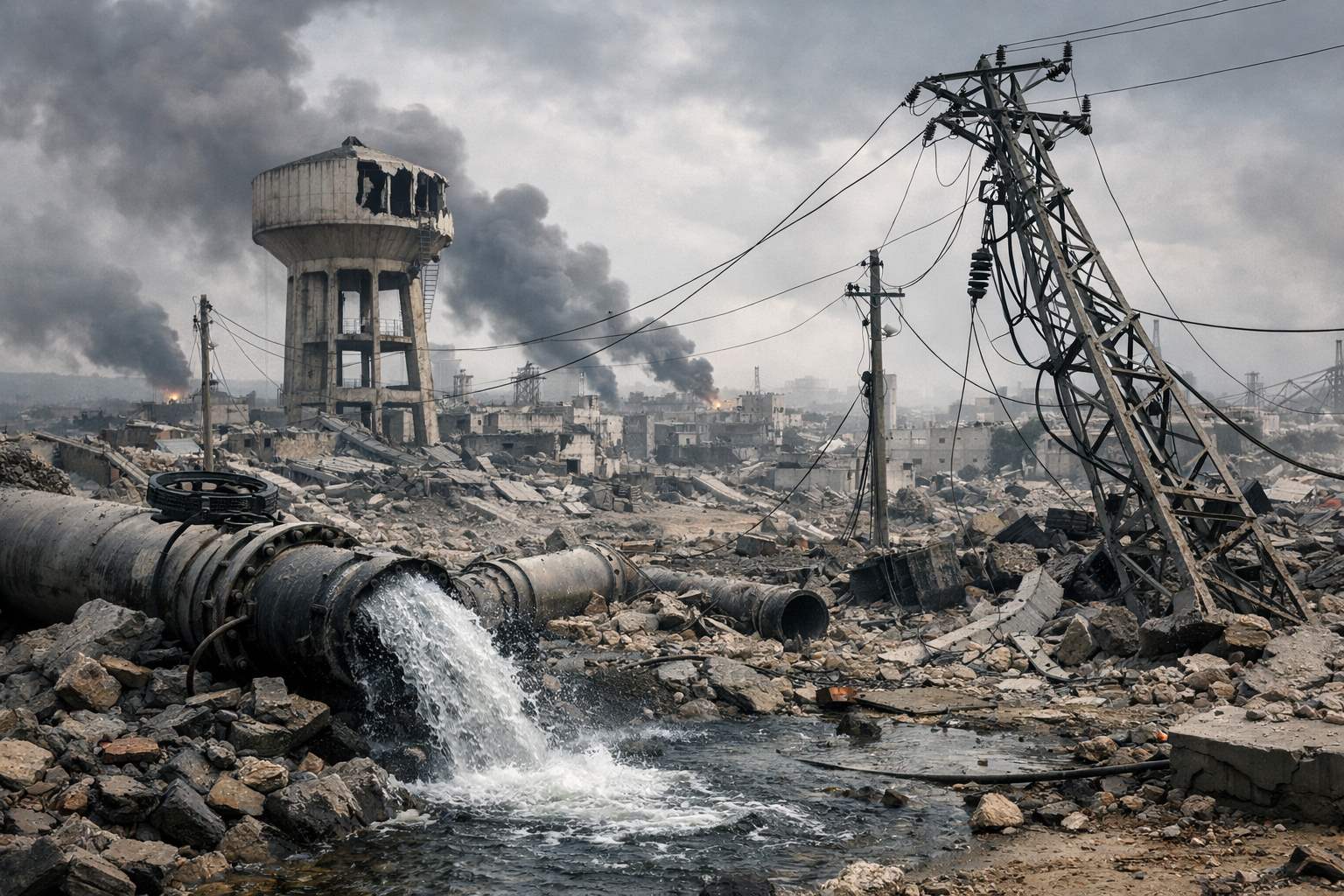
Local authorities and international agencies report extensive destruction to water and power networks in Gaza’s northern gateway.
April 29, 2026
By Global War News Editorial
Recent military operations in the northern Gaza Strip have left the infrastructure of Beit Hanoon in a state of near-total collapse. Local municipal reports, supported by satellite imagery analysis from independent monitors, indicate that essential services, including water desalination plants and electrical grids, have sustained damage that officials say may take months to repair.
The Israel Defense Forces (IDF) stated in a public briefing that operations in the area were targeted at dismantling militant infrastructure. However, the humanitarian impact of these maneuvers has drawn concern from international bodies. UNRWA officials reported on Wednesday that the destruction of primary access roads has severely hindered the delivery of emergency food and medical supplies to the remaining civilian population in the district.
Damage to Essential Services
According to a preliminary assessment by the Palestinian Water Authority, at least three major wells serving Beit Hanoon have been rendered inoperable. Residents have reportedly resorted to using untreated agricultural wells, raising immediate concerns regarding waterborne diseases.
The electrical infrastructure has fared no better. Reports from the Gaza Electricity Distribution Company (GEDCO) suggest that the primary feeder lines connecting northern Gaza to the central grid were severed during the height of the engagement. While the IDF stated it makes efforts to avoid civilian infrastructure, military spokespersons noted that urban combat environments often lead to unintended collateral damage when militant groups utilize civilian structures for tactical purposes.
Humanitarian Logistics and Access
The physical landscape of Beit Hanoon has been fundamentally altered. According to Al Jazeera’s regional coverage, entire blocks of the eastern sector are currently inaccessible to heavy vehicles, including ambulances and fire trucks, due to debris and cratering.
The World Health Organization (WHO) noted in a recent situation report that the Beit Hanoon Hospital, while still standing, is operating at less than 20% capacity. This is largely attributed to the lack of fuel for generators and the inability of medical staff to safely reach the facility. Observers note that the continued lack of a stable humanitarian corridor has turned the northern gateway into an isolated pocket of high-intensity need.
Analysis: The Long-Term Recovery Gap
Analysts suggest that the recurring nature of damage in Beit Hanoon creates a “recovery deficit” that international aid alone may not be able to fill. Each successive operation weakens the structural integrity of remaining buildings and further depletes the local technical expertise required for repairs.
This raises questions about the long-term viability of the district as a residential hub. If the primary infrastructure—power, water, and sewage—is not restored quickly, observers suggest we may see a permanent displacement of the local population toward the central and southern regions of the Gaza Strip. It remains unclear whether any formal reconstruction plan can be initiated while the security situation remains fluid and access for heavy machinery is restricted.
What to Watch
The immediate focus remains on the possibility of a temporary tactical pause to allow engineering teams to assess the water network. International mediators have reportedly highlighted the Beit Hanoon water crisis as a priority in ongoing discussions. For now, the district remains a focal point of both military activity and a deepening humanitarian crisis, with the full extent of the damage still being tallied as access remains limited.
Source Disclosure: This article incorporates official statements from the IDF, UNRWA, and the WHO. Infrastructure data was sourced from the Palestinian Water Authority and GEDCO. Additional reporting was provided by Al Jazeera and Reuters.
This article is based on publicly available reporting from named international news agencies and attributed official statements. All claims about ongoing events are attributed to their original sources. Analysis sections represent the editorial interpretation of reported facts and do not constitute advocacy for any party to the described conflict. AI tools may be utilized for image generation to assist in explaining complex concepts, as well as for refining grammar, spelling, and other linguistic enhancements. However, all original content is produced, fact-checked, and revised by the editorial team. This publication does not take political positions on active military conflicts.