
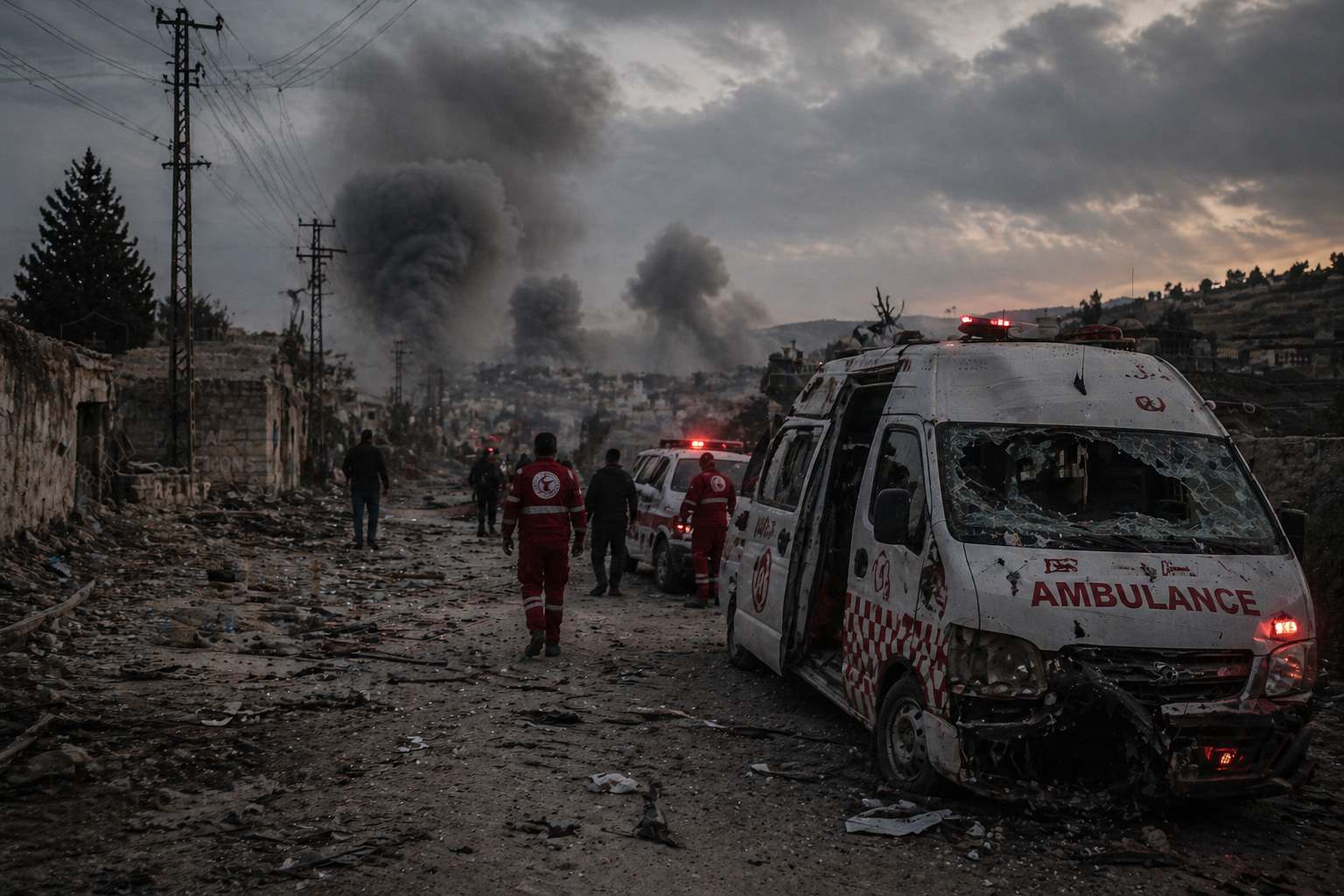
Incident near Majdal Zoun highlights fragility of the current three-week ceasefire extension as rescue teams are caught in “back-to-back” strikes.
April 29, 2026
By Global War News Editorial
Authorities in Beirut have reported that at least five people, including three paramedics, were killed late Tuesday following Israeli airstrikes in the southern Lebanese town of Majdal Zoun. The incident occurred during a rescue operation aimed at recovering survivors from an earlier bombardment, according to statements from the Lebanese Ministry of Public Health and the Lebanese Army.
The Israel Defense Forces (IDF) have not issued a specific comment on the Majdal Zoun strike. However, military spokespersons have stated throughout the week that the IDF maintains “freedom of action” to target Hezbollah movements that it characterizes as violations of the ceasefire agreement brokered on April 16 and extended on April 23. This latest loss of life marks the deadliest single day for medical personnel since the truce began.
Double-Tap Strike Allegations
According to reports from the Associated Press and Lebanon’s National News Agency (NNA), the fatalities occurred when a second strike hit a Lebanese Army patrol that was accompanying Civil Defense medical teams and bulldozers. The rescue teams were reportedly working to reach individuals trapped under the rubble of a residential structure targeted in a prior raid.
Lebanese President Joseph Aoun condemned the strike, stating publicly that the targeting of rescue workers is part of a “recurring pattern” that violates international humanitarian law. Conversely, Israeli military officials have previously accused Hezbollah of “embedding itself within civilian medical groups” and using emergency vehicles to transport munitions, claims that Lebanese authorities and the medical groups involved have consistently denied.
The Human Toll on Medical Workers
The humanitarian impact of the border conflict has fallen heavily on first responders. According to an AFP tally based on Ministry of Health data, over 95 medical workers have been killed since the broader regional escalation began in early March 2026.
- Majdal Zoun: 3 paramedics killed, 2 Lebanese soldiers wounded in the latest strike.
- Tyre District: Reports from Doctors Without Borders (MSF) indicate that medical facilities in nearby Tyre have also sustained collateral damage, with shrapnel injuring staff at Hiram Hospital earlier this month.
- Casualty Totals: The Lebanese Health Ministry reports that over 2,200 people have died in Lebanon since the start of the “Operation Eternal Darkness” offensive in April.
Analysis: The Fragility of the Ten-Day Truce
Analysts from the International Crisis Group (ICG) note that while a formal ceasefire is technically in place, the “rules of engagement” remain dangerously ill-defined. The agreement allows Israel the “right to take all necessary measures in self-defense against planned attacks,” a clause that observers suggest is being interpreted broadly to include preemptive strikes on suspected logistics hubs.
This ambiguity creates a cycle of escalation. Hezbollah has vowed to respond to “every violation” of the truce, while Israel maintains that any movement of Hezbollah’s Radwan Force near the “yellow line” (a 10-kilometer buffer zone) justifies an immediate kinetic response. Analysts have suggested that without neutral third-party monitors on the ground to verify these “violations,” the current three-week extension remains a ceasefire in name only. It remains unclear whether the Majdal Zoun incident will trigger a wider collapse of the US-brokered negotiations.
What to Watch
In the next 48 hours, diplomatic focus will turn to the US State Department’s assessment of the incident. If the Majdal Zoun strike is officially labeled a violation of the ceasefire terms, it could jeopardize the high-level talks scheduled to take place in Washington later this week. Locally, the Lebanese Army’s increased presence alongside medical teams suggests a shift in strategy to provide official “state cover” to rescue operations, though as this incident proves, that cover offers limited protection against aerial strikes.
Source Disclosure: This article is based on official statements from the Lebanese Ministry of Public Health, the Lebanese Army, and the IDF. On-ground reporting was provided by the Associated Press, Reuters, and Al Jazeera. Contextual data on the ceasefire was sourced from the US Department of State and Wikipedia’s 2026 conflict archives.
This article is based on publicly available reporting from named international news agencies and attributed official statements. All claims about ongoing events are attributed to their original sources. Analysis sections represent the editorial interpretation of reported facts and do not constitute advocacy for any party to the described conflict. AI tools may be utilized for image generation to assist in explaining complex concepts, as well as for refining grammar, spelling, and other linguistic enhancements. However, all original content is produced, fact-checked, and revised by the editorial team. This publication does not take political positions on active military conflicts.