
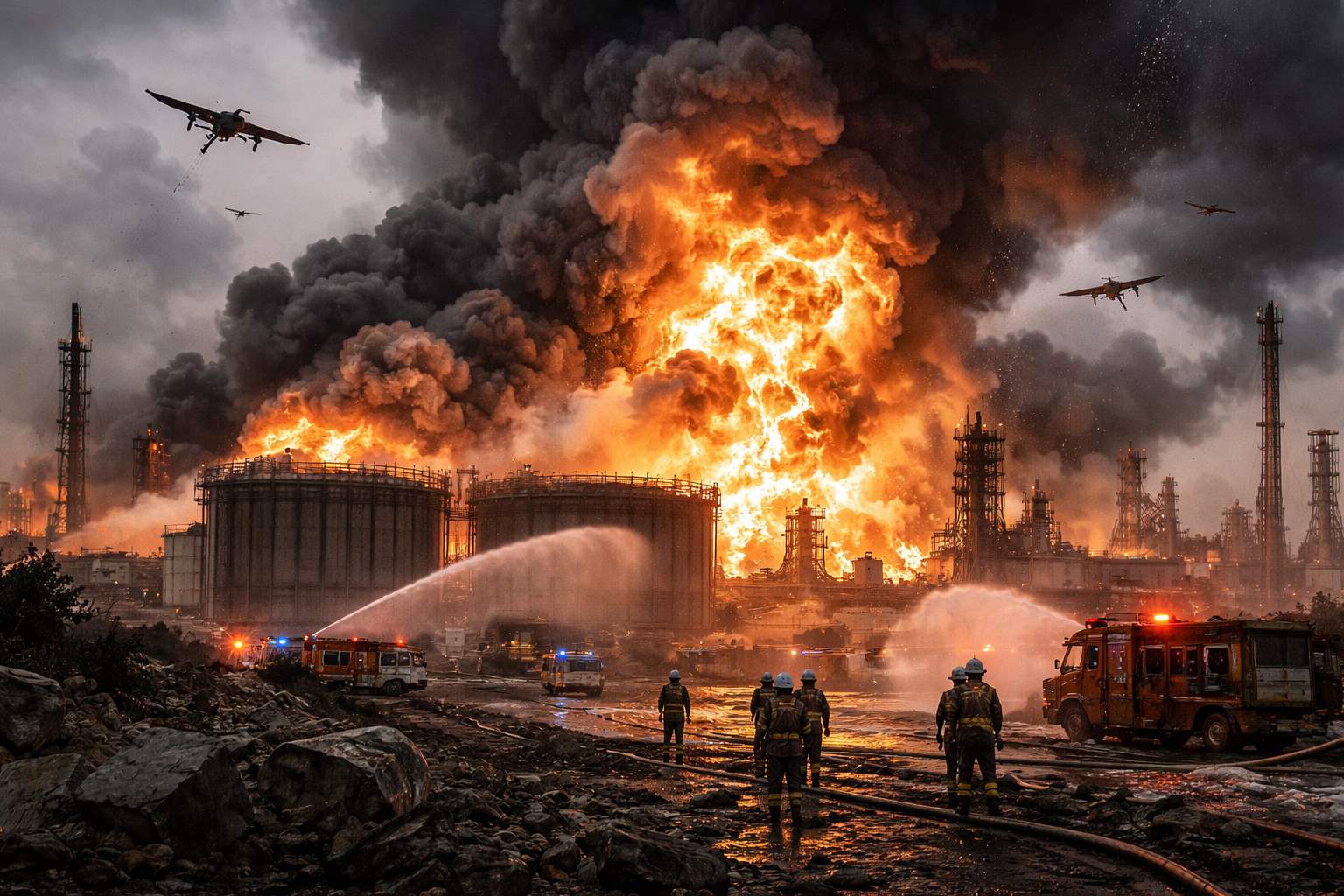
The third major strike in two weeks forces evacuations and deepens the paralysis of Russia’s critical energy infrastructure.
April 29, 2026
By Global War News Editorial
A Ukrainian drone campaign has once again targeted the Rosneft-owned Tuapse oil refinery on Russia’s Black Sea coast, triggering a large-scale blaze that led to the emergency evacuation of nearby residential streets. The strike, occurring overnight between April 27 and 28, represents the third significant attack on the facility in less than two weeks, effectively stalling efforts to restart operations at one of Russia’s most technologically advanced export hubs.
Veniamin Kondratiev, the governor of the Krasnodar region, confirmed the “serious incident” via Telegram on Tuesday, stating that emergency crews were deployed to contain a fire sparked by the aerial assault. Local district head Sergei Boyko ordered residents in the immediate vicinity to evacuate as thick plumes of black smoke drifted over the port city.
A Pattern of Persistent Disruption
The Tuapse refinery, which primarily processes crude for international markets rather than domestic consumption, has been under a state of siege throughout April. According to industry sources cited by Reuters and geolocated satellite footage analyzed by the Institute for the Study of War (ISW), the facility had already suspended primary refining units following strikes on April 16 and April 20.
Reports from the Ukrainian General Staff confirmed the latest operation, describing it as part of a broader strategy to disrupt the logistical and financial networks supporting the Russian military effort. While the Kremlin has characterized the strikes as “attacks on civilian targets,” Ukrainian defense officials maintain that the energy infrastructure is a legitimate military-economic target.
Environmental and Structural Toll
The cumulative damage to the Tuapse terminal has reached a critical threshold. Independent OSINT monitors and satellite imagery suggests that:
- Storage Destruction: Approximately 28 out of 47 fuel storage tanks at the site have been destroyed or severely damaged over the last month.
- Refining Capacity: The ELOU-AVT-12 primary processing unit, essential for the plant’s 12-million-ton annual capacity, remains inoperable.
- Environmental Crisis: Last week, local authorities in Tuapse warned residents of “black rain”, a phenomenon where soot and chemical byproducts from the fires mixed with rainfall to coat the city in oily residue.
Environmental groups have also noted the formation of a significant oil slick in the Black Sea near the port terminal, though the full extent of the ecological damage cannot be verified due to restricted access to the site.
Analysis: The Strategic Squeeze on Russian Exports
The persistent targeting of Tuapse highlights a shift in Ukrainian tactics toward “deep rear” economic warfare. Analysts note that by focusing on export-oriented refineries like Tuapse rather than those serving the domestic Russian market, Kyiv is attempting to maximize the drain on Moscow’s foreign currency reserves without necessarily triggering a domestic fuel crisis that could galvanize the Russian public.
However, observers also suggest this campaign carries significant risks. The disruption of Black Sea energy flows contributes to global market volatility, particularly as US-brokered peace talks remain paused. Some analysts have suggested that the “oil rain” and toxic plumes in Tuapse may be intended to increase the domestic political cost of the war for the Kremlin, though such events often result in a tightening of local security and censorship rather than policy shifts.
The central question remains whether Russia can effectively relocate its air defense assets to protect these sprawling industrial targets without weakening frontline positions. As of late April, the “open skies” over the Krasnodar Krai suggest that the defense of energy infrastructure remains a significant vulnerability for the Russian state.
What to Watch
Market analysts will be monitoring the diversion of tanker traffic from Tuapse to alternative ports such as Novorossiysk. However, with Ukrainian drones increasingly demonstrating the range to hit multiple Black Sea terminals, the safety of the entire regional export network is in question. Further strikes on the northern sections of the Tuapse refinery, which were previously unaffected, could signal an intent to completely dismantle the facility’s utility for the foreseeable future.
Source Disclosure: This article is based on official statements from the Governor of Krasnodar Krai, the Tuapse District Administration, and the Ukrainian General Staff. Statistical data regarding refinery capacity and damage assessments were sourced from Reuters, ISW, and independent OSINT projects (Astra and Militarnyi).
This article is based on publicly available reporting from named international news agencies and attributed official statements. All claims about ongoing events are attributed to their original sources. Analysis sections represent the editorial interpretation of reported facts and do not constitute advocacy for any party to the described conflict. AI tools may be utilized for image generation to assist in explaining complex concepts, as well as for refining grammar, spelling, and other linguistic enhancements. However, all original content is produced, fact-checked, and revised by the editorial team. This publication does not take political positions on active military conflicts.