
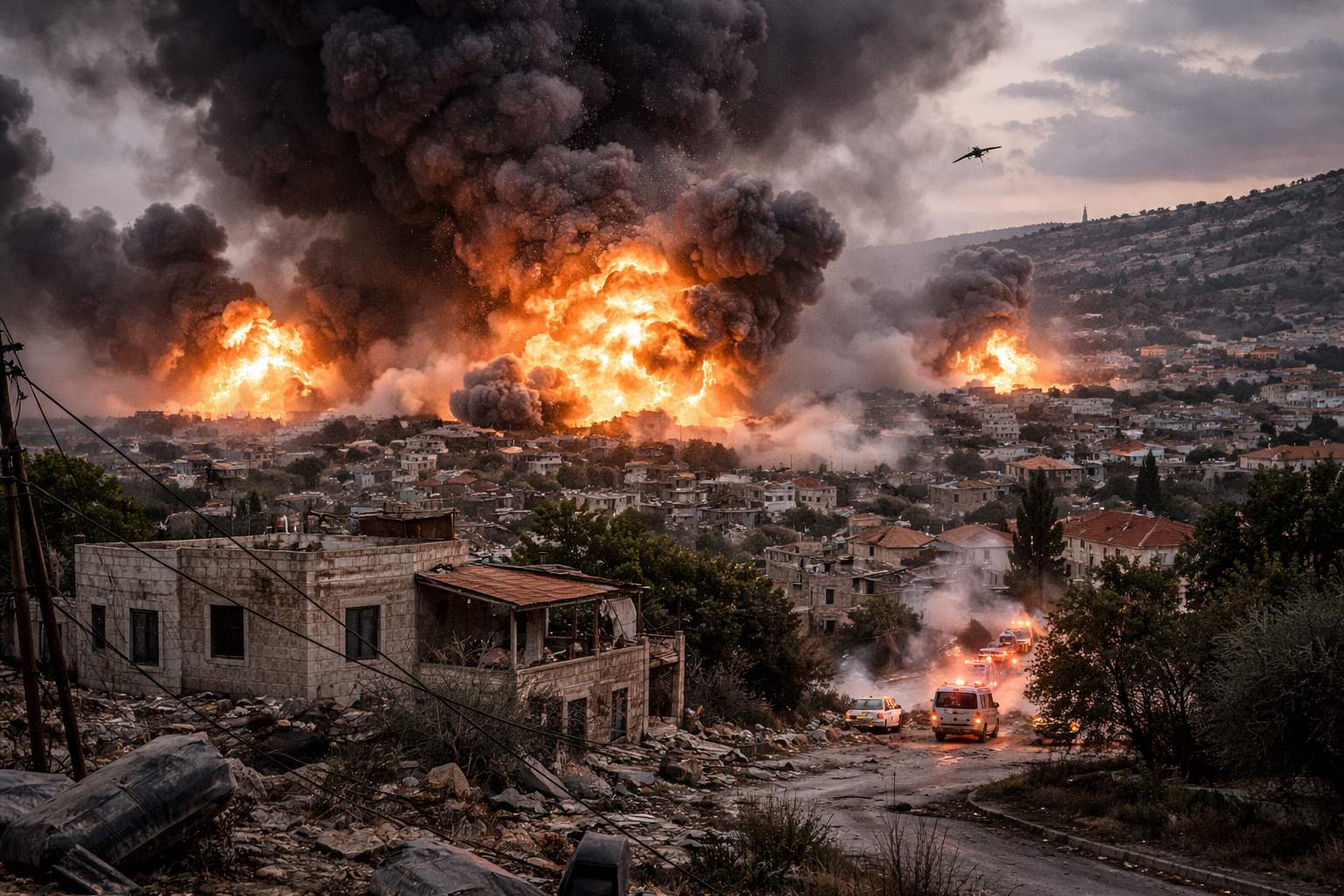
Series of blasts near Khiam and Marjayoun raises fears of a collapse in the fragile April ceasefire.
April 29, 2026
By Global War News Editorial
A series of heavy explosions echoed across the eastern sector of the Lebanon-Israel border late Wednesday morning, according to local residents and verified social media footage. The blasts, centered around the outskirts of Khiam and the Marjayoun plains, occurred amid a period of extreme volatility as both the Israel Defense Forces (IDF) and Hezbollah exchange accusations of violating the recently extended humanitarian truce.
While no official casualty figures have been confirmed by the Lebanese Ministry of Public Health, local civil defense units reported that the explosions targeted what appeared to be open terrain and abandoned structures. A spokesperson for the IDF stated publicly that the military is “monitoring activities” along the Blue Line but did not immediately confirm if the blasts were the result of planned kinetic action or ordnance disposal.
Localized Escalation and Response
Reports from the National News Agency (NNA) in Beirut suggest that the explosions followed the sighting of several unmanned aerial vehicles (UAVs) over the Litani River area. According to Al Jazeera’s regional correspondents, the sounds of outgoing artillery were heard shortly before the primary blasts, though the source of the fire remains a point of contention between local actors.
The United Nations Interim Force in Lebanon (UNIFIL) issued a brief statement calling for “maximum restraint.” UNIFIL peacekeepers remain at their positions, but patrols have reportedly been restricted in the immediate vicinity of Khiam due to the risk of secondary explosions. In a televised address earlier today, Lebanese caretaker Prime Minister Najib Mikati stated that “continued provocations” threaten to undo the progress made during the April 16 negotiations.
Military Activity and Strategic Posture
The strategic importance of the Khiam heights cannot be overstated, as the area overlooks both northern Israeli settlements and the Lebanese interior. Analysts from the International Institute for Strategic Studies (IISS) note that this specific sector has seen some of the most consistent friction since the 2026 escalation began.
- Hezbollah Position: According to statements from the group’s media wing, Hezbollah remains in a “defensive posture” but reserves the right to respond to what it terms “Zionist incursions” into Lebanese airspace.
- IDF Position: Military officials in Tel Aviv have reiterated that any attempt to re-establish launch sites within the 10-kilometer buffer zone established in the truce will be met with “preventative force.”
- UNIFIL Monitoring: Reports indicate that electronic monitoring systems along the border have recorded a 30% increase in ceasefire “anomalies” over the last 48 hours.
Analysis: The “Grey Zone” of the Ceasefire
Observers note that the current situation in Southern Lebanon has entered a “grey zone” where neither side is seeking a total return to all-out war, yet both feel compelled to maintain a credible deterrent through localized strikes. This raises questions about the definition of “defensive action” under the current agreement. If the IDF perceives a threat and strikes, Hezbollah often feels obligated to respond to maintain its political standing within Lebanon.
Analysts have suggested that these sporadic explosions may be “calibration strikes”, actions intended to test the response times and red lines of the opposing force without triggering a full-scale barrage. However, the risk of a miscalculation remains high. It remains unclear whether the latest blasts were a targeted operation against a specific asset or a symbolic warning. Without a clear mechanism for immediate de-escalation on the ground, these persistent tensions could eventually overwhelm the diplomatic efforts currently underway in Washington and Paris.
What to Watch
The focus now turns to the afternoon briefing from the IDF and any potential retaliatory statements from Hezbollah’s leadership. Markets in the region have already reacted to the reports, with a slight uptick in regional risk premiums. If the explosions are confirmed as a targeted assassination or a strike on a major munitions depot, the likelihood of a formal end to the ceasefire extension increases significantly.
Source Disclosure: This article is based on reporting from Lebanon’s National News Agency (NNA), official statements from the IDF and UNIFIL, and secondary coverage from Reuters and Al Jazeera. Contextual analysis was provided by the IISS and the International Crisis Group.
This article is based on publicly available reporting from named international news agencies and attributed official statements. All claims about ongoing events are attributed to their original sources. Analysis sections represent the editorial interpretation of reported facts and do not constitute advocacy for any party to the described conflict. AI tools may be utilized for image generation to assist in explaining complex concepts, as well as for refining grammar, spelling, and other linguistic enhancements. However, all original content is produced, fact-checked, and revised by the editorial team. This publication does not take political positions on active military conflicts.