
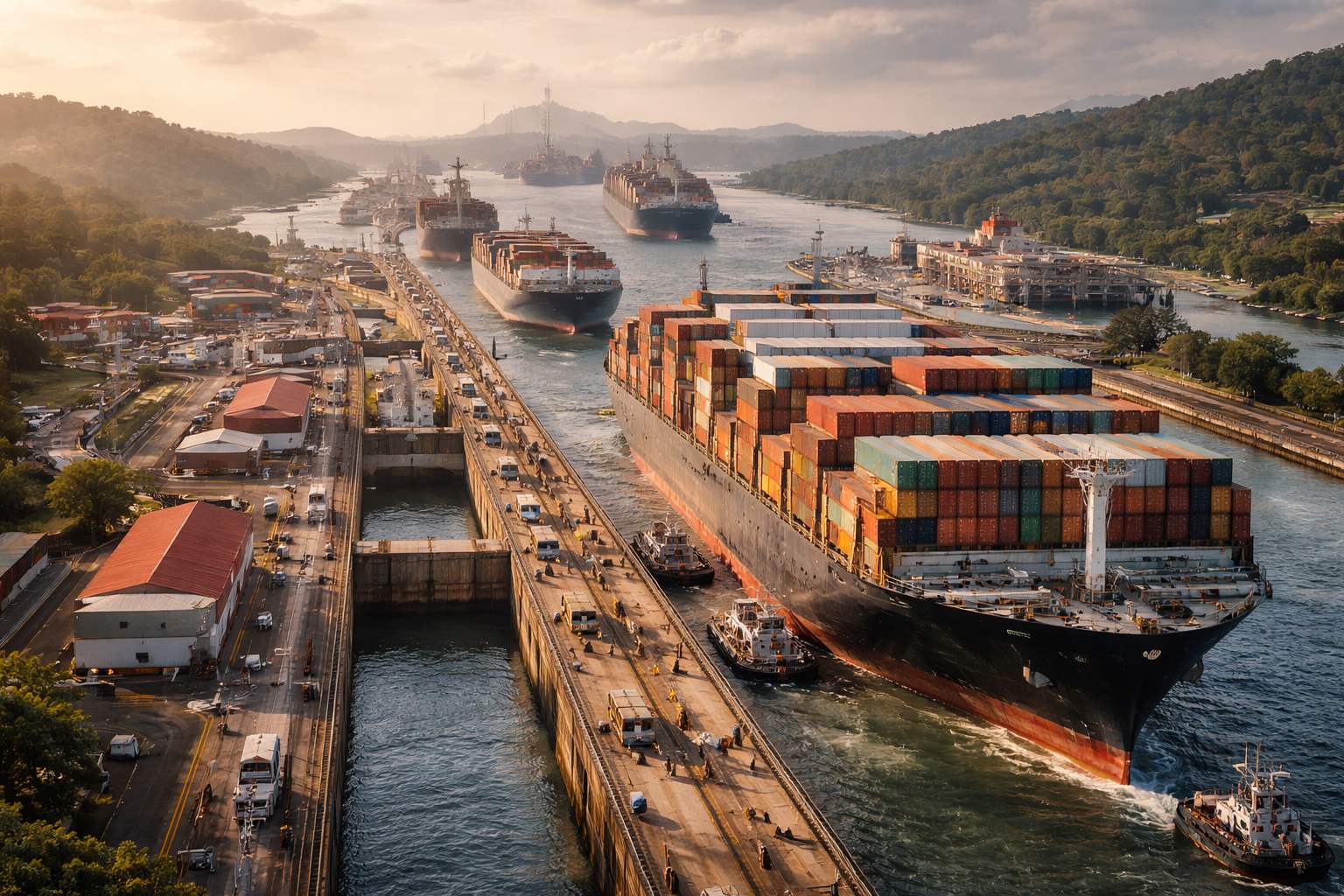
Shifting global trade routes drive transit bids to $4 million as shippers bypass the effectively closed Strait of Hormuz.
April 29, 2026
By Global War News Editorial
The Panama Canal Authority (ACP) has confirmed a significant surge in vessel traffic and cargo tonnage, directly attributed to the ongoing naval blockade of the Strait of Hormuz. As the Middle East conflict enters its second month, the transoceanic waterway has become a critical pressure valve for global energy and commodity flows, with some desperate shippers paying record-breaking premiums to bypass a growing maritime logjam.
According to official data released by the ACP on Tuesday, the canal handled an average of 40 transits per day last week, well above the usual planned capacity of 34 to 36 vessels. “The Panama Canal remains open and reliable amid global geopolitical complexities,” stated Administrator Ricaurte Vásquez Morales. He noted that the shift in trade patterns is most visible in the sudden spike of Liquefied Natural Gas (LNG) and petroleum products now moving from the United States toward Asian markets, cargoes that would typically originate from the Persian Gulf.
The “Auction Spike”: Bidding for Certainty
The most startling indicator of the current crisis is the skyrocketing cost of “slot auctions.” For vessels arriving without a prior reservation, the ACP holds daily auctions to grant immediate passage. Before the February 28 escalation in the Middle East, these slots typically sold for approximately $135,000.
In recent weeks, however, the average auction price has climbed to $385,000. On at least one occasion, an LNG carrier reportedly paid a $4 million “skip-the-line” fee to avoid a queue that has stretched to over five days. ACP officials have clarified that while these figures are historic, they reflect “temporary conditions driven by urgency” rather than a permanent change in the canal’s tariff structure.
Global Route Realignment
The effective closure of the Strait of Hormuz, which normally handles 20% of global oil supply—has forced a total recalibration of the “Maritime Silk Road.” Logistics analysts note that the Suez Canal, already hampered by regional instability, is no longer seen as a viable alternative for many high-value energy shipments.
- US-to-Asia Pivot: Asian refineries in South Korea and Japan have significantly increased orders for American crude and shale gas. This “Atlantic-to-Pacific” corridor relies almost exclusively on the Panama Canal’s Neopanamax locks.
- Tonnage Growth: The ACP reported that 254 million tons of cargo moved through the waterway in the first half of the 2026 fiscal year, a 5% increase over the previous year.
- Vessel Queues: At the Atlantic entrance, more than 50 vessels are currently anchored, with waiting times for non-booked ships fluctuating between 5 and 13 days depending on the size of the vessel.
Analysis: The Cost of Global Friction
Economists have suggested that the “Panama Pivot” is a symptom of a larger, more expensive era of global trade. By rerouting through Panama or around the Cape of Good Hope, shipping companies are significantly increasing their “ton-miles”—the distance cargo must travel. This leads to higher fuel consumption, increased insurance premiums, and ultimately, higher costs for the end consumer.
Observers note that while the Panama Canal is currently enjoying a revenue windfall from auction premiums, the infrastructure is being pushed to its operational limit. Deputy Administrator Ilya Espino de Marotta stated that while recent heavy rains have kept Gatún Lake at optimal levels for transits, the authority is watching for a potential El Niño event later this year. If water levels drop while demand remains at these record highs, the “Panama bottleneck” could become as significant a threat to global supply chains as the Middle East blockade itself.
What to Watch
The focus in the coming weeks will be on the “reservation ceiling.” If the ACP decides to cap daily transits to preserve infrastructure, the auction prices could climb even higher. Furthermore, the arrival of new-build tankers commissioned during the 2024 shipping boom is expected to hit the water this quarter, further crowding the approaches to Colón and Panama City. For now, the Panama Canal stands as the only stable bridge between a fractured West and an energy-hungry East.
Source Disclosure: This article is based on official transit data and statements provided by the Panama Canal Authority (ACP), including briefings from Administrator Ricaurte Vásquez Morales and Deputy Administrator Ilya Espino de Marotta. Additional reporting on global shipping rates and the Strait of Hormuz impact was sourced from AFP, Reuters, and maritime analysts at Logistics Middle East.
This article is based on publicly available reporting from named international news agencies and attributed official statements. All claims about ongoing events are attributed to their original sources. Analysis sections represent the editorial interpretation of reported facts and do not constitute advocacy for any party to the described conflict. AI tools may be utilized for image generation to assist in explaining complex concepts, as well as for refining grammar, spelling, and other linguistic enhancements. However, all original content is produced, fact-checked, and revised by the editorial team. This publication does not take political positions on active military conflicts.