
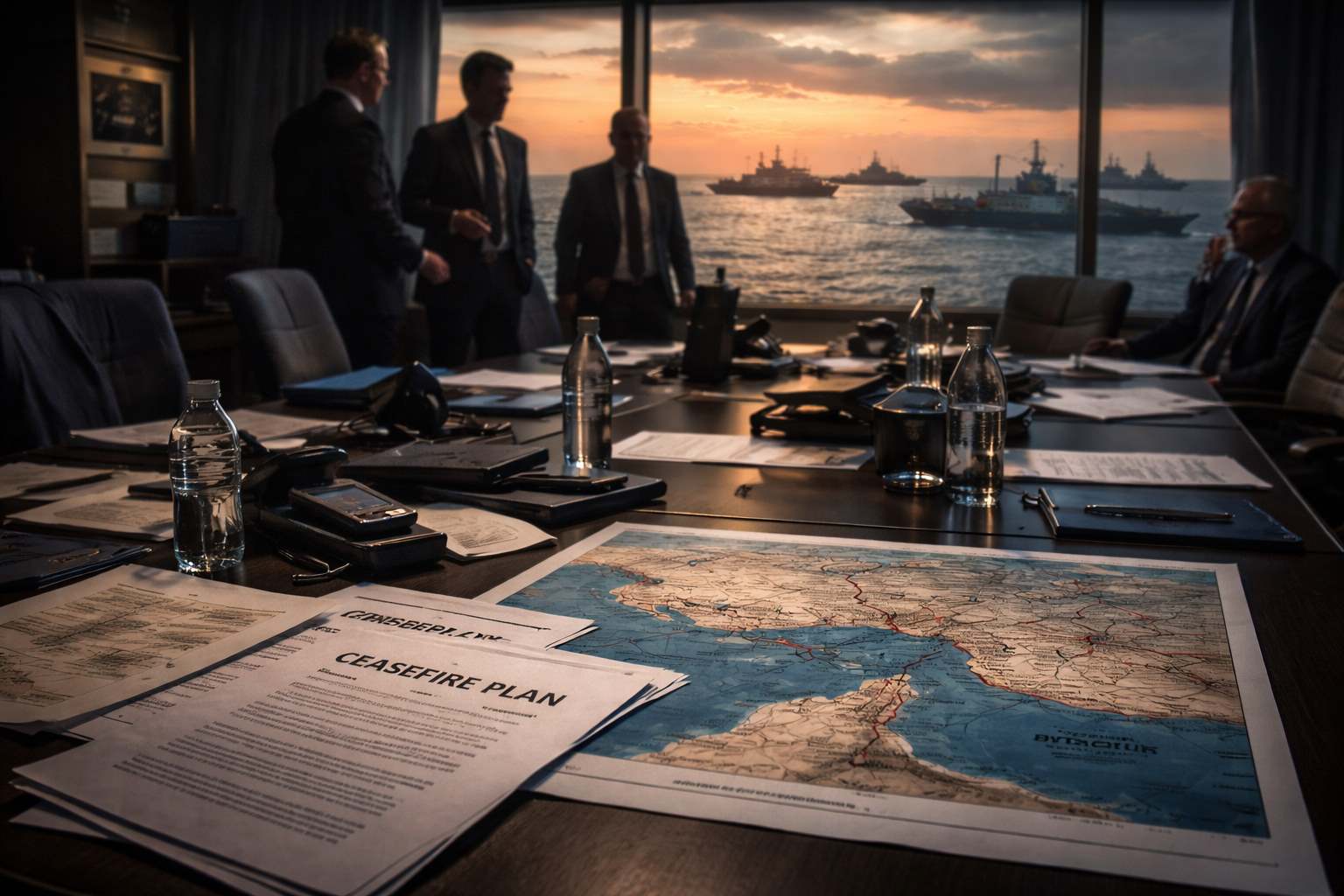
White House evaluates a three-stage de-escalation plan as the President cites Iranian “collapse” amid a tightened naval blockade.
April 29, 2026
By Global War News Editorial
The Trump administration is currently reviewing a new diplomatic roadmap from Tehran aimed at resolving the two-month conflict that has paralyzed global energy markets and brought the Middle East to a geopolitical flashpoint. The proposal, delivered via Pakistani mediators, seeks a phased withdrawal from the brink of total war, though early indications from Washington suggest significant skepticism regarding its terms.
On Tuesday, President Donald Trump addressed the overture through a post on Truth Social, claiming that Iranian leadership had communicated a “state of collapse” and an urgent desire to reopen the Strait of Hormuz. While the President noted his belief that Iran could “figure out their leadership situation,” he remained firm on the necessity of a deal that addresses both regional security and Tehran’s nuclear ambitions.
The Iranian Framework: A Three-Stage Plan
According to reports from the Wall Street Journal and regional news agencies in Islamabad, the Iranian proposal, championed by Foreign Minister Abbas Araghchi, outlines a sequential de-escalation process:
- Immediate Cessation of Hostilities: A permanent and guaranteed end to the war by the United States and Israel.
- Maritime Reopening: The lifting of the US naval blockade on Iranian ports and the reopening of the Strait of Hormuz under a “long-term management agreement” that preserves Iranian sovereignty.
- Future Negotiations: A commitment to discuss nuclear enrichment and regional proxy funding only after the conflict is fully concluded and economic normalization begins.
Iranian Defense Ministry spokesperson Reza Talaei-Nik stated on state television that Washington must “abandon its illegal and irrational demands,” asserting that the US is no longer in a position to dictate policy to independent nations.
Washington’s Red Lines
The primary sticking point for the White House appears to be the sequence of the proposed plan. While Secretary of State Marco Rubio told Fox News that the proposal was “better than what we thought they were going to submit,” he clarified that Washington has no intention of allowing Tehran to maintain total authority over the Strait of Hormuz.
Sources familiar with the administration’s deliberations indicate that President Trump is dissatisfied with the omission of nuclear issues from the first phase. The current US position, formulated following the failure of the initial Islamabad talks earlier this month, reportedly demands “zero enrichment” and the removal of past nuclear material as a precondition for a permanent end to hostilities.
Analysis: Diplomacy Under Duress
Analysts suggest that the timing of this proposal is not coincidental. Reports from the Institute for the Study of War (ISW) highlight that Iran is facing a critical storage crisis, with usable oil storage potentially reaching capacity within days due to the US-led blockade. This economic squeeze, combined with the “Operation Epic Fury” air campaign that has targeted Iranian infrastructure, appears to have forced a shift in Tehran’s negotiating posture.
However, observers note that the internal dynamics in Tehran remain opaque. While Foreign Minister Araghchi is shuttling between Islamabad and St. Petersburg, seeking Russian diplomatic support, hardline factions led by IRGC Commander Major General Ahmad Vahidi reportedly believe that Iran can still extract concessions without surrendering its nuclear leverage.
The central question for the Trump administration is whether to accept a staged de-escalation that stabilizes oil prices in the short term, or to maintain the “Maximum Pressure” military campaign until the Iranian government agrees to comprehensive nuclear dismantled. This raises questions about the sustainability of any agreement that postpones the most contentious issues to a later date—a sequence that analysts argue often leads to a resumption of conflict once economic pressure is relieved.
What to Watch
The diplomatic impasse persists as the White House national security team continues to evaluate the “Islamabad Accord” framework. Key indicators of the path forward will include whether the current temporary ceasefire, extended on April 21, is allowed to expire or if President Trump moves forward with threatened strikes on Iranian power plants and bridges. In the coming days, the role of Pakistan as a sole communication channel will be vital in determining if a middle ground exists between Tehran’s sovereignty demands and Washington’s “zero enrichment” mandate.
Source Disclosure: This article is based on official statements from the White House, the Iranian Foreign Ministry, and the US Department of State. Reporting was synthesized from the Wall Street Journal, Reuters, The Hindu, and Xinhua. Strategic analysis was provided by the Institute for the Study of War (ISW) and the House of Commons Library.
This article is based on publicly available reporting from named international news agencies and attributed official statements. All claims about ongoing events are attributed to their original sources. Analysis sections represent the editorial interpretation of reported facts and do not constitute advocacy for any party to the described conflict. AI tools may be utilized for image generation to assist in explaining complex concepts, as well as for refining grammar, spelling, and other linguistic enhancements. However, all original content is produced, fact-checked, and revised by the editorial team. This publication does not take political positions on active military conflicts.