
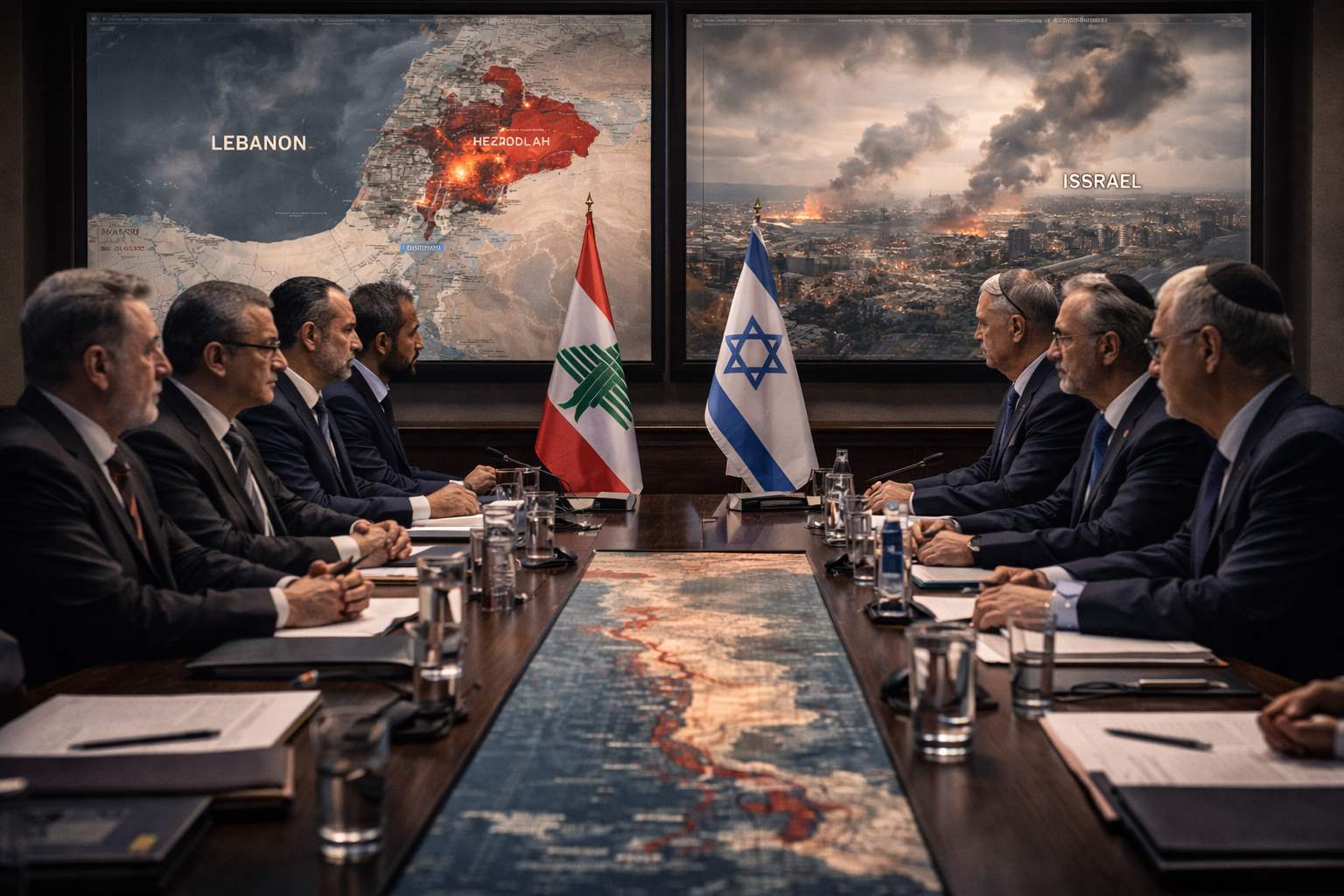
Lebanon and Israel engage in the first high-level diplomatic talks since 1983, navigating a fragile truce and the question of Hezbollah’s disarmament.
April 29, 2026
By Global War News Editorial
In a milestone that has shifted the diplomatic landscape of the Middle East, the Lebanese and Israeli governments are currently engaged in a second round of direct negotiations in Washington, D.C. These talks, hosted by US Secretary of State Marco Rubio, represent the first sustained diplomatic engagement between the two nations since the failed “May 17 Agreement” of 1983.
The framework for these discussions was established following a preliminary virtual meeting on April 12 and a subsequent high-level summit at the State Department on April 14. President Donald Trump, who announced a three-week extension of the initial 10-day ceasefire on April 23, has described the progress as “historic,” signaling a White House push to translate military friction into a durable regional settlement.
The Washington Framework
According to State Department briefings and reports from the Associated Press, the “Lebanon Peace Framework” focuses on three primary pillars intended to stabilize the Blue Line and restore Lebanese state authority:
- Sovereign Monopoly of Force: A central tenet of the talks is the Lebanese government’s commitment to ensuring that the Lebanese Armed Forces (LAF) are the sole military authority in the country. This directly addresses Israel’s demand for the total disarmament of Hezbollah.
- Border Demarcation: The delegations are reportedly discussing a permanent resolution to long-standing territorial disputes along the Blue Line, including the Shebaa Farms and the village of Ghajar.
- Humanitarian Stabilization: Under the guidance of Lebanese Ambassador Nada Moawad, the framework includes provisions for the safe return of over one million displaced civilians to Southern Lebanon, supported by international reconstruction aid.
Israeli Ambassador Yechiel Leiter stated publicly that the goal is a “real peace that lasts for generations,” while Lebanese President Joseph Aoun has framed the negotiations as the “only solution” to prevent the permanent destruction of the Lebanese state.
The Hezbollah Obstacle
Despite the optimism in Washington, the negotiations face a severe legitimacy crisis at home. Hezbollah, which remains a dominant military and political force in Lebanon, has categorically rejected the talks. In a televised address on April 27, Hezbollah leader Naim Qassem declared that the negotiations “do not exist for us” and vowed to continue “defensive resistance.”
Hezbollah’s rejection is not merely rhetorical. The group has outlined five conditions for ending the conflict, including a total Israeli withdrawal and the refusal to surrender its arsenal. Analysts from the Institute for the Study of War note that while the Lebanese government is negotiating in Washington, it lacks the domestic military capacity to enforce a disarmament agreement without risking a civil war. This internal “sovereignty gap” remains the greatest threat to the framework’s implementation.
Analysis: Diplomacy as an Opportunity for the State
Observers note that the 2026 Lebanon-Israel talks are being held under unique circumstances. Unlike previous years, the Lebanese government—supported by President Aoun and political leaders like Samir Geagea—appears more willing to publicly distance itself from Iran-aligned interests. This shift is largely attributed to the severe economic and military pressure exerted during the 2026 Iran War, which has left the Lebanese state in a fight for its own survival.
However, analysts suggest that the Washington negotiations are a high-stakes gamble. If the Lebanese government fails to secure an immediate and permanent ceasefire that includes an Israeli withdrawal, the political cost for President Aoun could be catastrophic. Conversely, for Israel, the talks provide a diplomatic track to achieve the “buffer zone” security it desires without the long-term cost of a military occupation. The central challenge remains whether American diplomacy can bridge the gap between Israel’s security requirements and Lebanon’s fragile internal balance of power.
What to Watch
The current three-week ceasefire extension is set to expire in mid-May. In the coming days, the focus will remain on whether the technical teams in Washington can produce a draft “Security and Stability Agreement.” Any move toward a formal signing ceremony between Prime Minister Benjamin Netanyahu and President Joseph Aoun would represent a total realignment of regional politics, but it would also likely trigger a domestic showdown between the Lebanese state and Hezbollah.
Source Disclosure: This article is based on official statements from the US State Department, the Lebanese Presidency, and the Israeli Ministry of Foreign Affairs. Factual data regarding the ceasefire dates and diplomatic envoys were sourced from the Associated Press, Reuters, and the 2026 Wikipedia Conflict Archives. Analysis of Hezbollah’s position was sourced from CGTN and the Alma Research Center.
This article is based on publicly available reporting from named international news agencies and attributed official statements. All claims about ongoing events are attributed to their original sources. Analysis sections represent the editorial interpretation of reported facts and do not constitute advocacy for any party to the described conflict. AI tools may be utilized for image generation to assist in explaining complex concepts, as well as for refining grammar, spelling, and other linguistic enhancements. However, all original content is produced, fact-checked, and revised by the editorial team. This publication does not take political positions on active military conflicts.