
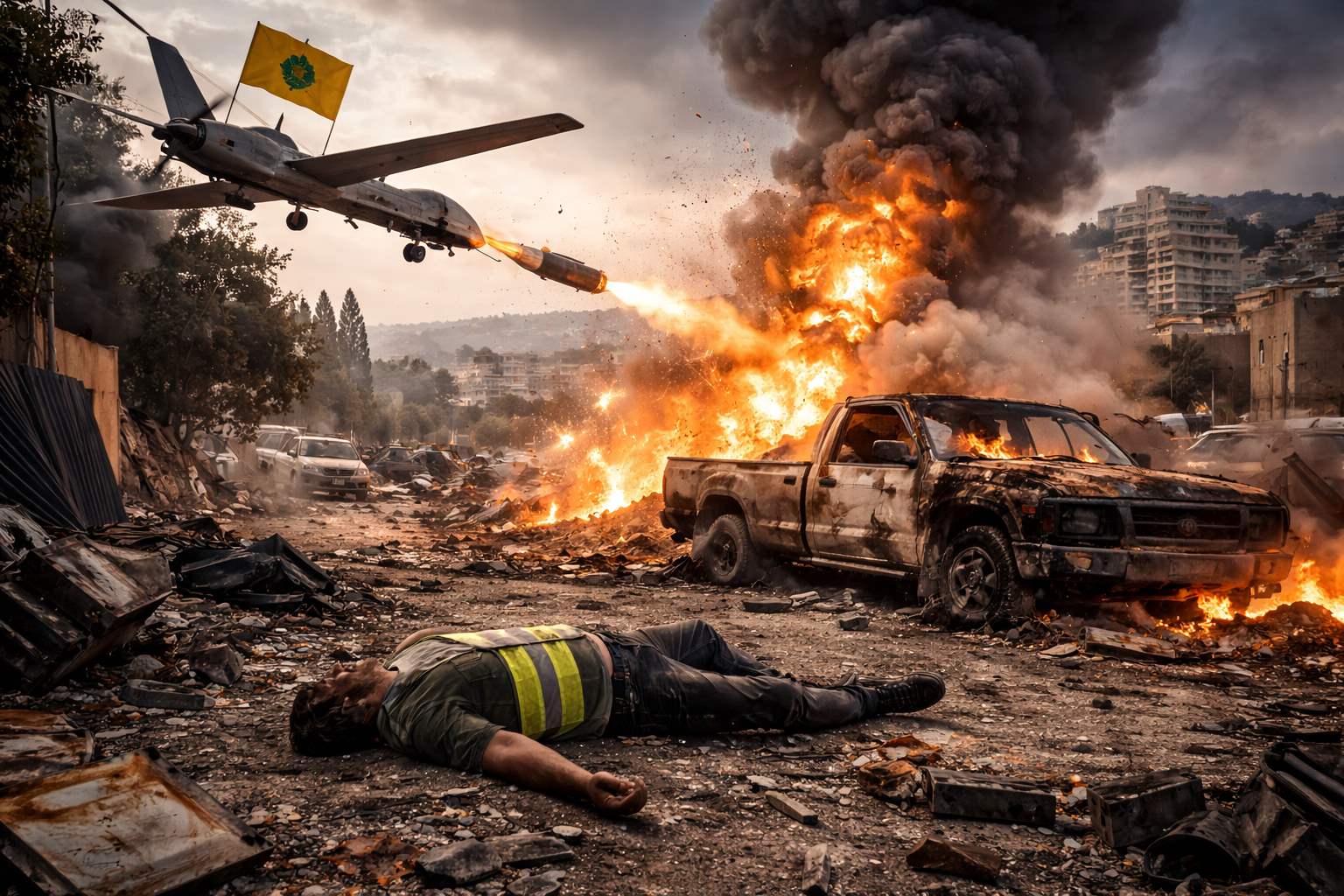
Fatality deepens tensions as explosive UAV attacks bypass conventional defenses despite active ceasefire efforts.
April 30, 2026
By Global War News Editorial
An Israeli civilian contractor for the Defense Ministry was killed on Tuesday when a Hezbollah-launched explosive drone targeted engineering equipment in southern Lebanon. The strike, which occurred near the town of Bint Jbeil in the Aitaroun area, marks a notable escalation in the use of first-person view (FPV) drones against operational forces.
The victim has been identified as 44-year-old Amer Hujirat, a resident of the northern Israeli town of Shfar’am. According to the Israel Defense Forces (IDF), Hujirat was operating heavy machinery as part of ongoing military efforts to dismantle Hezbollah infrastructure when the explosives-laden drone made a direct hit. His 19-year-old son, who was working alongside him under the same Defense Ministry contract, sustained light shrapnel injuries and was treated at Ziv Medical Center in Safed.
Hezbollah claimed responsibility for the attack, asserting that its “suicide drone” successfully targeted an Israeli engineering vehicle. The group alleged that the machinery was being used to destroy civilian dwellings rather than military assets. The incident highlights the continued volatility of the border region despite a fragile ceasefire environment that theoretically took effect on April 17.
Escalation of Drone Warfare
The strike on Amer Hujirat follows a pattern of increasing reliance on low-cost, high-impact unmanned aerial vehicles (UAVs) by Hezbollah militants. On Sunday, another explosive drone strike in southern Lebanon killed 19-year-old Sgt. Idan Fooks, the first Israeli soldier killed by a direct Hezbollah attack since the current truce began.
Prime Minister Benjamin Netanyahu recently addressed senior commanders, identifying the “drone threat” alongside the “missile threat” as the two primary tactical problems facing the IDF on the northern front. The precision and maneuverability of FPV drones allow them to bypass traditional integrated air defense systems, posing a high risk to both military personnel and civilian contractors working in forward positions.
The Broader Impact on Lebanon
The security situation remains equally precarious on the Lebanese side of the border. Following the drone attack, Lebanon’s Health Ministry reported that an Israeli airstrike on the village of Majdal Zoun killed five people. Among the fatalities were three civil defense medical personnel who were reportedly trapped under rubble during a rescue mission.
Lebanese Prime Minister Nawaf Salam condemned the strike on aid workers, characterizing the event as a violation of international humanitarian law. These exchanges illustrate the significant “spillover” effect of military operations on non-combatant populations, as both sides engage in tactical maneuvers that frequently impact residential and commercial zones.
Analysis: The Status of the Ceasefire
The killing of a civilian contractor underscores the extreme fragility of the ceasefire between Israel and Lebanon. While a wider regional pause in hostilities between the United States and Iran was announced earlier this month, local dynamics between the IDF and Hezbollah appear to operate on a separate, more violent track.
Observers note that “Operation Eternal Darkness,” as the IDF has termed its recent campaign in Lebanon, continues to focus on the physical destruction of Hezbollah’s forward defense line. Hezbollah, in turn, has demonstrated that it does not consider its operations restricted by the diplomatic arrangements made in Washington or Tehran. For the residents of northern Israel and southern Lebanon, the “ceasefire” currently exists more in political rhetoric than in daily reality.
What to Watch For
The current trajectory suggests several critical indicators for the coming weeks:
- Technological Adaptation: The success of Hezbollah’s FPV drones may prompt the IDF to deploy new electronic warfare countermeasures specifically tailored for low-altitude, small-form UAVs.
- Diplomatic Pressure: Whether the United States will intervene to clarify the scope of the current truce to include non-state actors like Hezbollah.
- Contractor Protocols: Potential changes in how the Israeli Defense Ministry deploys civilian engineering firms in active combat zones.
Source Disclosure: This report is based on official statements from the Israel Defense Forces (IDF), the Lebanese Health Ministry, and reporting from Reuters, Xinhua, and The Media Line. Analytical perspectives on drone warfare incorporate assessments from current regional military briefings.
This article is based on publicly available reporting from named international news agencies and attributed official statements. All claims about ongoing events are attributed to their original sources. Analysis sections represent the editorial interpretation of reported facts and do not constitute advocacy for any party to the described conflict. AI tools may be utilized for image generation to assist in explaining complex concepts, as well as for refining grammar, spelling, and other linguistic enhancements. However, all original content is produced, fact-checked, and revised by the editorial team. This publication does not take political positions on active military conflicts.