
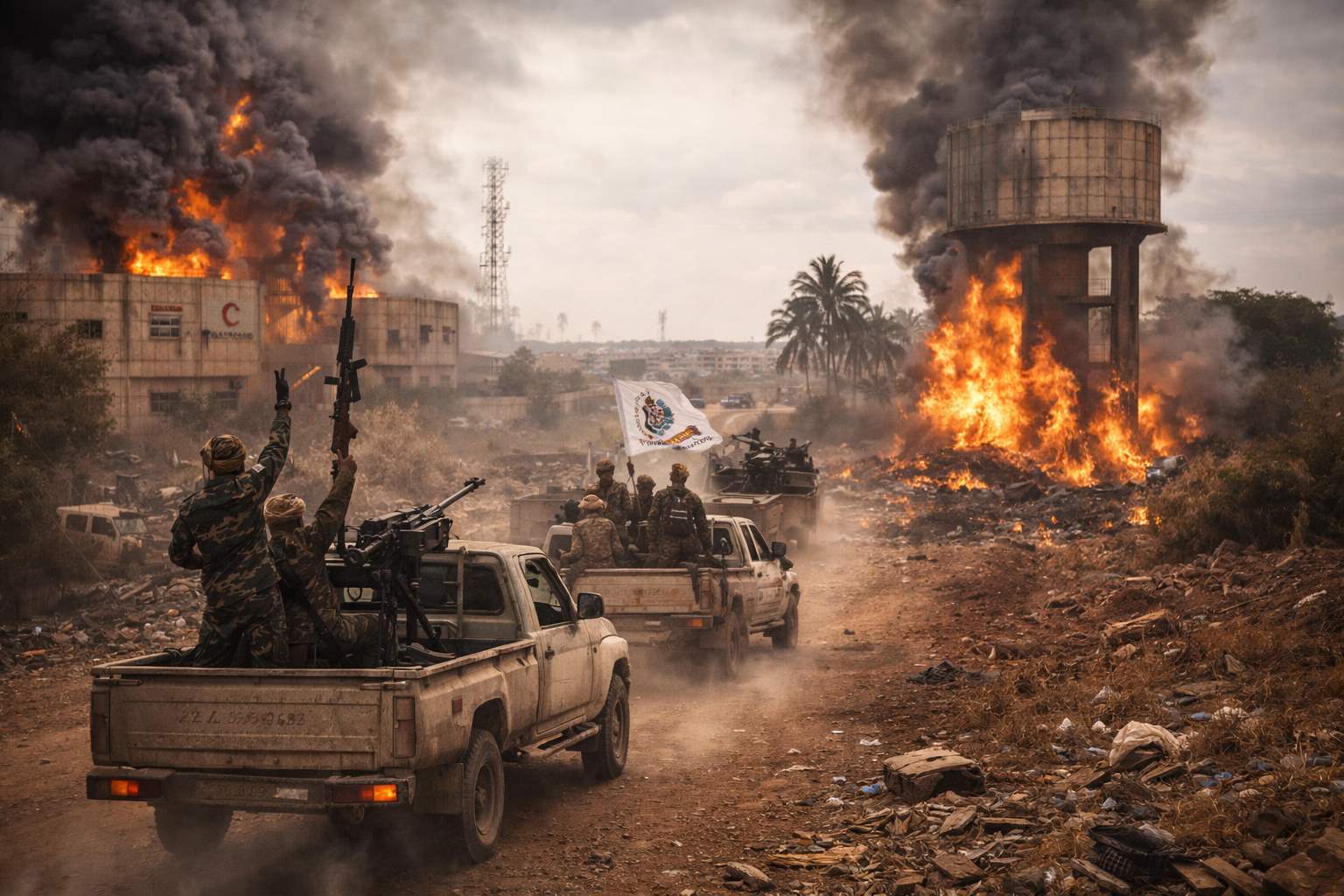
Satellite data and verified footage from South Kordofan show Rapid Support Forces moving eastward, impacting local hospitals and water reservoirs.
April 30, 2026
By Global War News Editorial
New evidence suggests a significant eastward expansion of the Rapid Support Forces (RSF) in Sudan’s South Kordofan state. Recent satellite imagery and verified video footage indicate that the paramilitary group has moved into areas surrounding critical civilian infrastructure, including medical facilities and essential water supplies.
According to reports from the Yale School of Public Health’s Humanitarian Research Lab, satellite data captured throughout late April shows a concentration of RSF military vehicles and temporary fortifications near several local hospitals. The lab noted that the proximity of these forces to civilian hubs significantly increases the risk of collateral damage and disruption to life-sustaining services for the local population.
The Sudanese Armed Forces (SAF) have reportedly responded with aerial bombardments in an attempt to halt the RSF advance. Local media outlets, including the Dabanga news service, reported that at least one water reservoir in the eastern part of the state was damaged during recent exchanges of fire, though it remains unclear which party was directly responsible for the strike.
Impact on Essential Services
The encroachment of fighting into civilian zones has led to a near-total collapse of the healthcare network in the affected districts of South Kordofan. According to the World Health Organization (WHO), at least three major clinics have suspended operations in the past week due to the proximity of active combat.
Water security has also emerged as a critical concern. In a region already prone to seasonal drought, the damage to reservoirs complicates survival for thousands of displaced persons. Humanitarian agencies, including Médecins Sans Frontières (MSF), have stated that access to these areas is currently blocked by checkpoints and active front lines, preventing the delivery of medical supplies or repair teams for the damaged infrastructure.
Geopolitical Context: Central Sudan’s Strategic Value
South Kordofan occupies a strategic position in central Sudan, serving as a gateway between the Darfur region to the west and the Nile Valley to the east. Analysts from the International Crisis Group suggest that the RSF’s eastward movement is part of a broader strategy to consolidate control over rural hubs that contain both agricultural resources and critical transport routes.
The region has a long history of conflict, predating the current war between the SAF and RSF. However, the current intensity of the fighting has introduced a new level of displacement. The United Nations High Commissioner for Refugees (UNHCR) reported that approximately 15,000 people have fled toward the South Sudanese border in the last 14 days alone.
Analysis: The Risk to Civilian Status
The documented movement of military assets into the immediate vicinity of hospitals and water sources raises serious questions regarding the protection of civilians under international law. While the RSF has publicly stated it aims to “secure” these areas from SAF influence, the physical presence of combatants effectively turns civilian infrastructure into a military target in the eyes of opposing forces.
Observers note that this pattern of “urbanization” of the conflict—where fighting shifts from open fields into the heart of villages and infrastructure hubs—is becoming a hallmark of the Sudanese war. This tactical shift places the burden of the conflict almost entirely on the shoulders of non-combatants, as the destruction of a single reservoir can lead to a humanitarian catastrophe far more lethal than the immediate exchange of gunfire.
What to Watch For
- Humanitarian Corridors: Whether international pressure will force both parties to allow technical teams access to repair the damaged water reservoirs.
- SAF Counter-Offensives: Intelligence reports suggest the SAF may be preparing a larger-scale ground operation to reclaim transport links in South Kordofan.
- Satellite Updates: Continued monitoring of RSF positions to see if the eastward push extends toward the White Nile state.
Source Disclosure: This report is based on satellite analysis from the Yale Humanitarian Research Lab, statements from the WHO and UNHCR, reporting from Dabanga news service, and analytical assessments from the International Crisis Group.
This article is based on publicly available reporting from named international news agencies and attributed official statements. All claims about ongoing events are attributed to their original sources. Analysis sections represent the editorial interpretation of reported facts and do not constitute advocacy for any party to the described conflict. AI tools may be utilized for image generation to assist in explaining complex concepts, as well as for refining grammar, spelling, and other linguistic enhancements. However, all original content is produced, fact-checked, and revised by the editorial team. This publication does not take political positions on active military conflicts.