
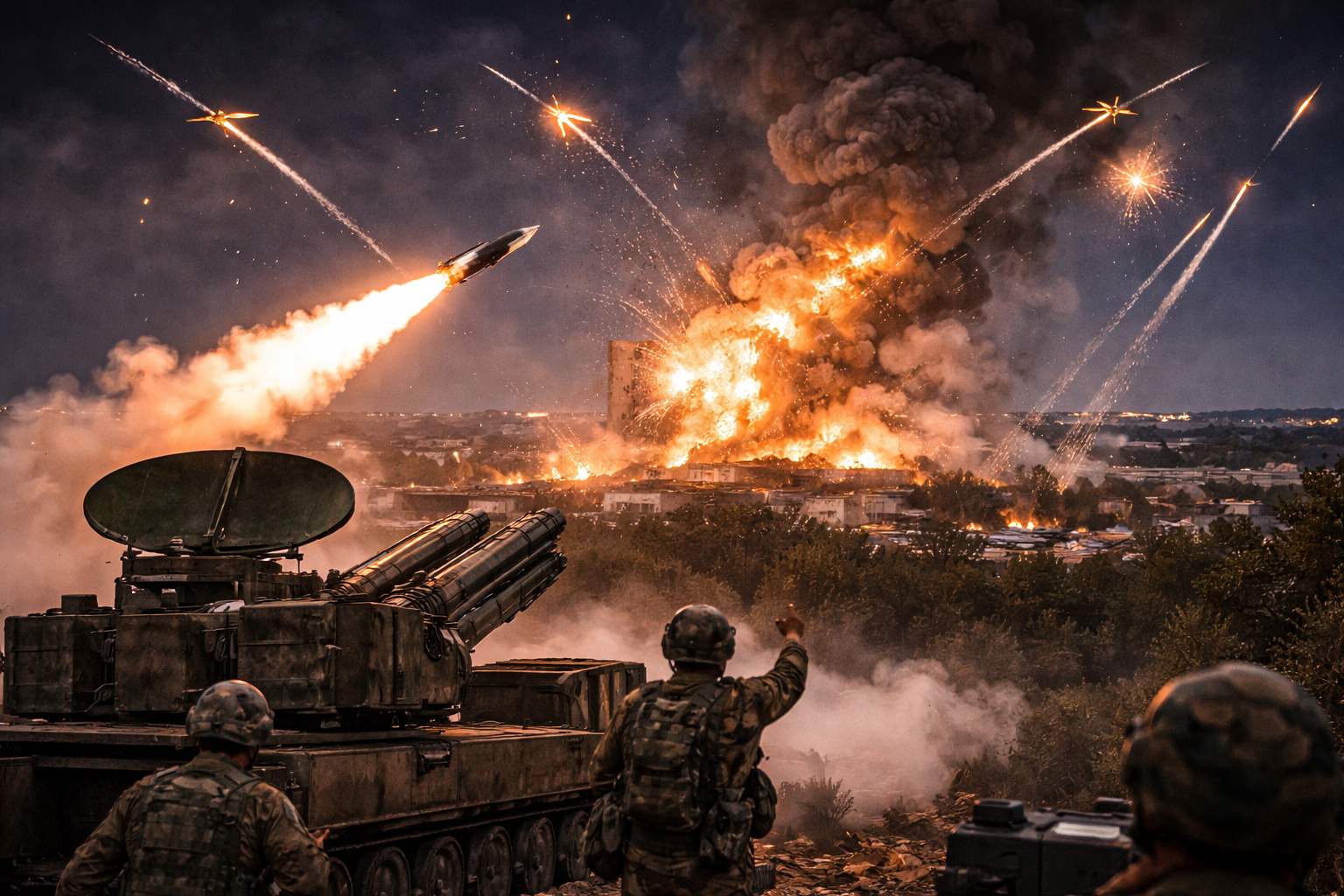
Long-range strike on a key Russian defense facility marks a significant penetration of industrial airspace 770 kilometers from the border.
April 30, 2026
By Global War News Editorial
Ukrainian long-range drones targeted the Sverdlov State Research and Production Enterprise in Dzerzhinsk, Nizhny Novgorod region, during the early hours of Thursday. The facility, located approximately 770 kilometers from the Ukrainian border, is one of Russia’s largest manufacturers of military explosives and ammunition components.
According to reports from the independent Russian Telegram news channel Astra, local residents reported hearing approximately ten explosions in different parts of the city. While the Russian Ministry of Defense has not yet detailed the extent of any damage, regional social media footage verified by OSINT analysts showed columns of smoke rising from the direction of the enterprise following the engagement of air defense systems.
The strike coincided with a broader wave of aerial activity across the region. Independent Telegram channel Exilenova Plus reported a series of explosions in neighboring areas of Novgorod Oblast as defense units attempted to intercept incoming threats.
Strategic Significance of the Sverdlov Plant
The Sverdlov plant is a critical node in the Russian defense industrial base. It is listed under sanctions by the United States, the European Union, the United Kingdom, and Japan due to its vital role in supplying the Russian military.
Historically, the facility has produced a wide array of industrial explosives, detonators, and ammunition components, including those used for artillery shells and high-explosive aerial bombs. Analysts from the Institute for the Study of War (ISW) suggest that targeting such facilities is part of a deliberate strategy to disrupt the supply chains that feed Russian frontline operations.
The plant’s location deep within Russian territory highlights the evolving reach of Ukrainian drone technology. Reaching Dzerzhinsk requires navigating through multiple layers of integrated air defense, suggesting increasing sophistication in flight path planning and electronic countermeasures.
Economic and Industrial Context
This operation is the latest in a series of strikes targeting Russian industrial and energy infrastructure. Just 24 hours prior, Ukrainian drones reportedly struck a production and dispatch station in Perm, more than 1,500 kilometers from the border, further demonstrating the expanded geographical scope of the campaign.
The economic impact of these strikes is two-fold:
- Immediate Operational Cost: The physical damage to specialized chemical production lines can take months to repair due to the complexity of the machinery.
- Resource Diversion: Repeated strikes force Russia to divert sophisticated air defense systems, such as the S-400 or Pantsir-S1, from the front lines to protect domestic industrial hubs.
Analysis: The Deep Strike Strategy
The attack on Nizhny Novgorod reflects a shift in the conflict’s tactical geography. By striking 800 kilometers behind the front lines, Ukraine is signaling that Russia’s rear-area defense production is no longer insulated from the war.
Observers note that while individual strikes may not immediately halt Russian military operations, they impose a cumulative “friction” on the war economy. The need to harden hundreds of industrial sites across a vast area places a significant logistical burden on the Russian state. The psychological impact of bringing the conflict to major industrial cities deep inside Russia also appears to be a calculated objective of the Ukrainian military command.
Current Status and Outlook
As of Thursday afternoon, Russian authorities have not officially commented on the specific damage at the Sverdlov facility. However, the Federal Agency for Air Transport (Rosaviatsiya) introduced temporary flight restrictions at airports in Perm, Ufa, and Izhevsk following the wave of drone activity, indicating a heightened state of alert across central Russia.
What to watch for:
- Satellite Imagery: High-resolution photos in the coming days may reveal the specific production halls affected by the strike.
- Energy Market Volatility: Potential impacts on industrial chemical supplies if the plant’s specialized lines are offline for an extended period.
- Retaliatory Patterns: Whether Russia increases its missile strikes on Ukrainian energy grids in response to these deep-penetration missions.
Source Disclosure:This report relies on data from the independent Russian media outlet Astra, reporting from the Kyiv Independent and News.Az, and analytical assessments provided by the Institute for the Study of War (ISW). Social media footage was used to corroborate the timing of the event but was not used as the sole basis for factual claims regarding damage.
This article is based on publicly available reporting from named international news agencies and attributed official statements. All claims about ongoing events are attributed to their original sources. Analysis sections represent the editorial interpretation of reported facts and do not constitute advocacy for any party to the described conflict. AI tools may be utilized for image generation to assist in explaining complex concepts, as well as for refining grammar, spelling, and other linguistic enhancements. However, all original content is produced, fact-checked, and revised by the editorial team. This publication does not take political positions on active military conflicts.